THE RULE OF INFERENCE SI
Some arguments involving identity are provably valid without any addition to our rules of inference. Take, for instance, the following argument:
The only person who can SPEAK for all Canadians is Pierre Trudeau.
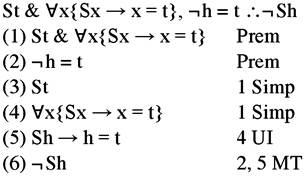
Stephen Harper, you are no Pierre Trudeau. [UD: people; Sx := x can speak for all Canadians]The inference we are expected to draw is that Stephen Harper cannot speak for all Canadians. This argument may be symbolized and proved as follows:
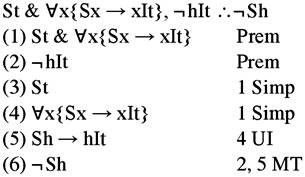
In fact, in order to tackle this example we did not need the special notation for identity either. We could have treated it as an ordinary relation, xly := x is identical with y, and proceed as follows:
Other arguments, though, depend on the fact that if certain properties are true of a given individual a, and a is identical to another individual b, those properties must be true of b too. A good example is the argument with which we began the previous section:
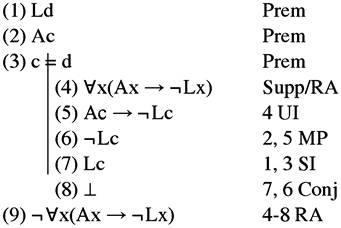
It is not true that no famous AUTHORS like LOGIC. Charles Dodgson certainly likes logic. And Lewis Carroll is a famous author. But Lewis Carroll and Charles Dodgson are one and the same person.
Such arguments are impossible to prove valid without a new rule of inference legitimizing the above principle, which we formulate as:

This new rule may now be put to use in proving the above argument valid:
Ld, Ac, c = d.,.-∣Vx(Ax → -∣Lx)
This rule of inference is sometimes called “Leibniz’s Law,” after Gottfried Leibniz (1646- 1716). Leibniz was famous for his principle of the Identity of Indiscemibles (which we will revisit in chapter 24), according to which any two things which are in principle indiscernible must be identical. If we interpret indiscernible things as those with exactly the same properties, this says that any two things with all the same properties must be identical. The Substitution OfIdenticals is the converse of this: any two things which are identical must share all the same properties.
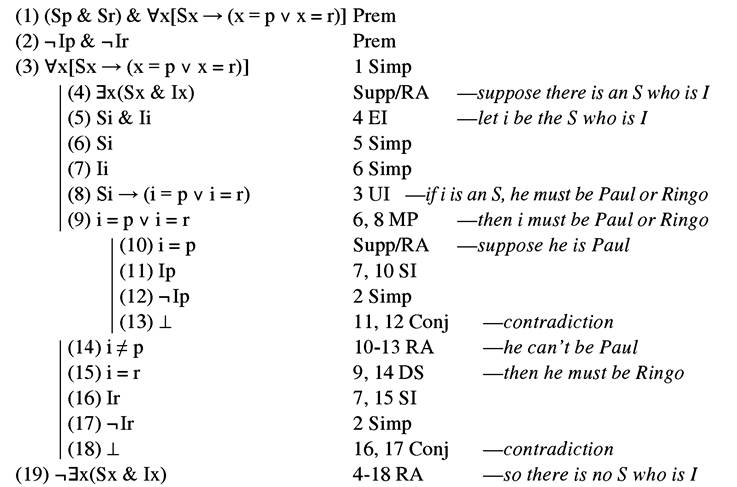
Here’s another example illustrating use of this rule of inference:

21.2.2