RUSSELL’S THEORY OF DEFINITE DESCRIPTIONS
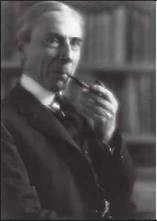
Bertrand Russell (1872-1970) was one of the most influential philosophers of the twentieth century, publishing widely on politics, metaphysics, theory of knowledge, and mathematical logic.
Born into a British aristocratic family, he was a social activist with radical views on morality and education. He was also an accomplished essayist, Winningthe Nobel Prize for literature in 1950. His classic works in logic are Principles of Mathematics (1903) and, with Alfred North Whitehead, Principia Mathematica (1910-13).Bertrand Russell was one of the foremost champions of the “logicist” approach to the foundations of mathematics, the attempt to reduce all mathematics to logic and set theory.
So it is no accident that he was also one of the pioneers of the merits of quantificational logic for the analysis of problems in philosophy, particularly ones that seemed to depend on some linguistic formulation. In particular, Russell was the first to analyze sentences called definite descriptions. These are so called because they begin with a definite article—‘the’ in English—which picks out an individual by the accompanying description. An example would be:
The CARDINAL who OPPOSED Galileo was Bellarmine.
If we try to symbolize this by Cb & Ob (Cx := x was a Cardinal, Ox := x opposed Galileo), this fails to distinguish it from
Bellarmine was a CARDINAL who OPPOSED Galileo.
What we have failed to capture here is the uniqueness implicit in the definite article: the original statement connotes not only that Bellarmine was a Cardinal who opposed Galileo, but that he was the unique one (in some respect) who did so. Russell’s famous example of a definite description was:
The present KING of France is BALD.
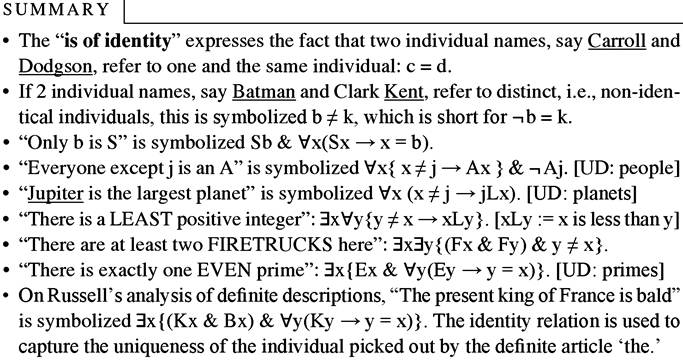
Russell’s way of bringing out the logic of such sentences is to use the identity relation to capture uniqueness.
On his view, the statement connotes that there is a present King of France, that there is only one such King, and he is bald. Thus he parses it as follows:
Analysis: “There is a living person who is King of France and bald, and such that any living person we pick who is king will be that same person.”
Using this kind of analysis, our original statement about Bellarmine,
The CARDINAL who OPPOSED Galileo was Bellarmine.
is symbolized

Analysis: “Bellarmine was a Cardinal who opposed Galileo, and any Cardinal who opposed Galileo was he.”
A word of warning: not every statement beginning with the definite article is a definite description. We have already seen and dealt with examples like this:
The CARDINAL is a bird with a RED breast. (UD: birds, not clergymen!)
This is not referring to some unique cardinal, but to all birds that are cardinals. The ‘is’ is an ‘is’ of predication, giving

Also some definite descriptions in English lack the definite article. For example,
Liza Minelli’s MOTHER2 is Judy Garland.
This means the person who is MOTHER2 of Liza Minelli is Judy Garland, yielding 
EXERCISES 21.1
Symbolize the following statements:
1. (a) Superman is Clark Kent.
(b) Francis Bacon is not Roger Bacon.
(c) Christopher Marlowe was Shakespeare.
(d) D.H. Lawrence was not Lawrence of Arabia, [d := D.H. Lawrence, a := Lawrence of Arabia]
2. Only Saddam would KILL his own sons-in-law. [UD: people; Kx := would kill his own sons-in-law]
3.
All except Einstein had COMBED their hair. [UD: people; Cx := x had combed his or her hair]4. Paul and Ringo are the only Beatles still ALIVE. [UD: Beatles]
5. There is only one GOD. [Gx := x is a god]
6. Nothing PrECEDED2 the Big Bang. [UD: events]
7. Everest is not the TALLEST2 mountain. [UD: mountains; xTy := x is taller than y]
8. George Best was the most SKILFUL2 soccer player ever bom in the UK. [UD: soccer players; Ux := x was bom in the UK; xSy := x is more skilful at soccer than y]
9. There is no more POPULAR2 RESTAURANT in the universe than the Big Bang Burger Bar. [xPy := x is more popular than y]
10. There’s at least one ODD PRIME. [Ox := x is odd, Px := x is prime]
11. At most one SIGHTING of the Loch Ness Monster can be VERIFIED. [Sx := x is a sighting of the Loch Ness Monster, Vx := x can be verified]
12. If there are more than two PEOPLE, there’s a CROWD. [Px := x is a person]
13. Shaquille O’Neal is TALLER2 than everyone else on his team. [UD: the Lakers team; xTy := X is taller than y]
14. Shaquille O’Neal is the TALLEST2 basketball player. [UD: basketball players; xTy := X is taller than y]
15. The MOUSE over there is SMALL.
16. He’s the HORSE that EATS a lot. [Ex := x eats a lot]
17. The only cowboy FASTER2 than Doc Holliday is the Kid. [UD: cowboys: xFy = x is faster than y]
18. (CHALLENGE) The CAT SAT2 on the MAT. [xSy := x sat on y]
21.2