SYMBOLIZING IDENTITIES AND QUANTITIES
Consider the following argument:
It is not true that no famous AUTHORS like LOGIC. Charles Dodgson certainly likes logic. And Lewis Carroll is a famous author. But Lewis Carroll and Charles Dodgson are one and the same person.
The last statement could also be expressed:
Lewis Carroll is Charles Dodgson.
But the ‘is’ here has a different status from the ‘is’ in the previous statement, “Lewis Carroll is a famous AUTHOR.” For this is just the “is of predication,” and we symbolize this statement Ac. In contrast, the ‘is’ in the last statement is the “is of identity”: it expresses the fact that the two names Carroll and Dodgson refer to one and the same individual. Using an obvious notation, we express this identity of Carroll and Dodgson by
c = d
Some other examples:
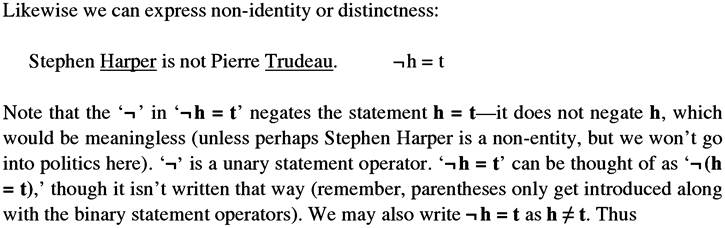
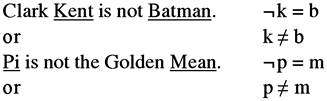
Actually, identity is a relation between individuals (more precisely, the same individual under two different names), and we considered the logic of relations in the previous chapter. In fact, we could have symbolized “x is identical to y” by xly, and “x is distinct from y” by -ιxly; and we will see in due course that this relation is an equivalence relation. But the relation of identity is a special case, because in making valid inferences like the Carroll-Dodgson one above we depend on being able to substitute one individual name for another denoting the same individual. For this we will introduce a rule of inference governing how we reason about questions of identity. But we will postpone treatment of that topic to the next section.
Using this new notation, we will now show how to treat various kinds of statements that do not obviously involve identity, especially those concerning how many individuals of a particular type there are.
Let’s treat them on a case-by-case basis.Only і...
Only Yogi Berra would SAY that. [UD: people; Sx := would say that]
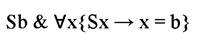
Analysis: Yogi Berra would say that, and anyone who said it would be him.
The only і..., None but і...
The only person who can SPEAK for all Canadians is Pierre Trudeau. [UD: people; Sx := can speak for all Canadians]

Analysis: Pierre Trudeau can speak for all Canadians, and anyone who can speak for all Canadians is Trudeau. The same symbolization takes care of
No one but Pierre Trudeau can SPEAK for all Canadians.
A slightly harder example involving a binary relation:

All except i...
All the network news anchors were AMERICAN except for Peter Jennings. [UD: network news anchors]

Analysis: Any network news anchor who was not Peter Jennings was American, and Peter Jennings was not American.
Superlatives
The LARGESt2 planet is Jupiter. [UD: planets; xLy := x is larger than y]
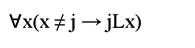
Analysis: Jupiter is larger than any planet except itself.
Note that if the UD were not restricted to planets, and instead we had Px := x is a planet, the symbolization would have been:

Analysis: Jupiter is a planet, and it is larger than any planet different from it.
There is no GREATEST prime number. [UD: prime numbers; xGy := x is greater than y]

Analysis: For any prime x there exists at least one prime number y distinct from it that is greater than it.
Another example:
There is a LEAST positive integer. [UD positive integers; xLy := x is less than y]
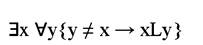
Analysis: There exists a positive integer x which is less than any positive integer y distinct from it.
Notice the crucial difference from the previous example in the order of the quantifiers. Notice, too, that if we had tried to symbolize it without identity, by
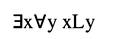
this would not do, since it would allow the deduction of iLi for some arbitrary integer i. But no integer can be less than itself.
At least one, two,...
There is at least one EVEN prime. [UD: primes]

Analysis: This is just our standard interpretation of the existential quantifier: ‘some’ means ‘at least one.’
There are at least two HUMAN species. [UD: species]
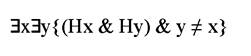
Analysis: There is at least one human species x, and at least one human species y, such that у is distinct from x.
At most one, two,...
There is at most one EVEN prime. [UD: primes]

Analysis: For any primes x and y, if they are both even then x is identical to y.
There are at most two HUMAN species. [UD: species]

Analysis: For any species x, y, and z, if they are all human species, then z is either the same as x or the same as y.
Exactly one, two,...
There is exactly one EVEN prime. [UD: primes]

Analysis: There is at least one even prime x, such that any even prime y is identical to x.
Notice that this is just a more succinct formulation than what we would get by conjoining the symbolizations of ‘there is at least one’ and ‘there is at most one’:

There are exactly two HUMAN species.
[UD: species]
Analysis: There are two distinct human species x and у such that any human species z will be identical either with x or with у.
Notice that this is just a more succinct formulation than what we would get by conjoining the symbolizations of ‘there are at least two’ and ‘there are at most two’:

As can be seen, the above analysis can in principle be applied to any statement of the form “There are exactly n objects” where n is any natural number. Even though it is already looking fearsomely complicated for n > 2, the fact that it is possible in principle has suggested to some philosophers that by means such as this, mathematics could be reduced to logic. You can always eliminate the reference to n in the statement “There are exactly n objects.” But there are difficulties; it is not obvious how to eliminate the references to numbers when they appear as individual names rather than adjectives, in statements such as ‘5 is prime.’ Still, this discussion is an example of the potential of mathematical logic to contribute to philosophical analysis.
21.1.2