SECOND ORDER LOGIC
This extension of logic generalizes it so that we can quantify over predicates themselves. For example, in treating identity above, we made use of the principle that if two individuals were identical, then they should have all their properties in common.
(This was the foundation of our rule of SI, the Substitution of Identicals.) But to express this in a properly general way, we need to be able to generalize not only over all individuals, but also over all predicates. If we are allowed this extension, we can express both this and Leibniz’s famous Principle of the Identity of Indiscemibles as follows:The Identity of Indiscemibles:

Any two individuals having all their properties in common are identical.
The Indiscemibility of Identicals:

Any two identical individuals have all their properties in common.
The Indiscernibility of Identicals is encapsulated in the rule SI introduced in chapter 21. But it is a theorem we can prove in second order logic. Likewise the Identity of Indis- cemibles:
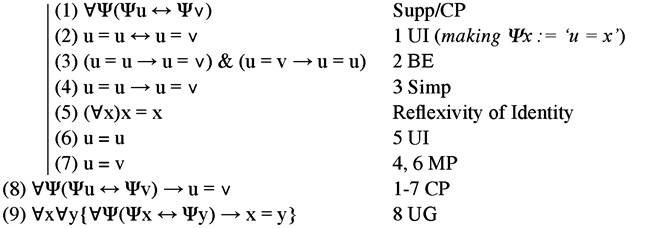
EXERCISE 24.1
(a) Derive the Indiscemibility of Identicals as a theorem in second order logic.
(b) Symbolize the statement: “There is no object that has no properties.”
24.2
More on the topic SECOND ORDER LOGIC:
- SECOND ORDER LOGIC
- References
- You now have behind you a course in elementary symbolic logic and its application to argument.
- Platonism in Mathematics
- PROPERTIES OF IDENTITY
- The Distinctive Role of Representations in Cognitive Science Explanations
- Arthur R.T.W.. An Introduction to Logic: Using Natural Deduction, Real Arguments, a Little History, and Some Humour. Broadview Press,2016. — 456 p., 2016
- Foundations and Philosophy of Mathematics
- Theoretical and Methodological Influences
- Some Difficulties of Contemporary Structuralism