MODAL LOGIC
We considered above (and in Appendix 1) the Paradox of Material Implication. This worries many philosophers, although teachers of first year logic are largely reconciled to  and q is F.
The basis of this extension of logic is the introduction of two more statement operators, not truth functional ones this time:
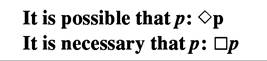
Actually each of these may be defined in terms of the other as follows: 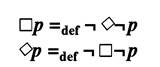
The first says that something is necessarily the case iff it is impossible for it not to be the case; the second says that something is possibly the case iff it is not necessary for it to not be the case. These are logically equivalent, and we’ll take the first as a rule of inference for Modal Logic:


EXERCISE 24.2

24.3
More on the topic MODAL LOGIC:
-
Contemporary philosophical research -
Fundamentals of philosophy -
Logic -
Philosophy of Science and Technology -
Political philosophy -
Social philosophy -
-
Conflictology -
Ecology -
Economy -
Finance -
History -
Law -
Medicine -
Philosophy -
Religious studies -