DERIVED RULES
It will prove useful in some abstract derivations to have a rule that allows us to repeat a statement already given or proved on a previous line. This is the rule of Reiteration:
Reiteration (R)
From a statement p, infer the same statement p (on another line of the derivation, with the same indentation or one to the right of the original statement).
It obviously stretches the meaning of “inference” or “argument” to call this an argument form. It is simply a rule that allows us to reiterate a statement already assumed or derived. (The qualification about indentation is needed only to prevent a statement that depends on an undischarged supposition being used later in a proof as if it does not.) Here is a simple (but admittedly contrived) example of its use:
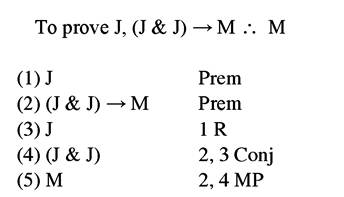
The validity of this rule follows immediately from our definition, since whatever p stands for, you cannot validly deny it, having asserted it. But its validity can also easily be derived from the rules of inference we have already: 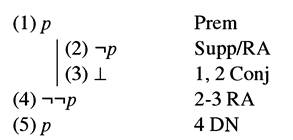
As such, we can regard it as an example of a derived rule of inference: that is, it is a valid argument form derived from the set of rules that we have taken as basic or primitive. We do not strictly speaking need it, as we could always run a derivation similar to that just given in any proof in which we needed it: it simply makes such proofs shorter. We could say precisely the same thing about some of our other rules of inference. For example, we proved the Hypothetical Syllogism (From p → q and q → r, infer p → r) using CP, and obviously any proof in which we use HS could be replaced by a longer proof where p is supposed and r is derived, and then CP is applied.
In fact, as you may have realized by now, it is a bit arbitrary which of the various valid forms we dignify as rules of inference. We want to pick a set of forms that is sufficient to derive all the argument forms that are formally valid, and we certainly do not want a set of forms from which a contradiction is provable. If the first condition is satisfied, our system can be said to be complete; if the second is satisfied, it is said to be consistent.
As the above examples of R and HS show, we have more than enough rules in our system. So we could reduce the number of rules of inference that we must have to those sufficient to guarantee completeness and consistency of the system. These would be our primitive rules of inference. The remaining ones (which would be kept simply for making derivations more intuitive and shorter) would be derived rules. Thus, now that we have the rule RA, from this together with the other rules of inference we may derive rules such as Conjunctive Syllogism, Double Negation, and De Morgan’s Laws (exercises 18, 19, 20, respectively). If you do all the exercises for this chapter and the last, you will see that there are some other redundancies in our system. In chapter 10, exercise 1, MT was proved using MP, Conj, and RA. On the other hand, in the next chapter, we will establish reductio ad impossibile using only CP, Simp, MP, MT, CS, and DN. So it appears we do not strictly need both MT and RA. Again, BE is strictly only a definition, giving a short form for a conjunction of conditionals, and so could be dispensed with. The following set would make a concise and adequate set of primitive rules, two rules for each main operator: MP, CP; Conj, Simp; Disj, DS; RA, DN. (Here the first form of DN, fromp infer

Of course, if economy of rules and symbols is what is desired, we could do much better. Given De Morgan’s Laws, we could translate any expression containing into  two we used, and then the only rules we would need would be MP, CP, RA, and DN.
Another concise way of presenting systems of logic is in terms of axioms, rules of inference, and theorems. We’ll come back to that in the next chapter, when we have the wherewithal to define axioms and theorems.
EXERCISES 11.2
18. Prove the CS rule by a reductio argument.
19. Show that once we have the Reductio ad Absurdum rule, the first form of DN may be derived in a four-line proof by proving the substitution instance;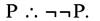
20. Show that De Morgan’s Laws may be derived from the other rules by proving 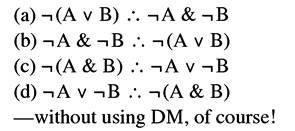
Using only the “primitive” rules of inference MP, CP, Conj, Simp, Disj, DS, RA, DN, derive the following rules:
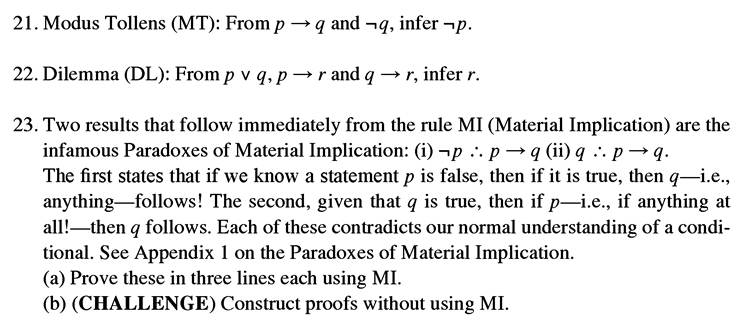
24. (CHALLENGE) An alternative set of primitive rules would be MP, CP, Conj, Simp, Disj, DL, RA, DN. Derive DS as a derived rule using this set Ofprimitive rules only. 
More on the topic DERIVED RULES:
- CONSISTENCY AND COMPLETENESS
- Nature and purpose of Islamic law
- Intuitionistic logic
- REVIEW OF FORENSIC ASSESSMENT INSTRUMENTS
- Legislation in the Empire
- Islamic law and the state
- The sources of Islamic law
- THE BIG DATA ECOSYSTEM
- Late Ash'arites and divine purposes ethics
- A guided tour through the literature