Intuitionistic logic
Another interesting attempt to generalize from classical logic that denies the Law of Bivalence is that of the Intuitionists, who deny the applicability of the Law of Excluded Middle: ∖-p v -∣p.
Here the motivation comes from within mathematics, and the desire to avoid the Platonist doctrine that mathematical propositions are true or false independently of whether any person knows them to be so. In opposition to this the Intuitionists held that a mathematical proposition is not true until a direct construction for it has been found whereby its truth may be exhibited. Brouwer, the originator of the idea,[90] wanted to set mathematics on a new and firmer foundation—free from the paradoxes discovered by Russell and others—by abandoning the idea that a proposition in mathematics could be proved by “Indirect Proof’—that is, by the form of reductio ad absurdum that derives p from the derivation of a contradiction from its negation, (This would involve applying RA—from the derivation of
 —this is still valid in intuitionis-
 tic logic—and then, by an application of the second form of DN—from derive p—
this is what is denied by the intuitionists.) Indirect proof only works if you assume that each proposition has a determinate truth value in advance of being discovered or invented by human ingenuity; then p must be either true or false, so that proving its negation false leaves its truth as the only other option. If bivalence is rejected, then to have proved -∣p false is to have proved but this is NOT the same as having established p directly.
 Correspondingly, in
 Predicate Logic only three of the four forms of Quantifier Negation are permissible:

But the following form is not valid:
From -і VxΦx, derive Ξx-∣Φx.
EXERCISE 24.5
Prove that the first three forms of QN above are derivable without assuming DN.
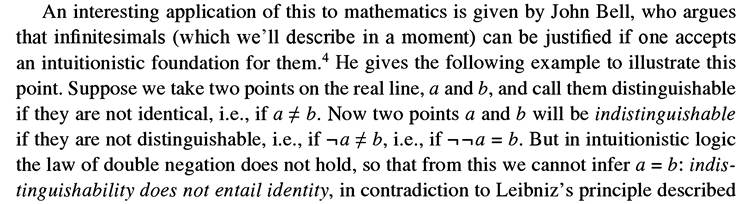
above. As a result, if we take all the points x that are indistinguishable from 0, and call this the infinitesimal neighbourhood of 0, Σ(0), then this does not reduce to the set of points containing only 0. Thus if we call all those numbers that are so close to 0 as to be indistinguishable from it infinitesimals, then from the fact that 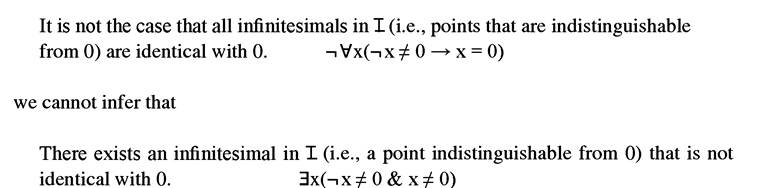
[1] John Bell, A Primer of Infinitesimal Analysis (Cambridge: Cambridge UP, 1998), pp. 6-7. This inference would be provable if we allowed the form of QN that was declared invalid


As mentioned above, Heyting gave a set of axioms for Intuitionistic Logic (hereafter IL). These can be recast as a natural deduction system like the one in this book.
In chapter 11 above we outlined the rules of Statement Logic that are necessary and sufficient for a formal system in which all correct proofs in classical logic can be performed (assuming biconditionals are re-expressed as conjunctions of conditionals): MP, CP; Conj, Simp; Disj, DS; RA, DN. We noted there that one form of the DN rule, , can be derived by RA, and thus need not be included among the primitive rules. Thus the converse DN rule,
 together with the other seven primitive rules, constitute a complete system.
 Now Heyting’s system of axioms is provably equivalent to this set of rules minus the converse DN rule: MP, CP; Conj, Simp; Disj, DS; and RA. To this set we may now add UI, UG, EI, EG; this set constitutes IL. What then is the status of this system vis-a-vis classical logic?
One way to regard IL is as a generalization of classical logic; on this reading it stands in the same relation to classical logic as non-Euclidean Geometry stands to Euclidean Geometry. In each case we drop one classical axiom; in each case, too, the resulting system can be proven to be consistent in the sense that the classical system can be modelled in it, so that the non-classical system is consistent if the classical one is. But then the meaning of at least some of the statement operators must be different. Just as the points and lines of non-Euclidean Geometry are implicitly defined by the four axioms of that geometry (without the parallel postulate), and so do not necessarily mean the same thing as in classical geometry, so ‘and,’ ‘not,’ ‘if...then...,’ and ‘or’ will also have slightly altered meanings without the principle of bivalence. This is particularly true of negation, since the law of double negation does not hold in the intuitionists’ system; and as we have seen, to say that a proposition is negated in the intuitionists’ sense is to say that it can be (constructively) proven that it is not (constructively) provable.
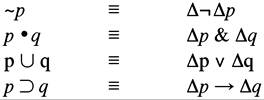
It is possible, though, that all the signs have different meanings, and indeed Heyting insisted that his signs are all to be taken as undefined primitives.[91] In keeping with this, if all the operators are defined and RA, but all expressed in terms of the new operators.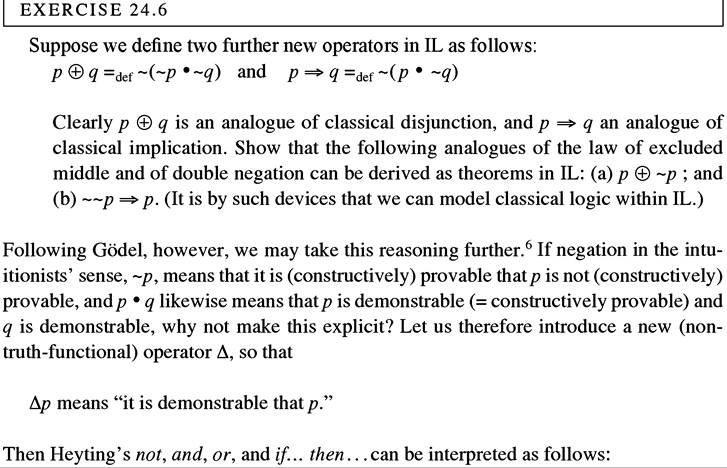
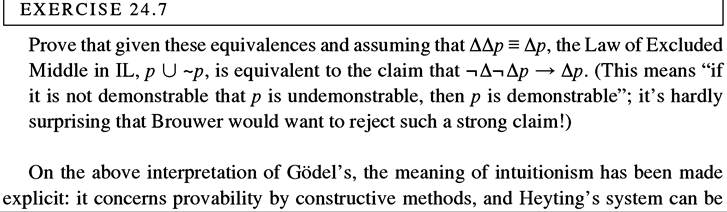
[1] See Kurt Gδdel, “Zur Intuitionistischen Arithmetik und Zahlentheorie,” and “Eine Interpretation des Intuitionistischen Aussagenkalkuls,” Ergebnisse eines mathematischen Kolloquiums, Heflt iv (1932), pp. 34-38 and 39-40; Kneale and Kneale, pp. 678-80.
regarded as an axiomatic theory of provability by such constructive methods. But then, as the Kneales astutely observe, “Heyting’s calculus is not a system of logic in the strict sense,” since “it presupposes classical logic, and has only been mistaken for an alternative logic because of the intuitionists’ unfortunate custom of talking of theorems as statements of provability” (Development, p. 681).
More on the topic Intuitionistic logic:
- BHK Semantics
- Intuitionistic logic
- Mathematical Logic Tradition
- 1 What Is This Book About?
- Propositional justification logic went through a historical process of development taking over twenty years from its beginnings to the stage represented in this book.
- Classical Semantic Tableaus
- The formal details of justification logic will be presented starting with the next chapter, but first we give some background and motivation for why the subject was developed in the first place.
- You now have behind you a course in elementary symbolic logic and its application to argument.
- Formulating Justification Logics
- From the very beginning, justification logics had important connections with modal logics.