QUANTUM LOGIC
One of the more curious features of Quantum Theory is that certain variables that physicists standardly use to define the state of a system, such as position, energy, momentum, angular momentum, etc., do not always have determinate values in certain situations.
A certain elementary particle coming out of some interaction of particles, for instance, might have two and only two possible values of spin along the x-direction: spin-up and spin-down. (This is what it means for the spin to be quantized.) And yet if the particle is in a certain state there may be no fact of the matter which direction its spin is in. On a certain proportion of experiments on similarly prepared particles, it will be found in the spin-up state, and in the remainder, spin-down. Nevertheless, to suppose that each particle is either in the spin-up or in the spin-down state prior to the experiment is incompatible with the state description according to quantum theory. And experiment shows that quantum theory makes the right predictions, and that the alternative of supposing that the particle is or is not in the spin-up state, and it was just a question of our not knowing which, turns out to be incompatible with the experimental statistics.[LXXXIX] There is no fact of the matter.One way of expressing this state of affairs is to say that while it is true that the particle is in either spin-up or in spin-down—the disjunction is true—neither disjunct can be asserted to be true or false without contradiction. This has led some philosophers to experiment with the idea that in quantum theory, nature exhibits a non-classical logic, in a word, a Quantum Logic.
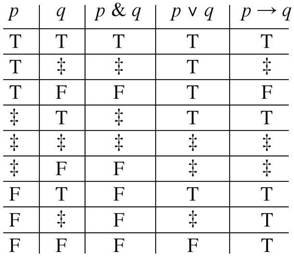
Hans Reichenbach was the first to offer a theory along these lines. He speculated that the Law of Bivalence—the principle that every statement is either true or false—should be abandoned. In place of the usual 2-valued logic, one should have for quantum theory a three-valued logic: true (T), false (F), and indeterminate (¢).
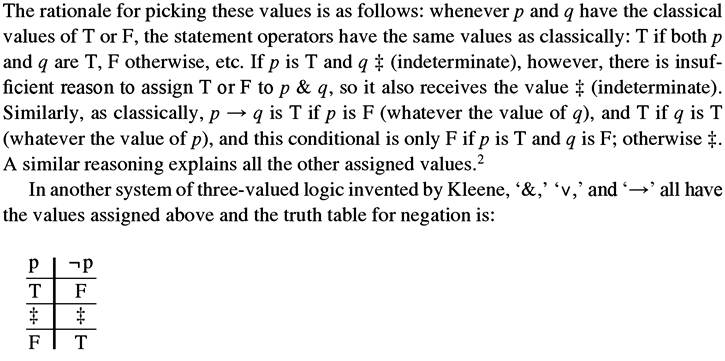
The statement that the particle mentioned above is in a state of spin-up would have the truth value ¢. Here is a tableof the proposed truth values for this three-valued system for three standard truth-functional operators:

EXERCISE 24.4
(a) Prove that p → p also does not hold in K3.
(b) Show that this can be fixed by altering the truth table for ς→, so that it has the value T when both p and q are ¢.
More recent theories, inspired by Hilary Putnam’s paper “Is Logic Empirical?,” have tried to develop an interpretation of quantum mechanics based on the idea that, just as Einstein’s General Relativity reveals that geometry is not Euclidean, so Quantum Mechanics reveals that logic is not Boolean—i.e., that there are certain propositions that are neither true nor false. The general consensus, however, is that the Quantum Logic approach has failed to convince its critics that a new system of logic is needed to express what is going on in the theory, nor has it solved any of the Interpretational problems that its devisers had hoped it would address.
24.5
More on the topic QUANTUM LOGIC:
- References
- From Logic to Metaphysics: Intentionality and Levels of Reality
- References
- Introduction
- References
- References
- References
- HAS A NEW SIGNIFICANCE
- The Mechanism of Wave Function Collapse
- Allhoff F.. Philosophies of the Sciences: A Guide. N.-Y.: Wiley-Blackwell,2010. — 386 p., 2010