Appendix One The Paradoxes of Material Implication
MATERIAL IMPLICATION
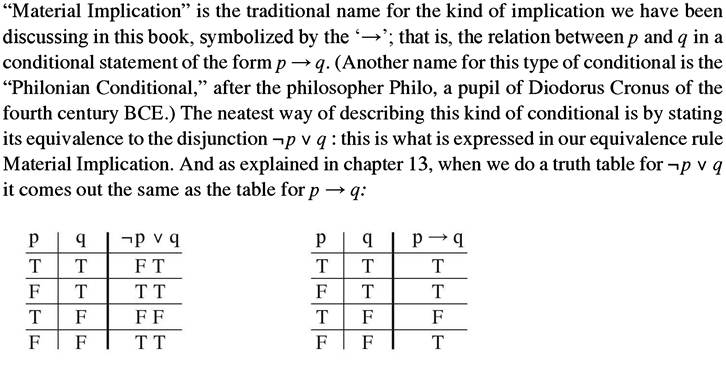
Philo is reported by Sextus Empiricus to have claimed that “A conditional is false only when it begins with a truth and ends with a falsehood” (Againstthe Mathematicians, viii, 113; Kneale and Kneale, p.
130). A rival view reported by Sextus is that of Chrysippus, where a conditional is true “when the contradictory of its consequent is Incompatiblewith its antecedent” (Outlines of Pyrrhonism, ii, IlO- 12; Kneale and Kneale, 129). The former view parallels our definition of formal validity, the latter Chrysippian view parallels our general definition of the validity of an argument.This says that a conditional is false only if the antecedent is true and the consequent false. From this it follows that (a) the conditional is true if the consequent is true, and (b) the conditional is true if the antecedent is false. (You can see this by inspecting rows 1 and 2 for (a), and 2 and 4 for (b).) To see what is paradoxical about this, take the following statement:
(Al) “If all philosophers are immortal, Socrates is dead.”
This has been chosen because it is evidently a false statement. Yet by the above criterion, it would count as a true conditional! For it not only satisfies (a), since the consequent 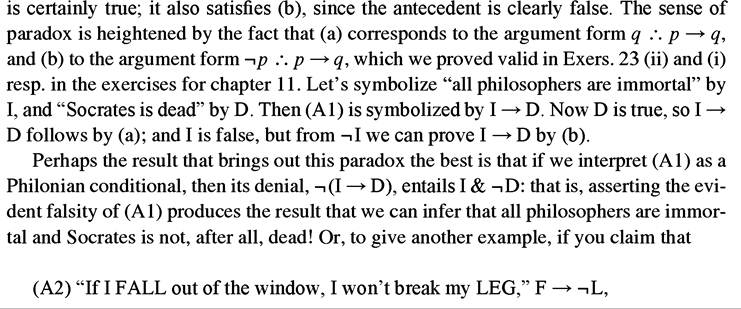 and I deny it and thus assert
 I would hardly be taken to be asserting that F &
L, that you will fall out of the window and break your leg!
As noted in chapter 11, these highly counterintuitive results are known as the Paradoxes of Material Implication. They derive from the fact that when we symbolize a conditional, we do not take into account any relationship of meaning or other connection between the antecedent and consequent, save for the truth-functional one.
Many (if not most) of the conditionals occurring in ordinary language, on the other hand, are considered true because of some non-truth-functional relationship between the antecedent and consequent, such as the meaning connection in the above example between being immortal and being dead. If such a connection is relevant to the validity of an inference, it needs to be made explicit as an extra implicit premise. In the above example concerning immortal philosophers and the dead Socrates, we would need to make explicit that “Someone who is immortal cannot be dead” (and also that Socrates is a philosopher). This is the reason we regard (Al) as false. If all philosophers are immortal, then, since Socrates is a philosopher and someone who is immortal cannot be dead, it cannot be true that Socrates is dead. Likewise, if I deny that when you fall out of the window you won’t break your leg it is because I believe there is a causal relationship between your falling out of the window and your possibly breaking your leg.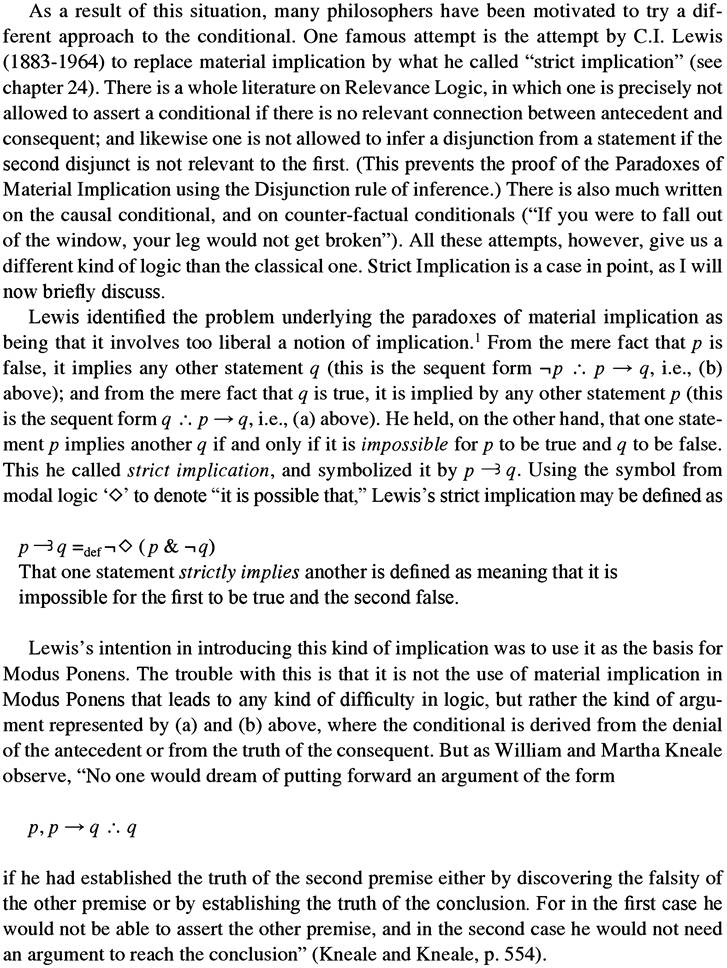
[1] In what follows I am following the account of Lewis’s strict implication given in Kneale and Kneale, pp. 549-59.
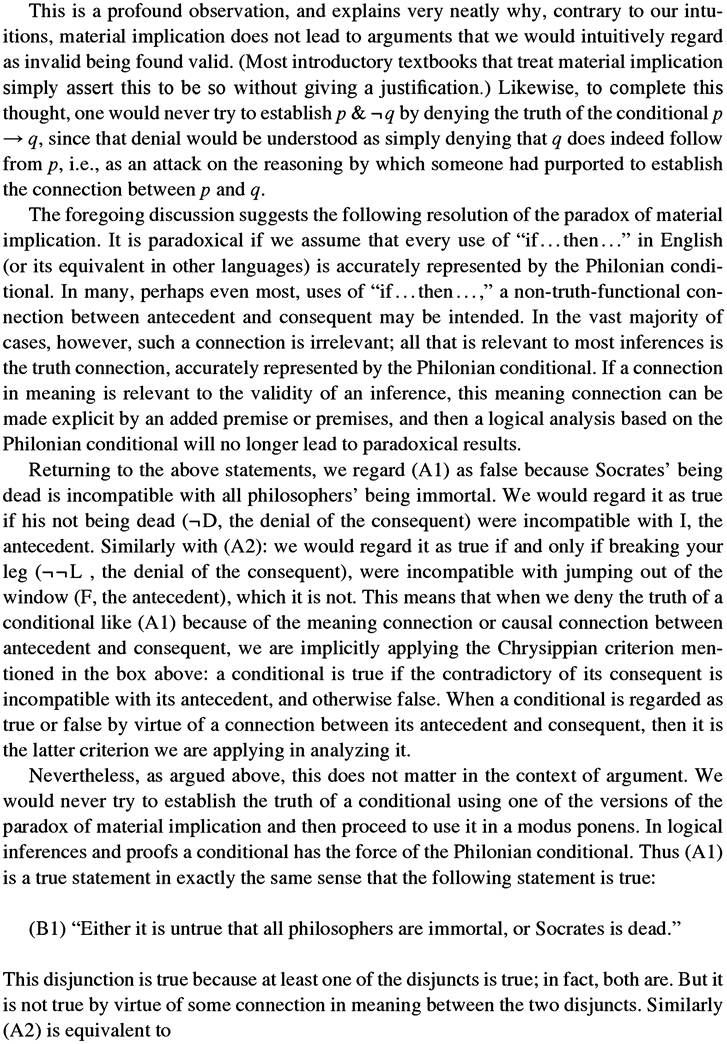
(B2) “Either it is untrue that you will fall out of the window, or you will not break a leg.” 
SUMMARY
• On the Philonian analysis, a conditional p → q is true if its antecedent is false or if its consequent is true, and is otherwise false.
• This is also called the Material Conditional. It is logically equivalent to and this equivalence underwrites the law of Material Implication (MI).
• On the Chrysippian analysis, a conditional p =≠> q is true if the denial of its consequent is incompatible with its antecedent, and is otherwise false.
• Probably the great majority of conditionals used in ordinary language are Chry- sippian, and embody some connection or relevance between antecedent and consequent.
• Nevertheless, in any normal case where a conditional is used to make inferences, it performs its role as a Philonian (i.e., material) conditional;
• and in the rare cases where the validity of an inference depends on some relevant information connecting the antecedent and consequent, this information can be made explicit as an added premise or premises, and the argument analyzed as if the conditional stands for material implication.