PROOF STRATEGIES
The strategies for constructing proofs using some of these rules of inference are reasonably obvious. In the case of the equivalence rules just considered, they can be used any time the replacement of some statement by its equivalent looks promising in the overall context of the proof.
Likewise the strategy for Conj and Simp is straightforward: you apply Conj to form a conjunction, and Simp to get one of the conjuncts from a conjunction you already have. (But remember, these can only be applied to whole lines, not within a line. From you cannot infer
 by disjunction, since
 ) is a negation—the
 is
is the governing operator.)
Still, it is the overall strategy of a proof that may cause difficulty, and here some advice will be in order. The overall strategy is determined by whatever the conclusion is that you are trying to reach. That will be your initial goal. In order to get there you may then determine various subsidiary goals, which will then generate strategies for various sub-proofs. So strategies may be organized according to whatever statement it is you are trying to prove. Here you should keep in mind the governing operator which tells you the kind of statement you are dealing with. For example,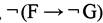 is not a conditional: the
governing operator indicating that it is a negation (the negation of a conditional, to be sure).
 In fact, in working out how to solve a proof it is quite helpful to think of which rules will introduce the governing operator of the statement you are aiming to prove: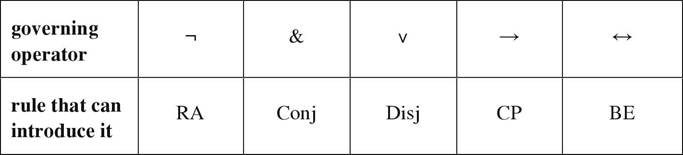
This gives you a starting point. But the following table gives more detailed strategic tips:
Goal-Directed Strategies
| TYPE OF STATEMENT YOU ARE TRYING TO PROVE | STRATEGY TO CONSIDER |
| conjunction | Conj: Search for the two conjuncts among your premises; if either one is not there, make deriving it a subsidiary goal. |
| disjunction | Disj: search for one of the two disjuncts among your premises; then apply Disj. |
| conditional | CP: suppose the antecedent of the conditional, and make deriving the consequent a subsidiary goal. |
| biconditional | BE: search your premises for the relevant conditional and its converse; if either is not there, make deriving it a subsidiary goal, and apply the CP strategy. |
| negation of a conjunction | RA: suppose the conjunction, and make a subsidiary goal of deriving a contradiction. |
| negation of a disjunction | RA: suppose the disjunction, and make a subsidiary goal of deriving a contradiction; or DM: apply DM to convert into a conjunction of negations, and apply Simp. |
| negation of a conditional | RA: suppose the conditional, and make a subsidiary goal of deriving a contradiction. |
| negation of a biconditional | RA: suppose the biconditional, and make a subsidiary goal of deriving a contradiction. |
These are just rules of thumb: often they will work, but sometimes not.
When no other goal-directed strategies seem to work, you can always do a reductio proof: suppose the opposite of what you are trying to prove, and aim for a contradiction.Premise-directed Strategies
I would recommend always having some such overall goal-directed strategy. But it is only human nature to try proceeding in the opposite direction, namely by beginning with the premises, and seeing how far you can get towards your conclusion by applying rules to what you are given. For this you will need strategies for breaking down the premises in proofs or subproofs into their components.
In such premise-directed strategies, you will need to identify the governing operator of the statement you are starting from, and then look for ways to eliminate it. We can draw up a table similar to the one given above for strategies for proving statements, but this time a table for strategies for breaking down statements:
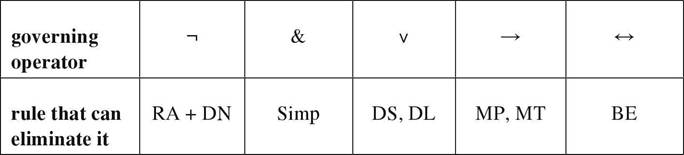
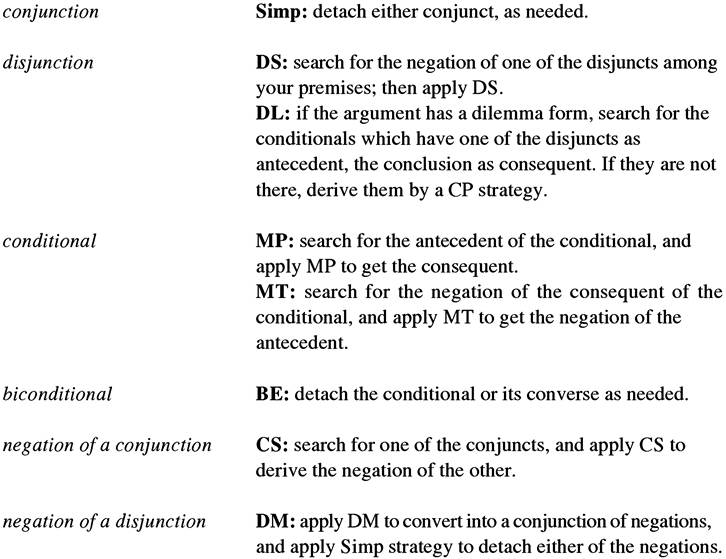
Again, we can give more detailed strategic tips:
TYPE OF STATEMENT YOU
ARE WORKING FROM
STRATEGY TO CONSIDER

Here is an example of application of these strategies. The proof in question has a conclusion that is a conjunction, but neither conjunct is given, so we set these as goals 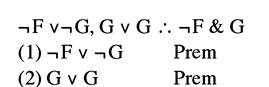
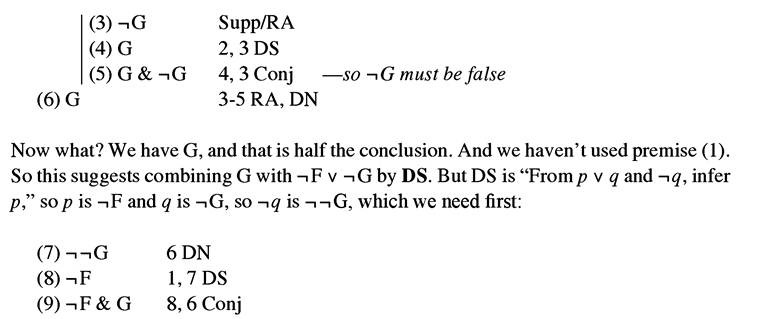
But now it is not easy to see where to proceed. Working forward from the premises, we cannot use a DS strategy on either one, and there is no obvious way to apply the DL strategy. So we resort to a reductio (RA). G should be provable from G v G, so let’s suppose the opposite and aim for a contradiction:
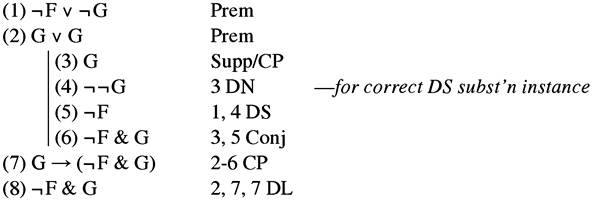
A DL-type proof is possible, but by no means obvious. It depends on noticing that the conclusion is derivable on the supposition of G, and that both disjuncts (!) of the second premise are G:
EXERCISES 11.1
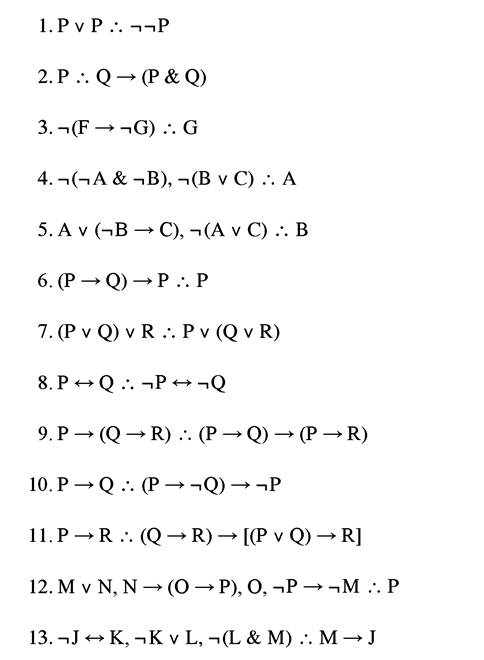
Prove the validity of the following abstract arguments:
14.
In the following quote, an argument is advanced by (then) Toronto Maple Leafs defenceman Bryan McCabe (a hockey player not usually noted for his logical expertise). What is he arguing for (what’s the conclusion)? Symbolize as indicated, fill in any premises that are implicit, and prove the argument valid:“I’ve got Spezza and Schaeffer right on me in the crease. If I get a STICK on one of them, I get a PENALTY. If I don’t, one of them pokes it IN. I LOSE either way.”[52]
15. In an editorial for the Toronto Globe and Mail on the Canadian Government’s cancelling of funding for the Law Commission, John Ibbitson argued:
By eliminating the commission’s funding, the Conservative government is strangling an agency it dislikes, without consulting Parliament, through fiscal trickery and sleight of hand.... If Justice Minister Vic Toews is unhappy with the sort of work that the Law Commission is doing, he has the authority to direct it to do other work. If the government believes the commission has outlived its usefulness,... then it should ask Parliament to repeal the act that created the commission. But the Conservatives know they would lose that vote. (Thursday September 28,2006, p. 4)
This argument can be paraphrased:
If the Conservative government is not CANCELLING the Law Commission through fiscal trickery and sleight of hand, then it should either DIRECT it to do other work, or it must believe the Commission has OUTLIVED its usefulness. But it has not directed it to do other work. If the government believes the commission has OUTLIVED its usefulness,...then it should ASK Parliament to repeal the act that created the commission. But the Conservatives cannot ask Parliament to repeal the act [since they would not have enough votes to repeal it]. It follows that the Conservative government is cancelling the Law Commission through fiscal trickery and sleight of hand.
Symbolize the paraphrased argument as indicated, and prove it valid.
16. (CHALLENGE) Symbolize the following argument as indicated, and prove it valid: “If the WHITE Sox are American League champions, then the YANKEES and BOSTON must both have been eliminated. Hence either Boston has been eliminated, or the White Sox are not American League champions.”
17. (CHALLENGE) Symbolize the following argument as indicated, and prove it valid: “If the AMERICANS and BRITISH do not both stay in Iraq, there will be a CIVIL war or a DISSOLUTION of the state. But since the Americans will stay and there won’t be a dissolution of the state, there will be civil war unless the British also stay in Iraq.”
11.2
More on the topic PROOF STRATEGIES:
- PROOF STRATEGIES
- Arthur R.T.W.. An Introduction to Logic: Using Natural Deduction, Real Arguments, a Little History, and Some Humour. Broadview Press,2016. — 456 p., 2016
- Contents
- HOW SHOULD SPECULATIONS BE EVALUATED? MAXWELL’S SPECULATIVE STRATEGIES
- Strategies Derived from the Dialogue Metaphor
- Exercises
- Heterogeneous Preferences, Social Choice and the Median Voter*
- Realizations
- The Independence Condition for Robustness and the Spiral Synergy of Robustness-as-Stability and Robustness-as-Consilience
- THEORY