TWO SIMPLIFYING MODIFICATIONS (OPTIONAL)1
One of the advantages of classifying equivalence rules separately is that we may now introduce the following simplifications:
1. Any statement may be replaced by another statement to which it is equivalent by an application of one of the Equivalence Rules (DN, DM, BE, TR, and MI), even if it is only a component of a compound statement.
That is, unlike the other rules of inference, from now on these do not have to be applied only to whole lines.2. Each of these equivalence rules can be applied simultaneously with, and on the same line as, one of the other rules of inference, e.g., 2, 3 MT, DN.
These two modifications can simplify certain proofs a lot. Here is an example of use of the first modification:
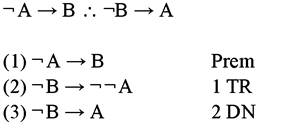
Here we have applied DN within the conditional, to its component . Without the first modification we would instead have had to do a 5 line conditional proof, beginning with -∣B as the supposition.
1 Some instructors may wish to defer this “relaxation” of the application of equivalence rules until later in the course. Accordingly, solutions for chapters 11-12 will be given both with and without these simplifying assumptions, and they will not be assumed to be in use until chapter 17.
Using the second modification we could save a further fine in the same proof by combining TR and DN on one line:

But even greater economy can be achieved by using our first modification, as can be seen in the following example. Without it, we need to perform a reductio:
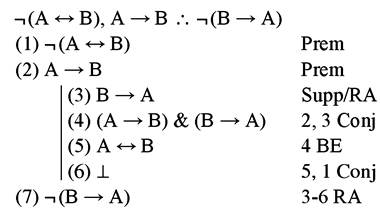
But if instead we apply the equivalence rule BE within the negation, we save three lines:
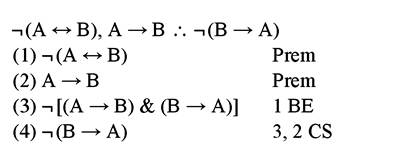
In some of the more complex proofs we shall consider later, particularly in Predicate Logic, the saving of writing allowed by these modifications will be considerable.
Caution: when applying the equivalence rules within compound statements, make sure that you are applying them to a component, not just an arbitrary string of symbols. For example, the following is NOT a valid application:
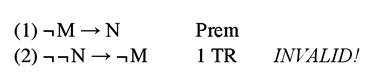
Here has been substituted for M → N in line 1. This a mistake because M →
N is not a component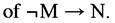 Compare with the following two valid applications
of the above rules: 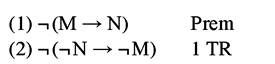

In the second of these we have subbed -∣ M for p and -∣ N for q in applying TR, and then applied DN to save a line.
11.1.3