RULES OF INFERENCE AND EQUIVALENCE RULES
From among the valid argument forms we have considered, we have selected some of the most useful as Rules of Inference. These we have proved valid using our definition of validity, and then used them to prove the validity of other argument forms.
It’s time now to systematize what we have established so far. Our rules of inference can be divided into two classes: the Rules OfInference proper, in which the inference goes only one way, and the Equivalence Rules, in which one statement entails the other and vice versa. First the one-way rules of inference, in which we derive a statement on one line from one, two, or three separate statements, each on its own line: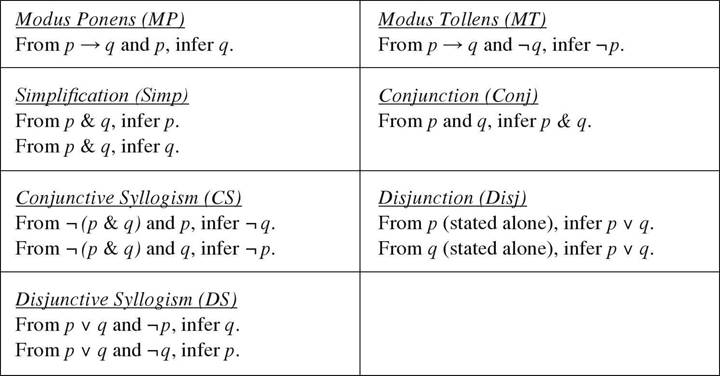
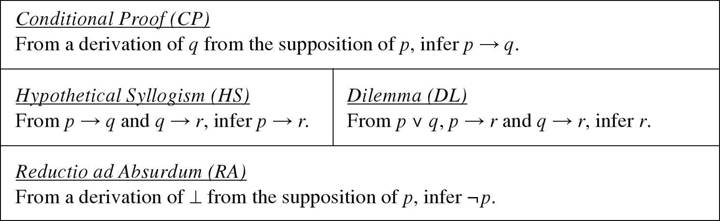
Now the equivalence rules, in which the inference goes from a single statement on one line to a single statement on another:
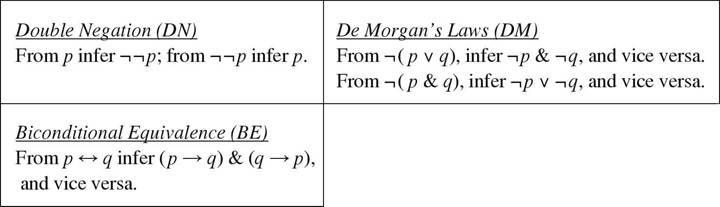
Equivalence Rules
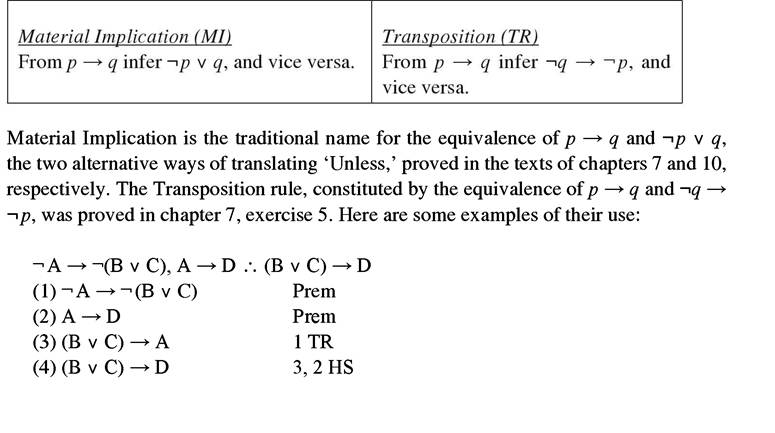
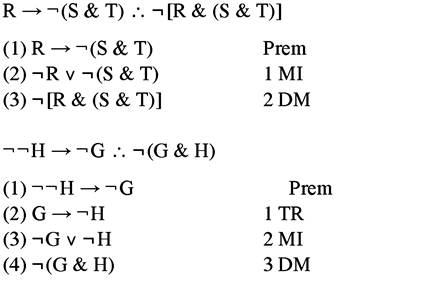
To these equivalence rules we will add two new rules, Material Implication and Transposition. They are defined as follows:
11.1.2
More on the topic RULES OF INFERENCE AND EQUIVALENCE RULES:
-
Contemporary philosophical research -
Fundamentals of philosophy -
Logic -
Philosophy of Science and Technology -
Political philosophy -
Social philosophy -
-
Conflictology -
Ecology -
Economy -
Finance -
History -
Law -
Medicine -
Philosophy -
Religious studies -