Reductio ad absurdum
We come now to what is perhaps the most important rule of inference after modus pon- ens. Certainly it has been at the creative heart of logic through the years, despite its not being part of the formal logic taught in universities until the twentieth century.
As we’ll see below, Galileo Galilei used the reductio ad absurdum argument form to brilliant effect in demolishing the physics of Aristotle, even while pouring scorn on the sterile logic he had learned in the Schools. The reductio is a way of refuting a proposition by showing that it leads to an absurdity, by reducing it to absurdity—hence the Latin name, which translates as “reduction to an absurdity.” Generally, of course, such a reduction cannot be achieved without enlisting the aid of other premises. But this very fact explains the rhetorical force of this style of arguing: you refute your opponent’s proposition by getting her agreement on a number of premises, supposing the proposition at issue, and then showing that together with those premises the supposition leads to an absurdity. Given those premises, therefore, the supposed proposition must be false.In general the absurdity will be some concrete statement that all the arguers agree cannot be upheld: that is, given background assumptions held in common, a statement that is clearly factually false. In the context of formal arguments however, we need something stronger for the absurdity: a statement which cannot be true by virtue of its form, namely a logical contradiction, of the form p
This kind of reasoning has a long and very distinguished history, going all the way back to the dawn of philosophy and mathematics in Ancient Greece. In fact, one of the most important arguments in the whole history of mathematics made use of it: a proof that the sides of a certain right triangle cannot be put into a ratio of one whole number to another—or, as we would say, that the square root of two is irrational.
Some background for this is provided in the box on the next page. The right triangle in question is an isosceles triangle whose shorter sides are each of length 1, so that by Pythagoras’ Theorem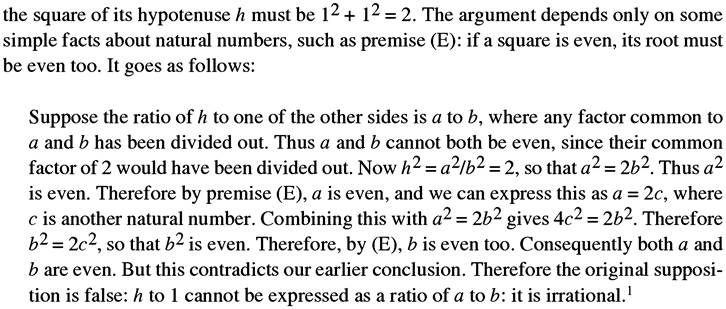
Pythagoras was a sage and a mystic of the sixth century BCE, who established a religious cult (the “Brotherhood”) in a far-flung colony of Greece near Croton in what is now southern Italy. What distinguished him from his twentieth-century counterpart, Jimmy Jones—I mean, apart from the fact that even when they were attacked by the townsfolk he did not force his followers to commit suicide by drinking poisoned Kool-Aid—was his immense learning. He systematized all he had learned of mathematics and music from Babylonian and Egyptian priests, and single-handedly started theoretical science. (Theverywords ‘theory,’ ‘philosophy,’ musical ‘harmony,’ ‘geometry,’ and ‘theorem’ were all coined by him or his followers; we still know the name Pythagoras today in association with the theorem about right-angled triangles he was credited with discovering.) The results he discovered in music, geometry, and number theory, fused together with mystical elements into an all-embracing cosmology, were the mysteries into which the adepts of his cult were initiated. The Pythagoreans believed that “all is number,” that everything in the universe has an associated natural number (> 1) (‘justice,’ for example, has the number 4—perhaps in the sense that we still speak of a “square deal”), and one of the deepest articles of faith of the Brotherhood was the rationality of the cosmos. This meant not just that the cosmos is rational in that it makes sense, but that, since everything has its number, any two things must be in a ratio of such numbers, such as 3 to 4. In this setting, one can only wonder that it was one of these very Pythagorean adepts who discovered the fateful result that there are two things—sides of a right-angled triangle, no less— which cannot possibly be in the ratio of two whole numbers.
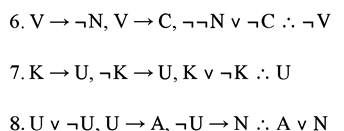
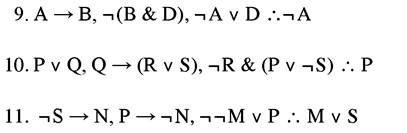
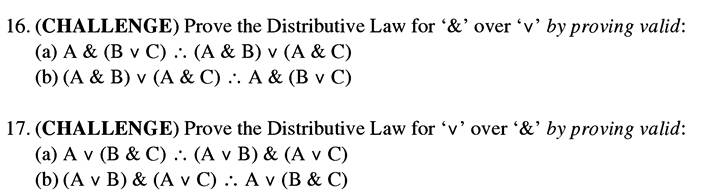
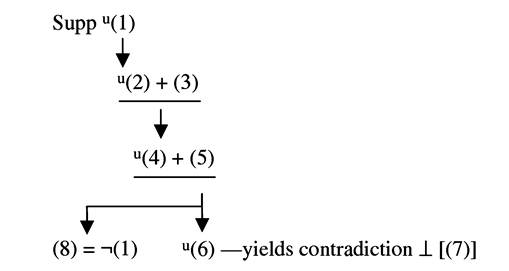
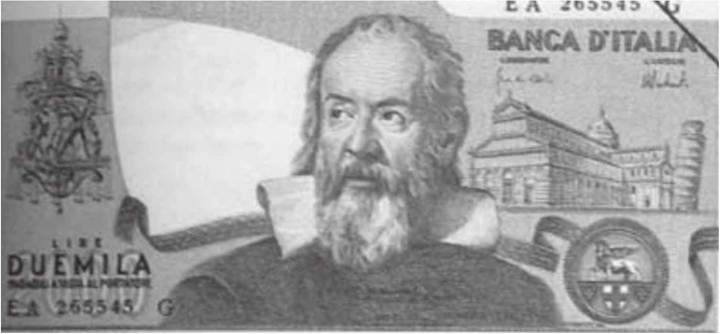
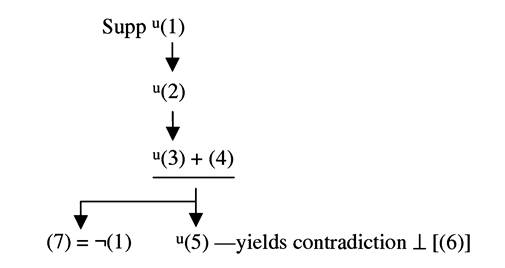
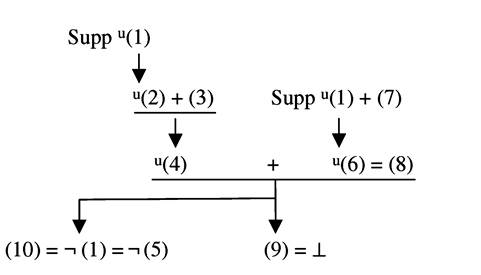
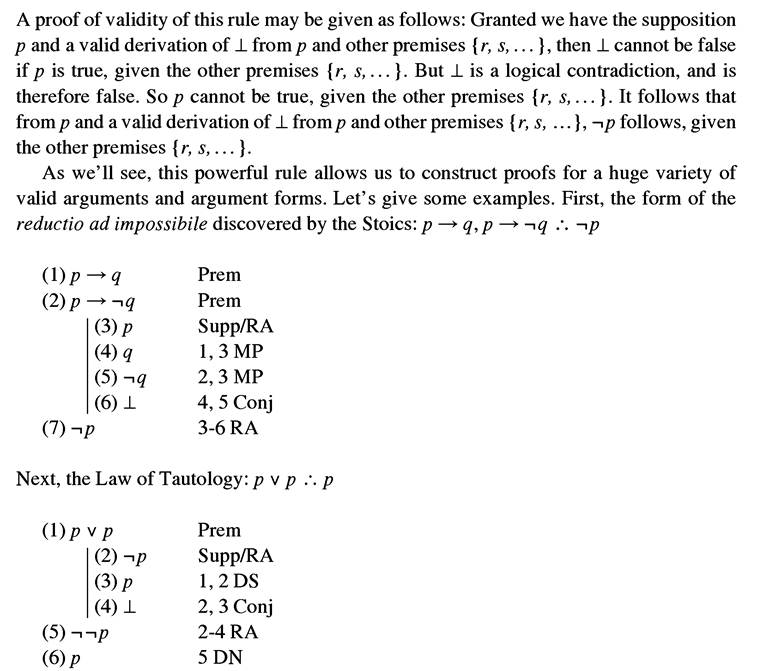
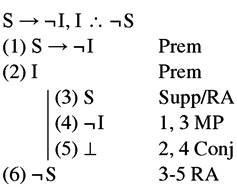
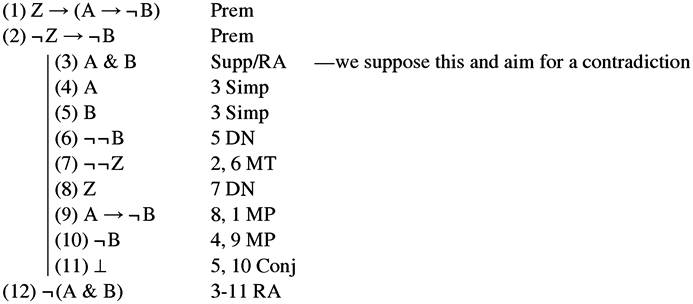
What happened to the ill-fated soul who discovered this awful truth is lost in the mists of legend. But mathematics was never the same again.[38] [39] Nor apparently was philosophy, for Zeno of Elea (another Italian Ancient Greek), apparently inspired by the Pythagoreans, began to use this style of reasoning to prove the paradoxical philosophy of his mentor, Parmenides. For example, in support of Parmenides’ claim that all that exists is One, Zeno proposed the following argument: If many things exist, it is necessary for them to be as many as they are, and neither more nor fewer. But if they are as many as they are, they will be finite. If many things exist, the things that exist are infinite. For there are always others between the things that exist, and again others between them. And in this way the things that exist are infinite.[40] It is readily seen that this argument is a reductio ad absurdum where the absurdity is a direct contradiction. From the supposition that many things exist, it is shown that the things that exist are finite, and then that the things that exist are infinite (i.e., not finite), a direct contradiction. (So what is the implicit conclusion of the argument?) Zeno’s introduction of this kind of reasoning into philosophy probably marks the starting point of the study of logic. At any rate, Euclides, a disciple of Socrates who studied the philosophy of Parmenides and Zeno of Elea, was the founder of the Megarian school which gave rise to Stoic Logic. And Socrates himself, so far as we can tell, was much taken with a method of proving things by taking a prized belief of one of his interlocutors, and then showing that it leads to absurd or unwelcome consequences. For instance, in the Meno Plato has Socrates argue that supposing virtue could be taught, then Athenian worthies would have taught it to their sons. But, as is well known, neither Pericles nor Themistocles nor Aristides succeeded in making their sons virtuous. For our rule of inference, though, we will take the Zenonian elenchus that is appropriate to formal arguments: the supposition must lead to a logical contradiction. To this end we define an explicit contradiction as a statement of the form C, etc. Thus a symbol for an explicit contradiction: The symbol 1 stands for any explicit contradiction of the form (This symbol will be a particularly useful shorthand for the long formulas we will encounter in Predicate Logic.) Now we may state the rule of inference: Reductio adAbsurdum (RA) To prove a statement false, suppose the statement: if an explicit contradiction is derivable from this supposition together with other premises (if needed), then infer the negation of the original statement. In symbols: From a derivation of ± (i.e., Here is an example of the use of the RA rule in a proof. It concerns the expression “unless p, q.” In chapter 7 we concluded that it could be symbolized equally well by Points to note: • as with the Conditional Proof rule, we begin with a supposition, and this is denoted by “Supp/RA” to indicate that we are supposing absurdum proof. • we indent the supposition and all the lines that depend upon that supposition. • on line (7) we derive the contradiction 1, which must be stated explicitly. • line (8), however, does not depend on the supposition; instead, it summarizes what has gone on in fines 2-7: given the premise a contradiction follows. Concluding that the supposition must have been wrong discharges the supposition. • note the justification for line (8): since it summarizes the derivation beginning in line (2) and ending in line (7), it is written 2-7 RA (i.e., lines 2 through 7) to indicate this. Third, the vitally important Law of Excluded Middle: so does not depend on any premises at all. Such proofs of statements with no given premises are very important in logic. We will return to them in chapter 12. Some of the rules we have already proved can be proved more simply in terms of the other rules together with RA, for instance, MT. An instance of the latter form of argument is provided by an abbreviated version of an argument we already encountered in chapter 4, ex. 12. J.R. Brown writes that the central argument of David Bloor’s book, Knowledge and Social Imagery, is “that it is not evidence, but instead social factors, which cause belief.” He then reasons: “If Knowledge and Social Imagery is right, then it is destined to have no direct impact on intellectual life. But since it has had an impact, it must be false.” If we symbolize “Knowledge and Social Imagery is right that it is not evidence, but instead SOCIAL factors, which cause belief’ by S, and “Knowledge and Social Imagery is destined to have a direct IMPACT on intellectual life” by I, we have Notice how the RA strategy is dictated by the fact that there is no obvious way to proceed directly. The supposition is simply the negation of what we are trying to prove (granting a double negation). Then we simply try to work in the information contained in both the given premises until we reach a contradiction. SUMMARY ____________________________________________________________ • The symbol 1 stands for any explicit contradiction of the form • The rule of inference Reductio ad Absurdum (RA) is From a derivation of From a derivation of an explicit contradiction from the supposition of a given statement together with other premises, infer the negation of the supposition. • The line on which the supposition is made is justified Supp/RA, and this line and all lines depending on the supposition are indented; the line after the contradiction has been derived is undented, because the application of RA discharges the supposition. • The validity of this argument form follows from our definition of fonnal validity: p cannot be true given the other premises {r, 5,...} if a false statement is validly derived from them. But ± is logically false. Therefore -∣p follows, given {r, 5,...}. EXERCISES 10.1 1. Prove the validity of the argument form Modus Tollens: and Conj in a reductio proof. 2. Prove the Commutative Law for Disjunction: _ _ 3. Use a reductio strategy to prove the Law of Clavius: 4. As a sister argument form to the reductio ad impossibile, the Stoics proved the form: Wait a little. Keep very still.... If you MOVE, I STRIKE, and if you do not move, I strike.[41] What should the boy infer? Supply the implicit conclusion and prove the validity of the argument using a reductio strategy. 5. Prove the validity of the simple constructive dilemma out using DL) by using MT, DS, MP (or MT), and Conj in a reductio proof. Prove the validity of the following dilemmas using reductio proofs: 12. In his witty and captivating book Godelf Escherf Bach, Douglas Hofstadter reports the following Zen meditation exercise, or Koan, called “Ganto’s Ax”: One day Tokusan told his student Ganto, “I have two monks who have been here for many years. Go and examine them.” Ganto picked up an ax and went to the hut where the two monks were meditating. He raised the ax, saying, “If you SAY a word I will CUT off your heads; and if you do not say a word, I will also cut off your heads.”[42] Hofstadter asks: “What if the ax were an axiom?” To answer, symbolize what Ganto says to the monks, guess what bloody conclusion it entails, and prove this. 13. One of the most celebrated paradoxes in the history of logic is the Liar Paradox. It has its origin in a line in a poem by Epimenides the Cretan: “The Cretans, always liars, evil beasts, idle bellies!” Thus a Cretan is saying “All Cretans are liars.”[43] But perhaps the most concise formulation is “I am lying.” In an episode of Star Trek, Spock uses this as a way to escape the grip of an evil computer, which apparently reasons as follows: “He SAYS he is lying. Ifhe says he is lying and he IS lying, then he is not lying. But if he says he is lying and he is not lying, then he is lying.” Symbolize and prove that this entails that he is lying and he is not lying. 14. As mentioned earlier, the problem of evil can be posed as a dilemma for theism: If God is perfectly LOVING, he must WISH to abolish evil; and if he is all-POW- ERFUL, he must be ABLE to abolish evil. But evil EXISTS; therefore God cannot be both omnipotent and perfectly loving.[44] Supply the unstated premise, and prove the validity of the argument. 15. You may be familiar with the concept of a “Catch-22.” It originates with Joseph Heller’s novel of that name: Yossarian tried another approach: “Is Orr crazy?” “He sure is,” Dr. Neeker said. “Can you ground him?” “I sure can. But first he has to ask me to. That’s part of the rule.” “Then why doesn’t he ask you to?” “Because he’s crazy,” Doc Daneeka said. “He has to be crazy to keep flying combat missions after all the close calls he’s had. Sure, I can ground Orr. But first he has to ask me to.” “That’s all he has to do to be grounded?” “That’s all. Let him ask me.” “And then you can ground him?,” Yossarian asked. “No. Then I can’t ground him.” You mean there’s a catch?” “Sure there’s a catch,” Doc Daneeka replied, “Catch-22. Anyone who wants to get out of combat duty isn’t really crazy.” There was only one catch and that was Catch-22, which specified that a concern for one’s own safety in the face of dangers that were real and immediate was the process of a rational mind. Orr was crazy and could be grounded. All he had to do was ask; and as soon as he did, he would no longer be crazy and would have to fly more missions. Orr would be crazy to fly more missions and sane if he didn’t, but if he was sane he had to fly them. If he flew them he was crazy and didn’t have to; but if he didn’t want to he was sane and had to. Yossarian was moved very deeply by the absolute simplicity of this clause of Catch-22 and let out a respectful whistle.8 The heart of this argument is: “If Orr was CRAZY, he could be GROUNDED if he ASKED to be. But he could be grounded only if he asked. And if he asked, he would no longer be crazy and could not be grounded.” Symbolize, and prove that it follows that Orr could not be grounded. (You will find one premise to be redundant.) 18. (CHALLENGE) In a critique of deconstructionism, E.O. Wilson construes its underlying premise as “Each author’s meaning is unique to himself; nothing of his true intention nor anything else connected to objective reality can be reliably assigned to it... That is what Jacques Derrida, the creator of deconstructionism, meant when he stated the formula Il n’y a pas de hors-texte (There is nothing outside the text). At least, that is what I think he meant, after reading him, his defenders, and his critics with some care. If the radical postmodernist premise is correct, we can never be sure what he meant. Conversely, if that is what he meant, it is not certain that we are obliged to consider his arguments further” (Consilience, p. 41). 8 Joseph Heller, Catch-22 (New York: Dell, 1961), p. 47. Wilson persuades himself that he has found a paradox loosely analogous to the liar paradox. But has he? Symbolizing the “radical postmodernist premise” as U, and the reductio strategy: the supposition and everything that depends on it are unasserted. The argument shows that the supposition leads to something that either (i) contradicts a premise or the supposition itself, or (ii) is absurd or unacceptable according to appropriate standards. This is often made clear by an explicit statement, as here: “this is a contradiction,” or “but this is absurd.” Then from this reasoning to an absurd consequence, we conclude the contradictory of the original supposition. To show that the conclusion follows from the reasoning, rather than from any one of the premises or intermediate conclusions by themselves, we symbolize the inference to the overall conclusion as branching off to the side, as we did with natural CPs: Galileo Galilei image by Justus (Giusto) Sustermans1 1597-1681. Galileo Galilei (1564-1642) provided some beautiful reductio arguments against some of the chief tenets of Aristotle’s physics, which was the standard physics taught in the universities in his time. Perhaps everyone’s favourite is the following, in which Galileo appears to prove that bodies will fall with the same speed whatever their weight. What is amazing about this is that he appears to prove it a priori, i.e., without an appeal to experience (even though he had satisfied himself of its truth through testing it experimentally). It occurs in a dialogue where Galileo has one character (Sagredo) claim that he has done an experiment in which a hundred-pound cannonball and a half-ounce musket ball are dropped through a height of two hundred braccia (about 170 feet), and has determined that the cannonball “does not anticipate the musket ball’s arrival on the ground by even half a span”—i.e., is no more than about 3 inches ahead of it on landing. The dialogue continues: S ALVIATI: But even without experiment, it is possible to prove clearly that a heavier moving body does not move more rapidly than another less heavy one, provided both bodies are of the same material, and in short such as those mentioned by Aristotle. But tell me, Simplicio, whether you accept that each falling body acquires a definite speed fixed by nature, a speed which cannot be increased or diminished except by the use of force or some impediment that retards it. [Simplicio acquiesces.] Then if we had two bodies whose natural speeds were unequal, it is evident that on uniting the two, the faster one would be partly slowed down by the slower one, and the slower one would be somewhat speeded up by the faster one. [Again Simplicio agrees.] But if this is so, and if it is also true that a large stone moves with eight degrees of speed, say, while the slower moves with four, then when they are joined together, their composite will move with a speed less than eight degrees. But the two stones joined together make a larger stone than the one which moved with eight degrees of speed; therefore this greater stone moves less rapidly than the lighter; which is contrary to your supposition. Thus you see how, from the supposition that a heavier body moves more rapidly than a lighter one, I infer that the heavier body moves less rapidly. (Galileo Galilei, Discorsi, 1638) The basic argument is relatively straightforward, and can be rephrased as follows: Suppose Aristotle is right in claiming that a heavier body falls through the same medium more rapidly than a lighter one made of the same material, in such a way that the natural speeds are proportional to their weights. Then if the two are united, the heavier one will be slowed down by the lighter, and the lighter speeded up by the heavier one. So the combined stones will move more slowly than the heavier one alone. But the two stones joined together make a heavier body than the larger stone. Therefore the heavier body (the combined system) moves more slowly than the lighter (either stone by itself). But this contradicts Aristotle’s supposition. Therefore the supposition is false. Marked up: (Suppose) u(l). ∣Then∣ u(2). [So] u(3) the combined stones will move more slowly than the heavier one alone. But (4).pΓherefore∣ u(5) the heavier body (the combined system) moves more slowly than the lighter (either stone by itself). But (6) this contradicts Aristotle’s supposition. I Therefore, (7) the supposition is false. Diagram: Let’s conclude by examining Zeno’s argument from the previous section, where he is trying to refute the supposition of his opponents that there are many things: If many things exist, it is necessary for them to be as many as they are, and neither more nor fewer. But if they are as many as they are, they will be finite. If many things exist, the things that exist are infinite. For there are always others between the things that exist, and again others between them. And in this way the things that exist are infinite. The first leg of the reductio argues that under the supposition that they are many, they must be finite in number. The second leg argues that on the same supposition they must be infinite. It is left implicit that this is contradictory, and that therefore the supposition is false. Making this reductio structure explicit involves interpreting “if’ as “supposing,” something that will often be necessary in analyzing reductios: If (Supposing) u(l) many things exist, ([then]) u(2). But (3) if they are as many as they are, they will be finite. [(Therefore) (4) they are finite.] If (Supposing) (5), (6) the things that exist are infinite. (For) (7). (And in this way) (8). [(9) But this contradicts (4). (Therefore) (10) it is not the case that many things exist.] Diagrammed: EXERCISES 10.2 Instructions for numbers 20-26: (i) mark up the argument: use parentheses for (supposition indicators), box any∖inference indicators∖ set the premises in, reinterpreting and cancelling material where necessary, underline the conclusions, and double-underline the main conclusion', (ii) identify unasserted statements with a prefix superscript u, and (iii) diagram the inference structure, supplying the supposition or the inference to its negation if either of these has been left implicit. 20. In the text we represented Jim Brown’s argument about Bloor’s book Knowledge and Social Imagery as an instance of modus tollens. The same argument can be construed as a reductio ad absurdum as follows: Suppose (1) Bloor’s central argument is right. Then (2) it is not evidence which causes belief. But in that case (3) Bloor’s argument could have no impact on intellectual life. Since (4) it has had such an impact, (5) it must therefore be wrong. 21. Cicero reports Chrysippus to have argued as follows: Supposing (1) the gods do not exist, (2) what can there be in nature better than man, seeing that (3) he alone possesses that highest possible mark of distinction, reason? (4) But that there should be a man who believes there to be nothing in the whole world better than himself is crazy arrogance. (5) Therefore there is something better. (6) Therefore god really does exist.[46] 22. In My Philosophical Development, Bertrand Russell gives the following argument in support of his view that many entities we believe to exist owe their credibility to inference: (1) Your own eyes as visual objects belong to the inferred part of the world... (2) The inference to your own eyes as visual objects is essentially of the same sort as the physicists’ inference to electrons, etc.; and, if (3) you are going to deny validity to the physicists’ inferences, (4) you ought also to deny that you know you have visible eyes—(5) which is absurd, as Euclid would say. 23. In Chapter 5, ex. 17 we examined the following argument given by Leibniz against Clarke: I have still other arguments against this strange imagination that (1) space is a property of God. (2) If it be so, space belongs to the essence of God. But (3) space has parts: therefore (4) there would be parts in the essence of God. (5) Spectatum admissi. (Here the words Spectatum admissi are the beginning of a quote from Horace, which can be translated as “If you saw such a thing, friends, could you restrain your laughter?”—i.e., “But this is absurd!”) Interpret this argument as a reductio argument against the supposition that. 24. Ocellus Lucanus long ago asserted the eternity of the world with the argument: (1) The world must have been eternal, because (2) it is a contradiction for the universe to have had a beginning, since, (3) supposing it had a beginning, (4) it must have been caused by some other thing, but then (5) it would not be the universe.11 25. (CHALLENGE) The Latin poet Lucretius gave a famous argument for the infinity of space in his De Rerum Natura (On the Nature of Things), written in the time of Jesus Christ: Suppose for the moment that (1) the totality of space is finite. Therefore (2) it will have a boundary or limit. Then (3) someone at the very edge could run up to its outermost limit and hurl a flying javelin, with the result that (4) the javelin would either keep going in the direction it was thrown, or would meet an obstruction that would stop it. (5) You must concede and choose one of these alternatives, and either one cuts off your escape and forces you to admit that the universe stretches without end. (6) For if there is something that obstructs it, and stationing itself as a limit, prevents it travelling in the direction it was aimed, then what it started from was not the limit. (7) Likewise, if it keeps going beyond the limit, then what it started from was not the limit. (8) Therefore a limit cannot exist anywhere, so that (9) the totality of space must be infinite.[47] [48] 26. (CHALLENGE) In his Two New Sciences, Galileo has the character Simplicio say of the proposition that a falling body acquires forces so that its speed increases in proportion to the space traversed that it “ought to be accepted without hesitation or controversy,” thus setting up Simplicio himself for a fall. Salviati replies that this is as false and impossible as that motion should be completed instantaneously, and here is a very clear demonstration of it. Supposing (1) the velocities are in proportion to the spaces traversed,... then (2) these spaces are traversed in equal intervals of time; (3) if, therefore, the velocity with which the falling body traverses a space of eight feet were double that with which it covered the first four, (just as one distance is double the other), then the time intervals required for these traversals would be equal. But (4) for one and the same body to fall eight feet and four feet in the same time is possible only in the case of instantaneous motion; but (5) to suppose all falling bodies fall instantaneously is absurd; therefore (6) it is not true that its velocity increases in proportion to the space.[49] 27. (CHALLENGE) Consider again Aristotle’s argument given in number 19 above, that nothing could change in an instant. This time take it to be a reductio in which statement (9) is in contradiction with (1), mark it up, and diagram it. 28. (CHALLENGE) In his fascinating book The Golden Ratio, Mario Livio presents the following argument from the famous medieval theologian Maimonides as a good example of the reductio style of argument: The basic principle [of all monotheistic religions] is that there is a First Being who brought every existing thing into being. For if it be supposed that he did not exist, then nothing else could possibly exist. Is this a valid reductio? If so, give an analysis using the techniques of this chapter. 29. (CHALLENGE) In The Life of the Cosmos, Lee Smolin gives the following presentation of Jacob Bekenstein5S argument that “the maximum amount of information that any system can contain is proportional to the area of its boundary”: According to the laws of thermodynamics, (1) no process is allowed that can decrease the entropy of a system. Suppose that (2) inside some boundary, a system exists that contains more entropy than could be contained by any black hole that would fit inside the boundary. It turns out that in this case (3) one can always add energy to the system until it is so dense that it must collapse to a black hole. But then (4) the entropy goes down to that of a black hole that could be contained inside the boundary. (5) [According to premise (1)] this is impossible, so there must be something wrong with the assumption of the argument, which was that a system can have more entropy than the largest black hole that fits into the same region. So (6) the entropy of any system contained within a finite region is bounded. But then (7) the information it can contain is also bounded, as (8) entropy is a measure of information.[50] Sketch a diagram for this reductio. 30. (CHALLENGE) In 1615 Peter Fonseca gave the following argument against the idea that space is a “true being”: Space is not a true being, for if it were, it would either be an uncreated being, which is appropriate only to God; or a created being, which it cannot be, since space could not have begun to exist, for wherever it is now, there necessarily it always was and always will be.[51] Letting T := space is a TRUE being, U := space is an UNCREATED being, G := only GOD is uncreated, C := space is a CREATED being, B := space BEGAN to exist, A := wherever it is now, there necessarily it ALWAYS was and always will be, (a) diagram the inference structure; (b) give a formal proof of the validity of the main inference: if T, then U or C. Chapter Eleven
 where q as always is a variable standing for any individual statement, such as C, or
 is an explicit contradiction, and so is
 ; on the other hand.
 is not. It is handy (particularly for long contradictions) to have
 from the supposition of p, infer
 and by p V q, but so far we have only proved (in chapter 7) that the second of these entails the first. Now we will prove that
 entails p v q. In what follows we are using the statement variables p and q to prove the validity of an argument form directly.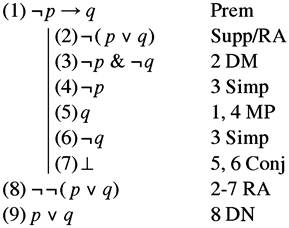
 to begin a reductio ad
  , then, supposing
 this is logically true, and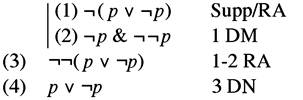


 ι from the supposition of p, infer
 using MP
  _ _
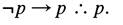
_ _ 
 Up till now, we have treated arguments of this form as dilemmas with the disjunction
 left implicit. But strictly, this last premise is a tautology that adds no new content to the argument, and the argument form is provably valid without it. The form is exemplified in the following passage from Rudyard Kipling’s Rikki-Tikki-Tavi, when Nagaina, a King Cobra whose husband had recently been slain, hisses at the son of the man who killed him:
  (with
(with