NATURAL DILEMMAS
In examining reasoning based on the conditional proof in the last chapter, we saw that it depended on the following insight: we may summarize a piece of reasoning from a supposition p to a consequence q as “Supposing p, q”\ but this amounts to the same thing as saying “If p, q” As a result of this equivalence, it is often the case that the explicit Conditionalization step—the concluding step of a conditional proof—is left implicit in natural reasoning.
The reader of a chain of reasoning that establishes q on the hypothesis or supposition p is left to draw the conclusion that p → q for him- or herself.A similar thing occurs in some dilemmas too. Sometimes a consequence will be inferred from a disjunct through some chain of reasoning, and also from the other disjunct, making it the conclusion of a simple constructive dilemma, but with no explicit conditional statements. If the dilemma is complex, a different consequent will be inferred from the second disjunct, and the disjunction of these inferred as the overall conclusion. In such cases, the reasoning is suppositional, sometimes explicitly so, but more often implicitly: the disjunct is supposed, and things are inferred from it. Here’s a schematic example of a complex constructive dilemma:
A or B. From A it follows that C, because D. Suppose, on the other hand, that B is true.
Then, given that E, it follows that F. Therefore C or F.
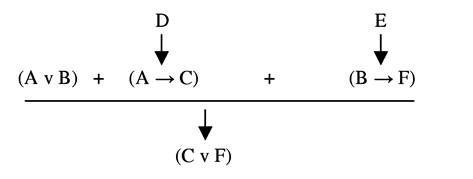
Here the first leg establishes that, given D, C follows on the supposition of A. That is, given D, it is inferred that A → C, even though this is not stated. Similarly, in the second leg, it is argued that, given E, F will follow from the supposition of B, i.e., B → F, even though the conditional is not stated explicitly. Then, since one of the two suppositions must be true—A v B—the conclusion CvF follows (it’s a complex constructive dilemma, whose validity we proved above).
So we could diagram this as follows:Diagram:
Let’s put some flesh on this skeleton, and look at a real-life example. Protagoras was perhaps the greatest of the “Sophists,” the first people in Ancient Greece to offer to take up as a profession the teaching of various intellectual skills (mainly rhetoric, the art of acquitting oneself well in public discourse—essential for lawyers, then as now). The following apocryphal story concerns a certain Euathlus, who had hired Protagoras to teach him rhetoric in preparation for a career as a lawyer. Since he could only afford half the fee, it was agreed that he would pay the second installment after Euathlus had won his first case. But after some time had passed, Euathlus had still not gone into practice, and Protagoras, worried about his reputation and getting low on cash, decided to sue him (how things change, eh?). In court, Protagoras argued to the jury as follows:
Euathlus maintains he should not pay me, but this is absurd. For suppose he wins this case. Since this is his first appearance in court, he should then pay me, because he has won his first case. On the other hand, suppose he loses the case. Then he ought to pay me because this is the judgement of the court. Therefore, since he must either win or lose the case, he must pay me.
Here the first statement can be regarded as a restatement of the main conclusion “Therefore... he must pay me.” Let’s read it that way. Then on marking up we get:

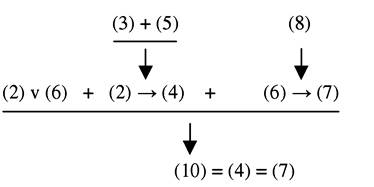
Here the first leg establishes that, given (3) and (5), then (4) follows on the supposition of
(2). That is, given (3) and (5), it is inferred that (2) → (4). Similarly, in the second leg, it is argued that, given (8), then (7) will follow on the supposition of (6), i.e., (6) → (7). But (7) is the same as (4). Thus, since (9) either (2) or (6) must be the case—(2) v (6)—the conclusion (10) = (4) = (7) follows (it’s a simple constructive dilemma).
So we diagram this as follows:Diagram:
Euathlus had learned well from Protagoras, however. For he replied in kind. His argument is given as an exercise for analysis in Exercise 19 below.
As another example of a natural dilemma, let’s look at this one from Voltaire. He reports the view of the Unitarians, who did not believe in the doctrine of Original Sin. Although he claims to “shudder in the reporting” of such a “profound superstition,” Voltaire gets his message across by equipping them with a strong argument in the form of what we may call a “trilemma,” a dilemma beginning with three disjuncts:
It is to offend God, they say, it is to accuse him of the most absurd barbarity, to dare to say that he made all the generations of men in order to torment them by eternal sufferings on the pretext that their first father ate some fruit in a garden... “How horrible,” exclaim the strict Unitarians, “to calumniate the Creator by imputing continual miracles to him in order to damn forever people whom he has given life for so little time! Either he created souls from all eternity, so that on this supposition, since they will be infinitely older than Adam’s sin, they will have no connection with him. Or these souls are formed every time a man sleeps with a woman, and in that case God is continually on the watch for every consummation of sex in the universe in order to create the spirits whom he will make eternally unhappy. Or God is himself the soul of all people, and in that case he damns himself. Which of these three suppositions is the most horrible and most senseless?”—Voltaire, Philosophical Dictionary[37]
Marking up the trilemma:
Either u(l), (so that on this supposition), ∣since∣ (2), u(3) they will have no connection with him. Or u(4), ∣and in that case∣u(5) God is continually on the watch for every Consumation of sex in the universe in order to create the spirits whom he will make eternally unhappy.
Or u(6),∣and in that case∣ u(7) he damns himself. (8) Which of these three suppositions is the most [are all] horrible and most senseless?We are offered three alternatives: either (1) he created souls for all eternity, or (4) these souls are formed every time a man sleeps with a woman, or (6) God is himself the soul of all people. Supposing (1), given (2), (3) will follow. Supposing (4), (5) will follow. Supposing (6), (7) will follow. But, (8) implies, since each of the three consequences is horrible and senseless, so must the three alternatives supposed. Since, it is also implied, these are the only way that original sin could happen, that doctrine must be false.
EXERCISES 9.2
19. In the text Protagoras’ argument against Euathlus was given and analyzed. Give a similar analysis of Euathlus ’ rejoinder, marking it up and diagramming it:
Protagoras maintains that I should pay him, but it is this which is absurd. For suppose he wins this case. Since I will not have won my first case, I do not need to pay him, according to our agreement. On the other hand, suppose he loses the case. Then I do not have to pay him, since this is the judgement of the court. Therefore, since he must either win or lose the case, I do not have to pay him.
20. (CHALLENGE) In Plato’s Apology, Socrates gives the following argument in the form of a dilemma to prove that death is something to be desired. Restate the main inference in your own words, symbolize, and prove its validity:
Death is one of two things. It is either annihilation, and the dead have no consciousness of anything, or, as we are told, it is really a change—a migration of the soul from this place to another. Now if there is no consciousness but only a dreamless sleep, death must be a marvellous gain... If death is like this, then, I call it a gain, because the whole of time, if you look at it in this way, can be regarded as no more than one single night. If on the other hand, death is a removal from here to some other place, and if what we are told is true, that all the dead are gone there, what greater blessing could there be than this, gentlemen?...
How much would one of you give to meet Orpheus and Musaeus, Hesiod, and Homer?— Plato, Apology21. (CHALLENGE) In his second letter to Clarke in their famous controversy, Gottfried Leibniz posed a dilemma for Sir Isaac Newton, who had claimed that God would need to intervene from time to time to keep the same quantity of motion in the universe. Supply the implicit conclusion of the argument, symbolize, and prove its validity:
If God is obliged to mend the course of nature from time to time, it must either be done Supematurally or naturally. If it is done Supematurally, we must have recourse to miracles in order to explain natural things, which [is absurd], for everything may easily be accounted for by miracles. But if it is done naturally, then God will... be comprehended under the nature of things, that is, he will be the soul of the world. [But it is agreed that it is false and heretical to claim that God is the soul of the world.]—Leibniz, Second Letter to Clarke, §12
22. (CHALLENGE) According to the historians of science Shapin and Schaffer, the chemist Robert Boyle posed a powerful dilemma for the materialist philosopher Hobbes. Restate the main inference in your own words, symbolize, and prove its validity:
In 1675 Boyle spelt out Hobbes’s dilemma. If “every body needs an outward movent [sc. something which moves it], it may well be demanded, how there comes to be any thing locally moved in the world?” Hobbes would need to appeal to some external prime mover, such as God. But if God were immaterial, then Hobbes would be compelled to admit that motion was generated by the interaction of matter and something immaterial. On the other hand, if God were material (and “Mr. Hobbes, in some writings of his, is believed to think the very notion of an immaterial substance to be absurd”), then Hobbes would be compelled to attribute inherent motion to this form of matter. Thus, either Hobbes would concede that motion was a product of spirit, or that motion was innate in matter.—Leviathan and the Air Pump, p. 204
23. (CHALLENGE) The main inference of the trilemma from Voltaire given in the text may be summarized as follows:
There is ORIGINAL Sin only if one or other of these three alternatives is true: either God created souls for all ETERNITY, or these souls are FORMED every time a man sleeps with a woman, or God is himself the SOUL of all people. But if God created souls for all eternity they would have no CONNECTION with him. On the other hand, if these souls are formed every time a man sleeps with a woman, God would be continually on the WATCH for every consummation of sex in the universe in order to create the spirits whom he will make eternally unhappy. Finally, if God is himself the soul of all people, in that case he DAMNS himself. But since the consequents of these three conditionals are all false, the doctrine of Original Sin must also be false.
Symbolize and prove the validity of this main inference.