RULES OF INFERENCE
Now there is a sense in which may symbolize the main inference as follows:

We can prove this inference’s validity as follows:
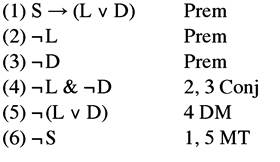
Sextus’ dilemma involved a disjunction, but the disjunction was the consequent of a conditional.
More typically, a dilemma will have a disjunction standing alone as one of its premises, and its proponent will argue that each of the disjuncts leads to a certain conclusion. If the conclusion is itself a disjunction, this is known as a complex constructive dilemma; if the conclusion is non-disjunctive, it is called a simple constructive dilemma:A simple constructive dilemma is an argument with a disjunctive premise, each of whose disjuncts implies the conclusion. Its form is: jl
A complex constructive dilemma is an argument with a disjunctive premise, each of whose disjuncts implies a different consequent, and whose conclusion is the disjunction of these consequents. Its form is:
Here is an example of each. The first concerns President Nixon’s dilemma in the “Watergate” scandal:
The decision of the Supreme Court in US versus Nixon (1974), handed down the first day of the Judiciary Committee’s final debate, was critical. If the President DEFIED the order, he would be IMPEACHED. If he OBEYED the order, it was increasingly apparent, he would be impeached on the evidence.[XXXV]
As is so often the case with dilemmas, the conclusion is left implicit: Nixon would be impeached. As also happens sometimes, the initial disjunction is considered too obvious to be worth stating: either Nixon would defy the order or he would obey it.
Making these elements explicit, we have the simple constructive dilemma:
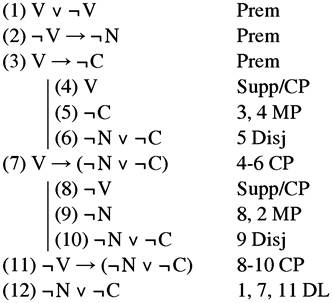
Our example of a complex dilemma is due to Abraham Lincoln, who was particularly adept at formulating dilemmas:
But the proclamation, as law, either is valid, or is not valid. If it is not valid, it needs no retraction. If it is valid, it cannot be retracted, any more than the dead can be brought back to life.2

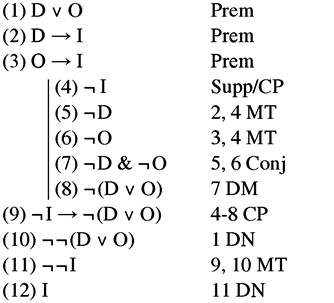
As you can see, this is not a very easy proof. It involves supposing that the conclusion is false, and showing that on this supposition the premise is false, so that given the truth of the premise, the conclusion follows by Modus Tollens. So for convenience we introduce the form of the simple constructive dilemma as a rule of inference:
Dilemma (DL)
From a disjunction and two conditionals whose antecedents are the disjuncts, and which have the same consequent, infer their consequent.
In symbols:
From
2
Letter to James C. Conkling, 26 August 1863; also taken from Copi and Cohen, p. 288.
Using this, we may prove the validity of both the dilemmas above. The first is a simple substitution instance, with D for p, O for q, and I for r:
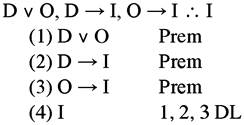
Note the justification for DL: it involves citing 3 separate lines: (1) the disjunction, (2) (first disjunct → conclusion), (3) (second disjunct → conclusion).
The second proof is more involved. The basic strategy is DL, but before we can apply that we need to get two conditionals which have the conclusion as consequent and the disjuncts as their antecedents:
Two further dilemma argument forms have traditionally been identified, the destructive dilemmas:
A simple destructive dilemma is an argument of the form:

A complex destructive dilemma is an argument of the form:

You can probably see that just as each constructive dilemma was a kind of disjunctive form of modus ponens, each destructive dilemma is a kind of disjunctive form of modus tollens.
Proofs of their validity are left as exercises [Exercises 1,2].SUMMARY
• A dilemma is an argument involving a disjunction, which shows that each of the two disjuncts leads to a certain conclusion, usually unwanted or surprising.
• Of the 4 common valid forms of dilemma—simple and complex constructive dilemmas, and simple and complex destructive dilemmas—the simple constructive dilemma is chosen as the rule of inference.
• Dilemma (DL): From and x
and x , stated separately, infer r.
From a disjunction and two conditionals whose antecedents are the disjuncts, and which have the same consequent, infer their consequent.
• All four forms may be proved valid using the rules of inference we already have.
EXERCISES 9.1
1. The argument form is called simple destructive dilemma.
Prove its validity.
2. The argument form is called complex destructive
dilemma. Prove its validity.
3. Another of Abraham Lincoln’s dilemmas:
Circuit Courts are USEFUL, or they are not useful. If useful, no State should be denied them; if not useful, no State should have them. Let them be provided for all, or abolished as to all.3
Symbolizing “All States should have them” by A, and “No State should have them” by N, and reading “Let them be provided for all, or abolished as to all” as AvN, prove the formal validity of Lincoln’s dilemma.
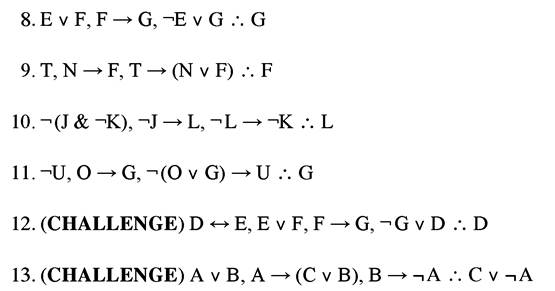
Prove the formal validity of each of the following abstract arguments: 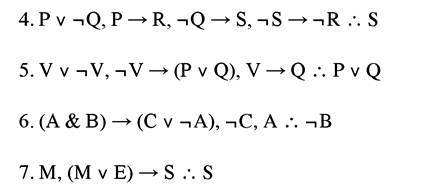
з
Lincoln, Annual Message to Congress, 3 December 1861; again, from Copi and Cohen, p.
291.
14. Lewis Carroll, the author of Alice in Wonderland, was a logician (perhaps confirming your fears about logic causing mild insanity!). Not surprising, then, to find arguments such as the dilemma contained in this passage:
Soon her eye fell on a little glass box that was lying under the table: she opened it, and found a very small cake, on which the words “EAT ME” were beautifully marked in currants. “Well, I’ll eat it,” said Alice, “and if it makes me larger, I can reach the key; and if it makes me smaller, I can creep under the door; so either way I’ll get into the garden, and I don’t care which happens!”
Symbolizing “It will make me LARGER” by L, and “I can reach the KEY” by K, “It will make me SMALLER” by S, “I can CREEP under the door” by C, and “I’ll get into the GARDEN” by G, and supplying two implicit conditionals and an implicit disjunction (assume that it will make her either larger or smaller), prove that Alice will get into the garden.
15. According to the Buddhist scholar Fedor Shcherbatskoi, the Buddhists claimed it is useless to give a definition of what a thing really is:
If the thing is KNOWN, they maintain, its definition is USELESS, and if the thing is not known, it is still more useless, because it is impossible.—N. Kandali (Shcherbatskoi, Buddhist Logic, p. 146)
This can be read as an enthymeme with implicit conclusion and implicit premise (the disjunction). Supply these implicit elements, symbolize, and prove its validity.
16. Tim Parks reports a dilemma remarked on by a British social scientist as follows:
Bateson remarks among other things on the fact that the schizophrenic’s apparent state of subjection does not allow him to comment on his mother’s contradictory behaviour. She rejects affection, demands affection, then criticizes him for an inhibition she had herself just induced. Ultimately, Bateson claims, the patient is up against the impossible dilemma: “If I am to KEEP my tie to mother, I must SHOW her that I love her; but if I do show her that I love her, then I will LOSE her.”—Tim Parks, “Unlocking the Mind’s Manacles,” New York Review of Books, October 7, 1999
Implicit here for the patient are the premises that, as well as the disjunction that.
What follows from this? Set out a formal proof17. The problem of evil can be expressed as a dilemma for theism:
Evil EXISTS. But if this is so, then either God cannot PREVENT evil, or he does not WANT to prevent evil. If God cannot prevent evil, he is not OMNIPOTENT. And if he doesn’t want to prevent evil, he is not BENEVOLENT. Therefore either God is not omnipotent or he is not benevolent.
Symbolize the argument, and prove its validity.
18. The physicist Lee Smolin has argued as follows:
If the laws of physics exist eternally and independently of the universe, then the reasons for them are beyond our rational comprehension. But if they are created by natural processes acting in time, it becomes possible that we may come to understand why they, and ultimately our world, are as we find them.
Thus, no less than for any other regularities we observe in the world, the extent to which we bring the laws of physics inside of time is the extent to which we make them amenable to rational understanding.[36]
This argument can be expressed as a dilemma as follows:
If the laws of physics exist ETERNALLY and independently of the universe, then they are not rationally COMPREHENSIBLE. But if they are created by NATURAL processes acting in time, then it becomes possible to BRING the laws of physics inside time. And if the laws are brought inside time they will become rationally comprehensible. But the laws of physics either exist eternally or are created by natural processes acting in time, so it follows that they are rationally comprehensible if and only if they can be brought inside time.
Symbolize the argument, and prove its validity.
9.2