Asyllogistic proofs: qn
Now let’s turn to some proofs. I promised in chapter 16 to say more in explanation of the restrictions on our quantifier rules. Our UG rule (in terms of u and x) is as follows:
From Φu derive (Vx)Φx, provided
(i) Φu neither is nor depends upon an undischarged supposition involving u, and
(ii) Φu does not contain a name і (or j or k) introduced by an application of EI to a formula involving u.
The second restriction does not come into its own until we get to relational logic with formulas involving both u and i. In our system UG cannot otherwise be validly applied to a formula derived by EI because the letters i, j, and к are reserved for EI, and u, v, and w are reserved for UG. Here are two examples of short, invalid proofs that illustrate this:


For example, without that restriction we could have proved from the true statement “Some movies are A VANTgarde” (UD: movies) that “All movies are avant garde” ∖
But why the first restriction? Well, we do not want to allow proofs like the following:
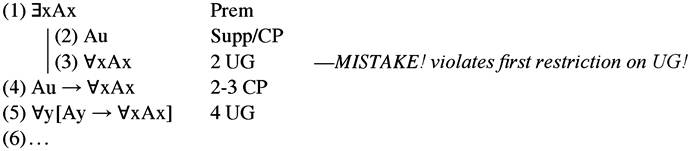
Notice that the problem here is not getting to line (5) from line (4): there we have correctly generalized from an instance involving u that no longer depends on a supposition involving u—the supposition was correctly discharged on line 4 by the CP move. It is the move from line (2) to line (3) that violates the restriction, as indicated by (3),s having the same indentation as (2), the line on which the supposition was made. If that were not a mistake and (5) were validly derived, the proof could continue: 
Again we would have proved that all x’s are A’s from the assumption that only some are.
So this first restriction is made precisely to preclude invalid proofs of this sort.Now let’s prove (as we promised to) that statements (3) and (6) of section 1, “Some people have not heard of Freud” and “Not everyone has heard of Freud,” mutually entail one another:
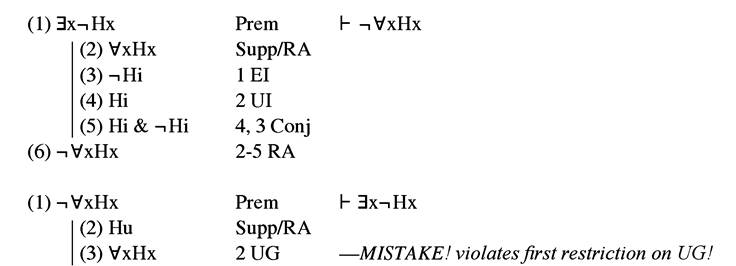
The first restriction is that ςςΦu neither is nor depends upon an undischarged supposition involving u.” Here the instance we are generalizing from, Hu, is an undischarged supposition involving u. We need to try something subtler:
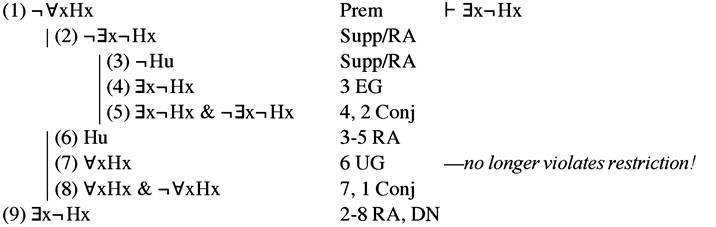
The reason that line (7) no longer violates the first restriction on UG is that by line (6) the supposition involving u has been discharged. As a result, Hu neither is nor depends on a supposition involving u, even though it contains the name u.
Similar proofs will establish the mutual equivalence of statements (4) and (5) above:  I leave this as an exercise.

ever propositional function of x followed the quantifiers in x. This means that we have effectively proved the following, our only derived rules in Predicate Logic:
Quantifier Negation (QN)
From the negation of a universal quantification infer the existential quantification whose propositional function is the negation of the original one, and vice versa. From
From the negation of an existential quantification infer the universal quantification whose propositional function is the negation of the original one, and vice versa. From
As usual, this rule is also understood to apply to the variables у and z too.
Here’s an example of a use of this rule of inference:
If Gorbachev was TELLING the truth about Stalin’s purges, then Brezhnev DECEIVED the Soviet people. But if Gorbachev was not telling the truth, then he himself deceived the Soviet people. Thus it is certain that someone deceived the Soviet people.

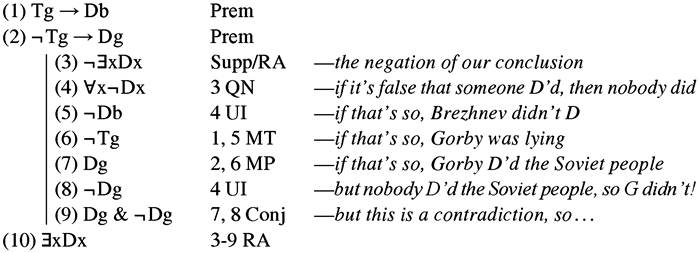
Notice the two uses of UI on 4 in lines (5) and (8) to two different instances. We could also have obtained a contradiction by EG as follows:


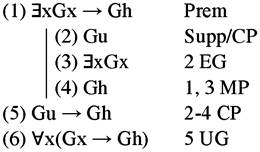
Again, this does not break the first restriction on UG, because the dependence on u has been discharged by the step of CP. To prove logical equivalence, we also need to prove  I leave this as an exercise. Notice, though, that the following won’t do:
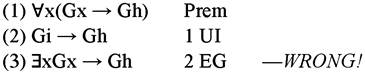
The reason is not that any restrictions on quantifiers have been violated: there aren’t any on UI or on EG. The problem is that the abstract statement ΞxGx → Gh is not an existential quantification! It is a conditional whose antecedent is an existential quantification. And you cannot get to a conditional by EG; to prove a conditional you would use CP.
But granting the equivalence of these two abstract statements, it must be admitted that all this raises a lot of questions. If Vx(Gx → Gh) is a universal quantification, why is there an ςh, in it? What does it mean to say that ςh, lies within the scope of the quantifier ∀x? Why doesn’t the ih, in ΞxGx → Gh lie within its scope? To address these and similar perplexities, we need to define the scope of a quantifier, and this requires setting up predicate logic in a systematic way. We’ll do this in section 3 below.
SUMMARY
• The restrictions on the UG rule are there to prevent proofs of invalid arguments. In deriving VxΦx from Φu, (i) the latter must neither itself be nor depend upon an undischarged supposition involving u, and (ii) it must not involve a letter і introduced by an application of EI to a formula involving u. In non-relational predicate logic, UG cannot be invalidly applied to a formula obtained by EI because i, j, and к are reserved for EI, and u, v, and w are reserved for UG.
• The rule of inference Quantifier Negation (QN) is:
From the negation of a universal quantification infer the existential quantification whose propositional function is the negation of the original one, and vice versa. From -i VxΦx, derive Ξx-∣Φx, and vice versa.
From the negation of an existential quantification infer the universal quantification whose propositional function is the negation of the original one, and vice versa. From -∣ΞxΦx, derive Vx-∣Φx, and vice versa.
EXERCISES 19.2
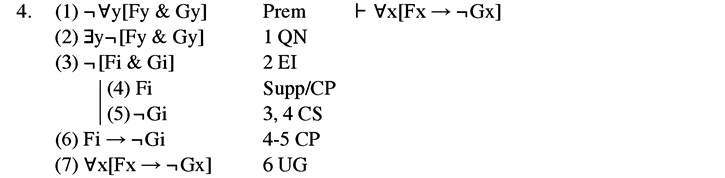
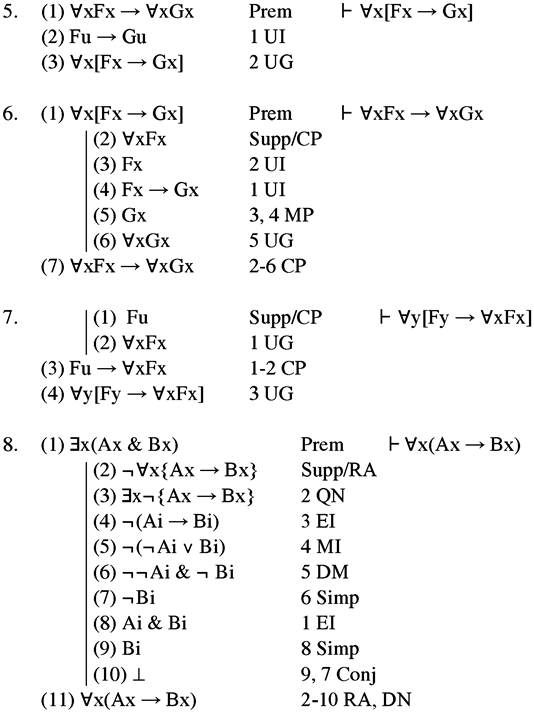
Identify the mistakes in the following proofs (4-8). In each one there is one major gaffe or type of error (if repeated) that renders the proof invalid.

Prove the validity of the arguments occurring in exercises 10-16:
10. On my 21st birthday an editorial appeared in the Miami Herald, “Never Forget What’s-His-Name,” in which it was asserted that no biography has ever been written of my namesake, the 21st President of the United States. This prompted a letter to the editor from a certain E.F.B. Fries, who pointed out that one had been written, Chester A. Arthur: A Quarter Century of Machine Politics, by George Frederick Howe in 1934. Fries’s implicit argument:
It is false that there has never been a BIOGRAPHY of Chester Arthur.
For Howe’s book is just such a biography. [UD: books; Bx := is a biography of Chester Arthur]11. Here is another interpretation of the probable reasoning of the tax-evading Englishman of exercise 19 of chapter 17:
No TAXES may be collected from ANIMALS. My dog Glory is an animal. Therefore, if Glory INVESTS in stocks, some individual who invests in stocks cannot be taxed. [UD: individuals; Tx := can be taxed]
12. Psychologists at a state prison in Connecticut in the 1970s ran a behaviour-modification program for child-molesters, who were given electric shocks as they watched slides of naked children. The psychologist in charge claimed that “the program is entirely voluntary”; to which the director of the Connecticut Civil Liberties Union replied with the following argument:
It’s inherently coercive—there’s no such thing as a real volunteer in a prison, especially when a prisoner knows participating may enhance his chances for parole.[LXXXII]
Symbolize and prove the validity of this paraphrase of the CCLU director's argument: Any prisoner who KNOWS participating in a program may enhance his chances for parole is not a VOLUNTEER. Since all prisoners know this, there is no such thing as a real volunteer in a prison. [UD: prisoners; Kx := x knows participating in a program may enhance his chances for parole, Vx := x is a real volunteer]
13. Responding to a proposed constitutional amendment that would permit non-denomi- national prayer in public schools, Congressman Drinan (then the sole Catholic priest in congress) attacked the amendment with an argument paraphrased by Howard Pospesel (Predicate Logic, 54) as follows:
The proposed amendment sanctions only nondenominational prayer. Therefore, since there is no such thing as a nondenominational prayer, it sanctions nothing. [UD: prayers; Sx := x is sanctioned by the proposed amendment, Dx := x is denominational]
14. The following is a paraphrase of an argument by the French philosopher Rene Descartes:
Everything that is EXTENDED is a SUBSTANCE.
But nothing is both a substance and a VACUUM. Yet every vacuum is extended. Therefore there is no vacuum.15. Prove that if the statement “Beauty is in the eye of the beholder” is interpreted to mean “Everything that is BEAUTIFUL is in the EYE of the beholder,” then it follows that “if there are things that are not in the eye of the beholder, then not everything is beautiful.” [Bx := x is beautiful, Ex := x is in the eye of the beholder]
16. Sarah knows that her friend Alice is holding a party for people of one sex only, but does not know which. But then she Ieams that Alice herself will be at the party, and concludes that everyone invited is female. Her reasoning:
Either all those invited are MALE or they are all FEMALE. At least one of them is female. No one can be both male and female. Therefore all those invited are female. [UD: those invited to the party]
17. Prove і (the other side of the “if any” equivalence).
18. Prove that from “If anything is CERTAIN, this is,” and “Not everything fails to be certain,” it follows that “This is certain” (whatever “this” may happen to be).
19. (CHALLENGE) Since they are contradictories, an E-statement entails the negation of the !-statement with the same subject and predicate terms. Construct a 6 line proof.
20. (CHALLENGE) Constmct a nine-line formal proof for the sequent Ξx(Sx V Px) H ΞxSx v ΞxPx
19.3