SYMBOLS, FORMULAS, AND WFFS
As we saw in Statement Logic, we can discuss validity at varying levels of abstraction. On the one hand, we have the Unreconstmcted natural arguments, occurring in their original wordings.
Then, when we have supplied missing premises and/or conclusions, discarded inessential elements, and perhaps even paraphrased, we have a system of one or more inferences, whose validity we can investigate. Each single-inference argument, expressed in words, is a concrete argument,2 whose form we can proceed to investigate. In doing so, we make certain judgements about whether the form depends on a pattern of statements related by our statement connectives, or a pattern of predicates ascribed to individuals (or, in relational logic, a pattern of predicates relating two or more individuals). We then represent the statements by letters: capitals for statements and their components, capitals followed by lower case letters for singular statements; and we represent combinations of these statements using statement operators and quantifiers. These are now abstract statements. They are represented by strings of symbols or formulas, not arbitrary strings of symbols, but ones that can be interpreted as abstract statements according to our conventions. We can then look at these patterns of abstract statements, our abstract arguments, and see whether they conform to forms Ofinference that are valid.2
This follows the usage of Lewis Carroll in his Symbolic Logic'. “A concrete Proposition is one that is expressed in words, and an abstract Proposition is one expressed in terms of letters.”
The forms of inference are expressed as argument forms, patterns into which the symbols representing abstract statements can be substituted. So a given inference may be valid or invalid; but the inference may be expressed concretely or abstractly; and the form of a valid inference corresponding to a rule of inference is expressed as an argument form.
To express Predicate Logic as a formal system we need only to generalize a little on our definitions for Statement Logic. As before, we concentrate on the abstract statements, which will be represented by well-formed formulas or wffs. For these, we can give rules of formation by a simple extension of the rules of formation for statements we examined in chapter 12. First, we list our symbols:
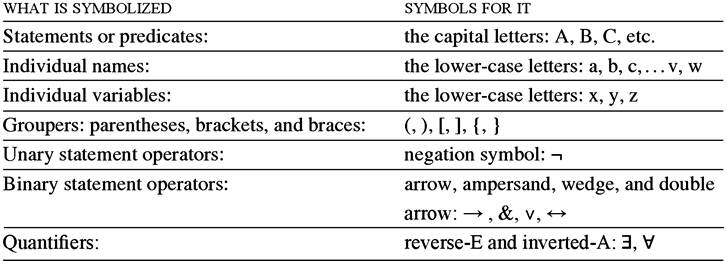
We can define & formula as before:
A formula is a string of (one or more) logical symbols, e.g..598" class="lazyload" data-src="/files/uch_group76/uch_pgroup316/uch_uch7361/image/image596.jpg">
Thus the following are formulas by this definition:
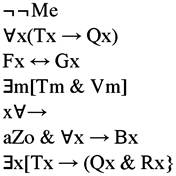
Of these, only the first two are well-formed. Clearly we need to define what strings represent well-formed statements. These may be the singular statements of statement logic, such as F or B, or those of predicate logic, such as Fa or Bm. But we will set up our definitions so that they also accommodate the statements in relational logic that we will need in chapters 20-23. There we will meet statements involving predicates that link two or more individuals, such as “Angelina MARRIED BradA which we will symbolize aMb.
In addition, we will also need to have groupers only occurring in corresponding pairs, and for quantifications we also need to define quantifiers:
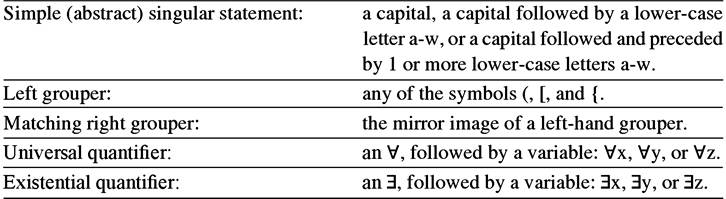
Now we can give a recursive definition of a well-formed formula as follows:
The following, and only the following, formulas are wffs:
(i) a simple singular statement or
(ii) a negation symbol followed by a wff or
(iii) a left grouper, followed by a wff, followed by a binary operator, followed by a wff, followed by a matching right grouper or
(iv) a formula that can be generated from a wff by prefixing a quantifier (whose variable does not occur in the wff) and replacing one or more occurrences of an individual name by the same variable.[83]
As in statement logic, we will append the convention that:
(v) Matching left and right groupers at the left and right extremes of a wff formed by applying clause (iii) last are understood to be there even when they are not explicitly written in.
Let’s see how this definition works by exploring some examples.
First the symbol(DA
is a wff by clause (i). It is an abstract statement, and could stand for any statement at all (whose internal structure we have declined to investigate further). Similarly,

are all wffs by clause (і). Те’ could stand for “Erica has a FEAR of flying.” ςaCr, could stand for “Angela CARES for Rodney,” isEs, for “The preceding statement is EQUIVALENT to itself,” and iaBth, for “The ambulance station is BETWEEN the theatre and the hospital.” In practice, you are unlikely to see wffs with more than three individual names,  are all wffs by clause (ii), and so will be an infinity of others such as
 , pro
, pro
vided (So & Do) is itself a wff.

are all wffs by clause (iii), and by convention (v) may be written as

Finally, by clause (iv) the following are wffs:

The first of these is an А-statement obtained by replacing every e in the first wff of (4) by x. The second is obtained by replacing only the first name e by an x. The result is a statement like the “Hendrix” one above. The last of these would be obtained from the last of the wffs in (4) in three stages: first, replace the second and fourth occurrences of a by z and put an Vz in front; then replace all occurrences of r by у and put a Vy in front; then replace the remaining occurrences of a by x and put a in front.
A quantification is a formula that is a wff according to the above rules of formation when (and only when) clause (iv) is applied last.
It is not just any wff beginning with a quantifier. Remember ΞxGx → Gh is not an existential quantification, but a conditional. This corresponds to the fact that it would be generated as a wff as follows: Ge is a wff by (i), so ΞxGx is by clause (iv). Gh is a wff by (i), so ΞxGx → Gh is a wff by clause (ii) (applying the convention (v) to drop the outermost groupers). The last connective used in forming a wff according to clauses (ii) and (iii) is the governing connective of the wff. Here it is the arrow, so the wff as a whole is a conditional. If clause (iv) is applied last, the wff is a quantification, as we just saw.
19.3.2