NON-CLASSICAL STATEMENTS
So far we have been using predicate logic to treat the material traditionally amenable to the theory of syllogisms: first what was dealt with in Aristotle’s theory of the syllogism, then with the additional material (singular statements, negative predicates in the subject, arguments with more than 3 predicates, non-standard sorites, and so on) amenable to the methods introduced by Boole, Venn, and company in the nineteenth century.
But it should be obvious that we can do very much more with the predicate logic that we have generalized from modern statement logic. For example, if the universe of discourse (UD) is people, Bx := X is a backwoodsman, and Hx := x has heard of Sigmund Freud, we have not only
and

but also


Statements (3) to (6) are worth a bit of reflection. It is tempting to translate (5) “There isn’t anyone who has heard of Freud” by Ξx-∣Hx. But this is (3), “There are some people who haven’t heard of Freud.” We want (5), “there are no people who have heard of Freud...,” so the -і negates the existential quantifier, not the predicate. However, (5) seems to say exactly the same as (4). Likewise, (3) seems to say exactly the same as (6). This is indeed the case, and we shall prove the equivalence of (3) and (6), and of (4) and (5), in due course.
Also, note that statement (9), ΞxHx & Ξx-∣Hx, is not a contradiction. That some people have heard of Freud is perfectly compatible with some having not heard of him.
What is a contradiction is ΞxHx & -∣ΞxHx, since it has the form p & -ψ with p := ΞxHx.Predicate logic can even deal with some quite complex statements, such as the following from the envelope of a Delta Airlines ticket:
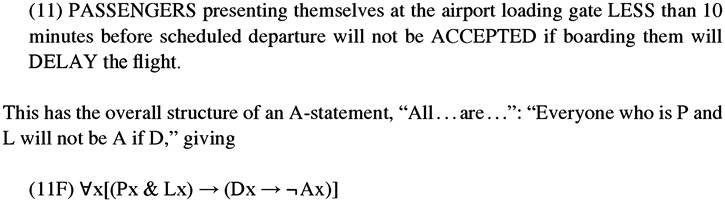
The symbolization is simplified if we are allowed to assume that we are only concerned with passengers, so that this constitutes the universe of discourse:
(12) Passengers presenting themselves at the airport loading gate LESS than 10 minutes before scheduled departure will not be ACCEPTED if boarding them will DELAY the flight. (UD: passengers)

19.1.2 ‘ANY’
This little word is surprisingly problematic. You were probably thinking that it should always be translated by a universal quantifier, as in the first of the following statements:
(13) Anything CONCERNING the theatre INTERESTED Diderot.

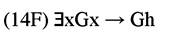
(14) If anyone was a GREAT guitar player, Hendrix was. [UD: guitar players]
But what about the second statement, would symbolize
(15) If everyone was a GREAT guitar player, Hendrix was.
This is trivially true, because it is false that everyone was a great guitar player, whereas (14) makes a substantive claim for Hendrix’s lasting glory. What it seems to mean is that if there was someone who was a great guitar player, then Hendrix was. So it could be symbolized as
Thus as a general rule of thumb, we may note:
If ‘any’ can be replaced by ‘some’ without altering the meaning of a statement, then it should be translated by an existential quantifier.
Good examples of this are provided by negative statements involving ‘any.’ For instance,
(16) There aren’t any books on RESERVE for this course. [UD: books for this course]  whereas -і VxRx would symbolize “Not all books for this course are on reserve”—i.e., that some are not on reserve.
But, going back to the previous example, what about Vx(Gx → Gh)? (Notice the arrangement of parentheses here.) This seems to say that, for each guitar player, if that player was a great guitar player, then Hendrix was. Isn’t that the same thing as ΞxGx → Gh? If it is, we should be able to prove one abstract statement from the other, and vice versa. We’ll do this in the next section.
SUMMARY _______________________________________________________________
• A wide range of statements can be symbolized with the resources we already have, going well beyond the traditional categorical logic. For instance Ξx-∣Hx translates “There are some people who haven’t heard of Freud,” and Vx(Hx v Bx) translates “Everyone has either heard of Freud or is a backwoodsman” (with Hx := X has heard of Freud, Bx := x is a backwoodsman; UD: people).
•  translates “If anyone was a GREAT guitar player, Hendrix was” (UD: people), implying the rule of thumb:
• If ‘any’ can be replaced by ‘some’ without altering the meaning of a statement, then it should be translated by an existential quantifier.
EXERCISES 19.1
!.Symbolize the following statements:
(a) Everybody is GUILTY.—Albert Camus [UD: people]
(b) There are WEREWOLVES.
(c) There are pilots with an ALCOHOL problem. [UD: pilots]
(d) There is no such thing as SOCIETY.—Margaret Thatcher [UD: things]
(e) Not all PROSTITUTES are JUNKIES.—Newspaper
(f) He LIVES well who is well HIDDEN.—Descartes’ motto [UD: people]
(g) Only those who are well HIDDEN LIVE well.
[UD: people](h) All non-TICKET-holders should LINE up at the booth.
(i) No one without TICKETS should LINE up at the booth.
(j) No MURDERED child or DYING father POISONED his love of the Lord.— Marshall Sella, 1997
(k) A member OfPARLIAMENT who behaves as a strictly HONEST man is regarded as a FOOL.—James Boswell
(l) Paul Revere, American HERO and PATRIOT, was also a MIDDLECLASS BUSINESSMAN who had mouths to FEED.—Marcella Bombardieri, Boston Globe
(m) Everything GOOD in Christianity comes from either PLATO or the STOICS.— Bertrand Russell
(n) Some HUSBANDS are IMPERIOUS and some WIVES PERVERSE.—Samuel Johnson
(o) Any pilot, MUSLIM or CHRISTIAN, who sees he is heading toward TROUBLE, will say religious PRAYERS.—Yusri Hamid, Egypt Air pilot [UD: pilots]
(p) WOMEN with long FINGERNAILS never make MEAT loaf, and they have HUSBANDS who make over $50,000 a year.—Erma Bombeck [Mx := x sometimes makes meatloaf]
(q) A crime is a MISDEMEANOR if and only if it is not punishable by DEATH or IMPRISONMENT in a state penitentiary.—Webster’s Dictionary [UD: crimes]
(r) If anyone’s to BLAME, I am. [UD: people; Bx := x is to blame, і := I]
(s) There isn’t anyone in this ROOM. [UD: people; Rx := x is in this room]
(t) There isn’t anyone in this ROOM who has never SINNED. [UD: people; Rx := x is in this room, Sx := x has sinned at some time]
(u) No one whose TESTICLES are crushed or whose male MEMBER is cut off shall ENTER the assembly of the Lord.—Holy Bible, Deuteronomy 23:1 [UD: men]
(v) Every man I meet is either MARRIED, too YOUNG, or he wants to do my HAIR.—Doris Day [UD: men; Dx := x is met by Doris Day]
2. Using the symbolizations suggested, translate (a) from English IntoPredicateLogic, and then use the same interpretations of the symbols to render (b) from Predicate Logic into colloquial English:
(a) If there are no UNICORNS, then all unicorns use BLACKBERRIES.

3. Using the dictionary provided, translate (a)-(c) from English into Predicate Logic, and then use the same interpretations of the symbols to render (d)-(f) from Predicate Logic into colloquial English:
(a) Only logicians who wrote CHILDREN’S books are FAMOUS.
(b) All logicians who wrote children’s books with an INSPIRED imagination are famous.
(c) The necessary and sufficient conditions for Lewis Carroll’s being FAMOUS are that he was a logician who wrote CHILDREN’S books and had an INSPIRED imagination.
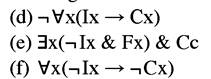
[Dictionary: UD: logicians; C := wrote children’s books, F := is famous, I := had an inspired imagination]
19.2
More on the topic NON-CLASSICAL STATEMENTS:
- NON-CLASSICAL STATEMENTS
- Index
- Arthur R.T.W.. An Introduction to Logic: Using Natural Deduction, Real Arguments, a Little History, and Some Humour. Broadview Press,2016. — 456 p., 2016
- Contents
- QUANTUM LOGIC
- Intuitionistic logic
- STUMBLING DOWN THE AUDIT TRAIL
- Alai M., Buzzoni M., Tarozzi G. (eds.). Science Between Truth and Ethical Responsibility: Evandro Agazzi in the Contemporary Scientific and Philosophical Debate. Springer,2015. — 337 pp., 2015
- Two Concluding Remarks
- Conclusion