NON-EMPTINESS OF THE UD
One final consideration: we have said that universal statements do not in general entail the corresponding existential statements, although in many and perhaps most contexts it is presumed that the class denoted by the subject term is not empty.
A similar analysis applies to cases where we have restricted the UD so that it includes only individuals from the class denoted by what was the subject term. This is easier to explain by examples. Take Leibniz’s famous Principle of Sufficient Reason: “Nothing happens without a sufficient reason why it should be thus rather than otherwise,” or more briefly,“Everything that HAPPENS has a SUFFICIENT reason.”
This could be symbolized:

From (1) we cannot get to the corresponding !-statement, “Something that happens has a sufficient reason”

without making the assumption ΞxHx an implicit premise in our reasoning. But that’s fine, since obviously Leibniz is presuming that some things do happen! This corresponds to the fact that in our logic diagram we have to assume that there is at least one thing that H’s, an X in the H region, in order for it to follow:
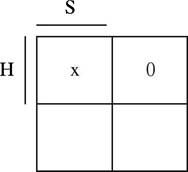
But what if we restrict the UD to things that happen? In that case, we can derive “Some thing that happens has a sufficient reason” from “Everything that happens has a sufficient reason” as follows:
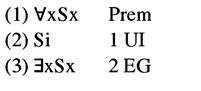
(Since there are no restrictions on UI or EG, in this proof any individual at all could have served for the instance in line (2).)
It is therefore not the case that we can never derive an existential quantification from a universal one, nor even that we cannot derive an !-statement from the corresponding А-statement.
We can if we assume that there is at least one individual satisfying the original subject term of the А-statement, or equivalently, once we have restricted the UD, if we assume that the restricted UD is non-empty.[81]This can be seen when we do a Carroll diagram for this case: in order for the conclusion to follow, we have to make the assumption that the restricted UD is non-empty. In other words, in the diagram, we must put an x somewhere in the UD, which means in the region S. The argument is valid if and only if we can assume, as an added implicit assumption, that the restricted UD is non-empty, i.e., that there is at least one thing that happens.
UD: things that happen
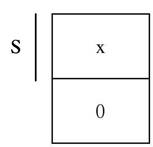
We can summarize this by saying that in any case where an existential conclusion is being derived from universal premises, it is presupposed that the class denoted by the subject term is not empty, or equivalently, when we have restricted the UD to members of that class, that the UD itself is non-empty. The argument will be valid only on that assumption; if making explicit on the diagram that there is an x somewhere in the restricted UD makes the argument valid, then it is penevalid. (In such a case the x must be entered last, and must straddle any remaining empty regions of the diagram.)
As an example, let’s investigate the validity of the following argument:
No foods containing TRANSFATS are GOOD for your health.
Nothing that isn’t good for your health is RECOMMENDED by the nutritionist. Therefore some foods recommended by the nutritionist are good for your health.
Here it is natural to take the UD to be foods, and the Carroll diagram of the premises is:
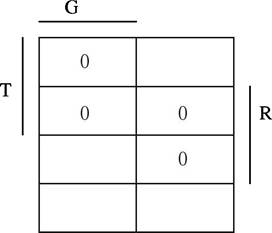
No existential conclusion is validly derivable as it stands. But is it penevalid? If the nonempty subject term is taken to be “foods containing transfats,” we should enter an ix, in the top right hand comer TGR.
Applying the Principle of Charity, it seems reasonable to think this is being presupposed. But this will not allow us to infer the conclusion. What if what is being presupposed is that there are foods that are not good for your health? In that case the ix, will have to straddle the top and bottom right squares, TGR andTGR. But these will not be foods recommended by the nutritionist, so it still will not yield a valid argument. This exhausts what we can allow by applying the Principle of Charity, and we conclude that the argument is invalid.The same result is obtained if we restrict the UD to foods containing transfats. The resulting Carroll diagram is UD: foods containing transfats
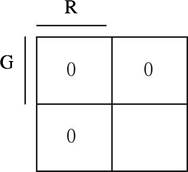
If we grant that it is being presupposed that there are foods that are not good for your health, this puts an ix, in the bottom right hand comer. But this does not entail that some R are G, so the argument is invalid.
SUMMARY
On the interpretation adopted here
• Universal (A- and E-) statements have no existential import.
• Particular (I- and O-) statements do have existential import.
Consequently:
• The traditional notion of conversion by limitation fails: An А-statement does not generally entail an !-statement, nor does an E-statement generally entail an О-statement. They are not subalternates of one another.
• An А-statement and its corresponding E-statement are not contraries.
• An !-statement and its corresponding О-statement are not subcontraries.
• But it remains true that an A-statement and its corresponding O-statement are contradictories, as are an !-statement and its corresponding E-statement.
Finally:
• Arguments whose validity depends on the class of the subject term S being known to be non-empty are calledpenevalid. They are interpreted as enthymemes with an implicit premise ΞxSx.
• In order to test the validity of such an argument by the Carroll diagram method, the non-emptiness of the class of the subject term S must be represented explicitly on the diagram by placing an ix, (disjunctively) in any remaining non-empty cells in S; if the argument comes out valid when that is done, then it is penevalid.
• When an argument is symbolized by restricting the UD to the members of the subject class S of one of the universal quantifications in the original argument, the argument will be penevalid if and only if the restricted UD is assumed to be non-empty. On a logic diagram, the non-emptiness of the UD must be represented explicitly on the diagram by placing an ix, (disjunctively) in any remaining nonempty cells of the restricted UD.
EXERCISES 18.2
The arguments in 17-21 are penevalid. (i) Using Carroll diagrams, determine in each case the one-predicate existential premise that would render it valid, (ii) symbolize the argument together with this implicit premise, and (iii) prove its validity using predicate logic.
17. Some philosophers have held that every meaningful word is a name. The following argument is offered in refutation:
PREPOSITIONS are not NAMES, but they are MEANINGFUL. This proves that some meaningful words are not names. [UD: words]
18. No HORNED dinosaurs are FLESHEATERS. All flesheaters SCARE children. Therefore some dinosaurs that scare children are not homed. [UD: dinosaurs]
19. All BIRDS are MAMMALS. But birds have HOLLOW bones. Therefore some mammals have hollow bones.
20. No FUNDAMENTALISTS are ATHEISTS. No non-atheists argue RATIONALLY. Therefore some fundamentalists do not argue rationally.
21. All BIRDS are WARM-blooded. OSTRICHES cannot FLY. No creatures but birds are ostriches. Therefore some warm-blooded creatures cannot fly.
22. Lewis Carroll declares the following argument valid. Show that it is penevalid:
No MONKEYS are SOLDIERS. All monkeys are mISCHIEVOUS. Therefore some mischievous creatures are not soldiers. [UD: creatures]
23. Re-analyze argument 19 above, restricting the UD to BIRDS. That is, prove it is penevalid by (i) representing the argument with this restricted UD on a Carroll diagram, (ii) representing the non-emptiness of the UD on the diagram, and (iii) showing that the conclusion cannot now be denied.
24. Re-analyze argument 20 above, restricting the UD to FUNDAMENTALISTS. That is, prove it is penevalid by (i) representing the argument with this restricted UD on a Carroll diagram, (ii) representing the non-emptiness of the UD on the diagram, and (iii) showing that the conclusion cannot now be denied.
For exercises 25-28 use Carroll diagrams to determine whether the argument given is valid, penevalid, or invalid:
25. No DINOSAURS are ALIVE today. Some REPTILES are alive today. Therefore some dinosaurs are not reptiles.
26. No VEGANS eat MEAT. All VEGANS refuse DAIRY foods. Therefore some people who refuse dairy foods are Vegans.
27. Only BELIEVERS are FUNDAMENTALISTS. Some non-believers are ATHEISTS. Therefore some atheists are not fundamentalists.
28. Only BELIEVERS are FUNDAMENTALISTS. All non-believers are ATHEISTS. No fundamentalists argue RATIONALLY. Therefore some atheists argue rationally.
29. Two statements are said to be contraries if they cannot both be true, i.e., if the truth of one entails the falsity of the other. Traditionally, an А-statement and its corresponding E-statement were held to be contraries. But on the modern interpretation of existential import, an А-statement and its corresponding E-statement can both be true if there are no individuals in the subject category. Prove this by proving that
Vx(Sx → Px), Vx(Sx → -і Px) H -∣ΞxSx
30. (CHALLENGE) Two statements are said to be subcontraries if they cannot both be false, i.e., if the falsity of one entails the truth of the other. Traditionally, an !-statement and its corresponding O-statement were held to be subcontraries. But on the modem interpretation the falsity of an !-statement entails the corresponding O-statement if and only if there are individuals in the subject category. Prove that existence of the individuals in the subject category is a sufficient condition by proving that
-∣?x(Sx & Px), ΞxSx H Ξx(Sx & -∣Px)
31.
(CHALLENGE) In a letter to T. Fowler, author of a well-known nineteenth-century logic book, Lewis Carroll wrote objecting against Fowler’s interpretation of the copula “are” as not connoting any actual existence: “According to this view the Propositions ‘all x are y,’ ‘some x are y,’ mean ‘ if any x exist, all of them are y,’ ‘ if any X exist, some of them are y.’”Now suppose my (empty) purse to be lying on the table, and that I say
“All the sovereigns in that purse are made of gold;
All of the sovereigns in that purse are my property;
:. Some of my property is made of gold.”
Carroll takes this to be a valid syllogism, and objects that on Fowler’s interpretation “though these two premises are true, the conclusion may very easily be false: it might easily happen that I had much ‘property,’ but that none of it was ‘made of gold.’” [On Carroll’s own interpretation, A- and !-statements have existential import, but E- and О-statements do not.] Explain how the interpretation of existential import offered in the text could resolve this dispute.