DISJUNCTION
Disjunctive Syllogism is a rule for eliminating a disjunction. Is there a rule for introducing one? Yes, there is. It’s so simple that it appears fishy, so I’ll introduce it somewhat obliquely.
Consider statement (2) of the previous section, “If either the BULB has gone or the FUSE has blown, the LIGHT won’t come on,” symbolized (B v F) Assume this is true, and that we discover that the fuse has indeed blown. We should be able to infer that the light will not come on. But when we try a proof we become stuck: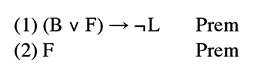
We should be able to get to But to do so we need to acknowledge that, knowing that the fuse has blown, we of course also know that either the bulb has gone or the fuse has blown. For to assert a disjunction is to assert that one or the other (or both) of the disjuncts is true; so if we know one is true, we know the disjunction of this with another statement—any other statement—is also true. This is the rule
Disjunction (Disj)
From any statement, infer its disjunction with another statement.
In symbols:
From p (stated alone), infer p v q.
From q (stated alone), infer p v q.
The validity of this argument form is established as follows: one cannot assert p to be true and at the same time deny that eitherp or q is true; similarly, one cannot assert q to be true and at the same time deny that either p or q is true. The argument form is therefore valid by our definition of formal validity.
With this rule we can complete the above proof:
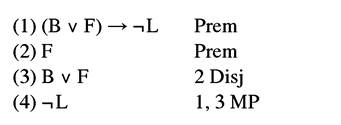
The reason this rule appears fishy at first is that, once we are given the first disjunct, the disjunction follows whatever the second disjunct is.
The second disjunct appears to come out of thin air. I think what confuses us is that to form a disjunction, we need to have both of the disjuncts, and the wedge connecting them. But this is about inferring the disjunction; we are concerned with rules of inference, not rules of formation. Secondly, the rule is unfamiliar. I think this is because it is weaker to assert BvF than it is to assert B, and we are not used to inferring something weaker, and thus losing information. But the above proof shows that we sometimes need to; and the reasoning justifying the rule is completely consistent with what is meant by disjunction.Now I should mention a PITFALL FOR THE UNWARY. There are many analogies between conjunction and disjunction. For some students, there is an overwhelming temptation to regard the analogy as complete. So they imagine there is a counterpart to Simplification'.
NOTA VALID RULE OF INFERENCE! 1
From a disjunction infer either one of its disjuncts.
In sym bols: YO W!
From p V q infer p alone; from p v q infer q alone.
This is UTTERLY INVALID! From the true statement that I am either a philosopher or a billionaire, you cannot validly infer that I am a billionaire! Here’s an example of a proof that contains both it and another error. As an exercise, see if you can spot them before reading on:
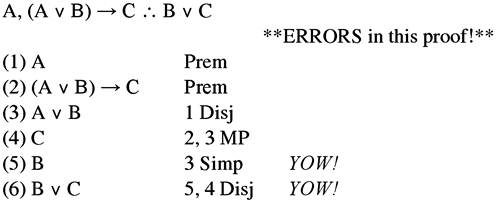
The invocation of ‘Simp’ in line (5) is the utterly invalid move just described; but also in line (6) there a confusion between Disj, which needs only one of the disjuncts, and Conj, which needs both. A valid proof would have the same first four lines, but would end:

6.2.3 DE MORGAN’S LAWS
A third rule of inference concerning disjunction was implicit in what I said in section 1 about denying a disjunction: to deny a disjunction is to assert that neither of the disjuncts is true, i.e., that they are both false.
Similarly, to deny a conjunction is to deny one or the other or both of its conjuncts. Thus we have the pair of rules known as De Morgan’s Laws:De Morgan’s Laws (DM)
(1) From the denial of a disjunction, infer the conjunction of the denials of each of its disjuncts, and vice versa.
(2) From the denial of a conjunction, infer the disjunction of the denials of each of its conjuncts, and vice versa.
In symbols:

Notice how this differs from the action of negation in algebra, where
There we say that the negation “distributes” across addition. One way to remember De Morgan’s Laws is as follows. When distributing across a conjunction p & q, the & turns into a v; and when distributing
 across a disjunction p v q, the v turns into an &. But I find it easiest to remember them by the following formulas:
‘Not either’ is equivalent to ‘neither.’
‘Not both’ is equivalent to ‘either not one or not the other.’

We will prove the validity of De Morgan’s Laws later by deriving them using our other valid rules of inference. They are named after the nineteenth-century English logician Augustus De Morgan. Actually they were known in antiquity; they are given his name in recognition of his contributions to the development of modem logic.
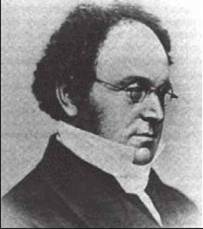
Augustus De Morgan (left) was born in Madurai in India, where his father served for the British East India Company. Apart from his contributions to logic, in which he was a founder of the algebra of relations, he is known for introducing the term “mathematical induction,” and has a crater on the moon named in his honour.
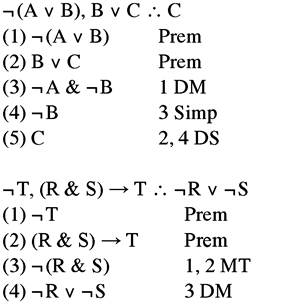
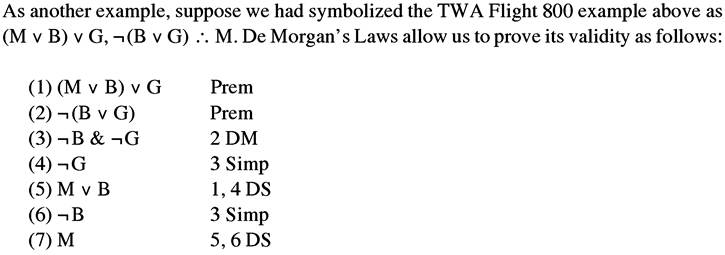
Here are proofs of two abstract arguments that put De Morgan’s Laws into action:
SUMMARY
• The rule of inference Disjunction (Disj) is
Fromp (stated alone), inferp v q*9 from q (stated alone), inferp v q:
From any statement, infer its disjunction with another statement.
• The validity of this argument form follows from our definition of formal validity: it is impossible for p v q to be false if p (resp. q) is true.
• The rule of inference Disjunctive Syllogism(DS) is
Fromp V q and , infer q*9 fromp v q and
 inferp:
From the assertion of a disjunction and the denial of one of its disjuncts, infer the other disjunct.
• The validity of this argument form follows from our definition of formal validity: it is impossible for p v q to be true, and yet for both p and q to be false.
• De Morgan’s Laws (DM) are the rules of inference:
From and vice versa:
From the denial of a disjunction, infer the conjunction of the denials of each of its disjuncts, and vice versa; and
From and vice versa:
From the denial of a conjunction, infer the disjunction of the denials of each of its conjuncts, and vice versa.
• The validity of De Morgan’s Laws will be proved later by deriving them from our other valid rules.
• The argument form ж jt is INVALID∖
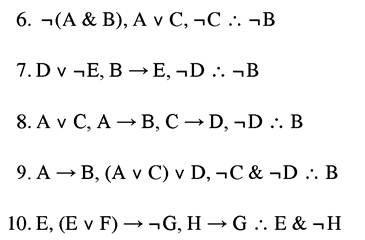
EXERCISES 6.2
Prove the validity Ofthefollowing abstract arguments:
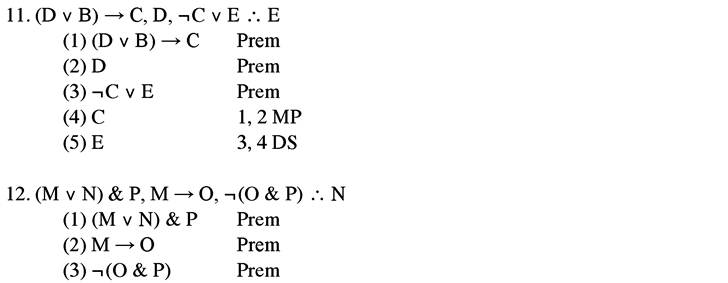
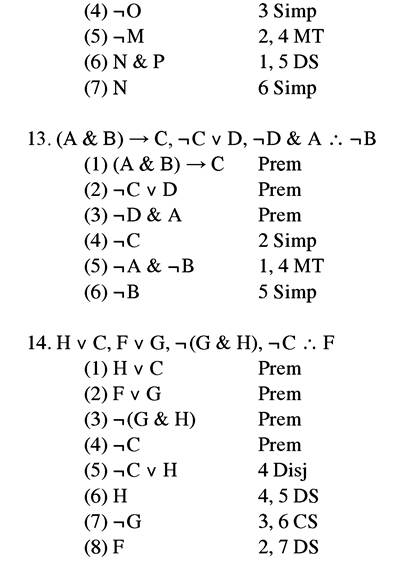
In the following erroneous proofs, (a) identify the mistakes made in applying rules of inference, and (b) provide a correct proof of the abstract argument given.
15.
An article in the Miami News reports the difficulties of a married couple contending with an unplanned birth:About a year ago, their troubles began. Mrs. Mathias was having medical problems, and went to a doctor who told her “she either had a tumor or was pregnant,” Mr. Mathias said. “We were scared because she couldn’t be pregnant and we thought it had to be a tumor,” he said.[26]
Symbolize and prove the validity of the Mathias's reasoning.
16. “If ANYONE knows anything about anything,” said Bear to himself, “it’s OWL who knows something about something,” he said, “or my name’s not Winnie-the-POOH,” he said. “Which it is,” he added. “So there you are.”[27]
Symbolize and prove the validity of Pooh’s reasoning.
17. Symbolize the following argument and prove its validity.
Either Clarkson travelled at her OWN expense or it was paid for by Canadian TAXPAYERS. If she had gone at her own expense, then she would have flown in a COMMERCIAL jet. But she flew in a GOVERNMENTjet. Clearly if she did that she did not fly in a Commercialjet, so we can conclude that Clarkson’s travel was paid for by Canadian taxpayers.
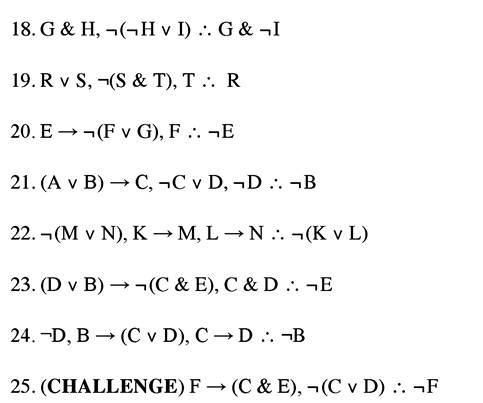
Prove the validity of the following abstract arguments:
26. (CHALLENGE) One of the reasons De Morgan’s Laws were not better known in antiquity is that they are not valid for alternations (exclusive disjunctions). They were therefore not part of Stoic Logic, which adopted the exclusive as opposed to the inclusive ‘or.’ As we shall see below, De Morgan’s Laws are examples of equiva- 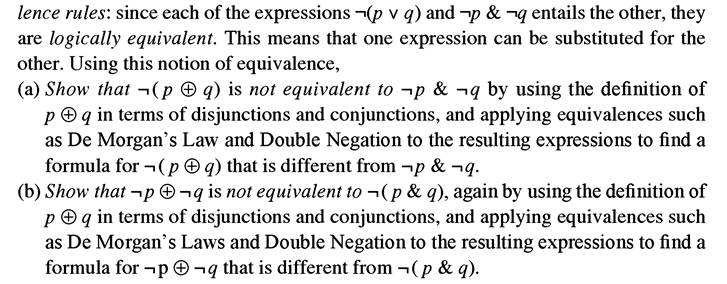
Chapter Seven