DISJUNCTIVE SYLLOGISM
In the last section we said that to assert a disjunction is to assert that one or the other or both the disjuncts are true. But this means that if we know in addition that one of the disjuncts is false, then the other one must be true.
This is the foundation for the following rule (also true for alternations), noted by Chrysippus the Stoic: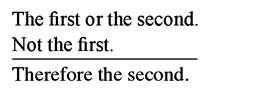
For instance:
Either wealth is an EVIL or wealth is a GOOD; but wealth is not an evil; therefore wealth is a good.—Sextus Empiricus, Against the Logicians

The formal validity of this argument is established as follows: it is contradictory to assert EvG and at the same time to deny E and G; therefore it is contradictory to assert EvG and -і E and also deny G. The rule of inference encapsulating the validity of this form is
Disjunctive Syllogism (DS)
From the assertion of a disjunction and the denial of one of its disjuncts, infer the other disjunct.
In symbols:
From p V q and -∣p, infer q.
From p V q and -∣g, infer p.
Here’s an example. When Galileo pointed his telescope at the heavens in the early seventeenth century, he was able to observe all the phases of the planet Venus, thus proving that it goes around the sun (and not, as in the Ptolemaic system, around the earth). Physics Professor Verne Booth explains:
This was a triumph of the greatest importance for the Copemicans, for in the Ptolemaic system Venus could never get far enough away from the sun to show a full phase. The fact that Venus displays a full set of phases constitutes the one conclusive proof that it revolves around the sun.
Restating to bring out the underlying logic:
Either the PTOLEMAIC system is correct, or Venus revolves around the SUN.
If the Ptolemaic system is correct, Venus could never get far enough away from the sun to show a FULL phase. The fact that Venus displays a full set of phases constitutes the one conclusive proof that it revolves around the sun.Symbolized:
A proof would proceed as follows:
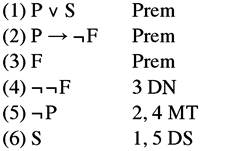
The sharper among you may have noticed that the alternatives in the first statement are mutually exclusive: if P is true, S is false, and vice versa. You may then have wondered whether anything is lost in representing what is strictly an alternation as a disjunction. Let’s see. If we had made the exclusive ‘or’ explicit, (1) would have been symbolized (P V S) & -і (P & S). This would have required us to put in an extra step (numbered (O) here):
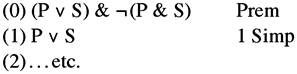
Clearly, putting in this extra step doesn’t affect the logic of this proof. This is because DS is a valid rule for alternations as well as disjunctions. So in this case no harm comes from having represented the first premise as a disjunction, nor will it if the only rule being applied is DS. In contrast, the following rule identified by the Stoics is valid only for alternations: 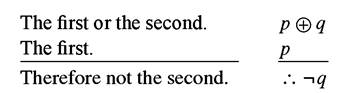
This rule is NOT valid for disjunctions, precisely because the disjuncts are not mutually exclusive alternatives. However, note that if we represent an alternation in terms of disjunction, we have to explicitly include the fact that we have “Not both the first and the second,” since p © q is represented by (p v q) & -∣ (p &q). But then we have
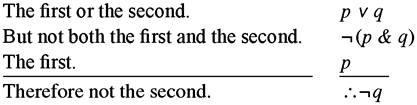
the last three lines of which are simply conjunctive argument.
Therefore this rule is simply subsumed under the CS rule. What all this means in practice is that in symbolizing an argument you can simply assume that you are dealing with disjunctions, unless the argument rides on the exclusivity of the disjuncts. That will be made clear by an expression like “but not both.” But as soon as you make this explicit, DS and CS can do the job.Here’s a slightly harder example.4 The top FBI official investigating the crash of TWA flight 800 off the coast of New York in July, 1996, announced four months later that mechanical failure was the most likely cause of the crash. Like the fictional investigator Sherlock Holmes, he reasoned by eliminating the alternative possibilities:
The crash was caused either by a MECHANICAL failure, or a BOMB, or a GUIDED missile. But the evidence shows that it wasn’t caused by a bomb, nor was it caused by a guided missile. So the cause was mechanical failure. 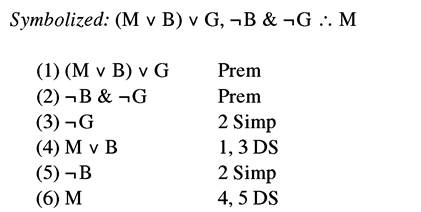
You may be wondering why I symbolized this as (M v B) vG, rather than M v (B v G). Actually, these formulas are equivalent: each entails the other, as we’ll soon prove. I chose the one that was more convenient for the proof. [Note that we could have symbolized the second premise as in that case it would have been more convenient to symbolize the
first as M V (В V G), since then M would follow from these two premises in one line by DS.]
4
This example is due to Howard Pospesel, Propositional Logic (3rd ed., Inglewood Cliffs: Prentice Hall, 1998), p. 132.
6.2.2