EVALUATING EXTENDED ARGUMENTS
At this point we turn from our consideration of single-inference arguments, and go back to extended arguments involving more than one inference. In the last section of chapter 1 we looked at a very useful method for analyzing such arguments, where we represent their inference-structure by means of diagrams.
In this method, each inference is represented by a downward-pointing arrow, going to each inferred statement from the premise(s) or reason(s) given in support of it. It is important not to confuse these downward-pointing arrows i 4,’ which represent inferences, with the horizontal arrows ς→∕ which represent implications. As explained at the end of the previous chapter, I may assert an implication, say “If BLACK holes do not exist, cosmology will need a complete OVERHAUL,” -∣B → O, without asserting -∣B and without inferring O. On the other hand, if I assert both the conditional containing the implication and the antecedent, from these one could infer the consequent by modus ponens. Then we would have the single-inference argument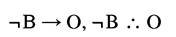
Now, in a single-inference argument, the inference-structure is straightforward: it simply goes from the premises, taken jointly, to the conclusion. So the above argument would be diagrammed:
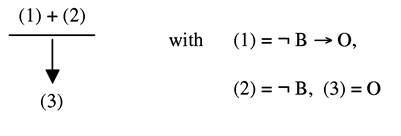
Here the downward arrow would represent the inference from the premises to the conclusion, which in this case we know is a valid one, since it is an instance of modus ponens. In other cases we will be able to prove inferences valid by symbolizing the numbered statements and using formal proofs.
Now let’s proceed to arguments having more complex inferential structures. Once we have identified all the inferences, we can ask whether each of these inferences is valid.
We will not generally be able to prove their validity: formal logic covers too little natural reasoning for that. But we will be able to apply the definition of validity in all cases to make an intuitive assessment: for a valid inference, the denial of the conclusion is incompatible with accepting all the premises. So for each inference we will be able to ask: given what seem to be appropriate standards of evidence, would it be possible to accept the premises and still deny the conclusion?1 Asking this question will often help to tease out implicit premises which, when granted, render the inference in question valid. As an example, consider the following argument by Chrysippus against Epicurus’ idea that atoms undergo causeless swerves in their motions, as reported by the Roman philosopher Cicero:(1) If there is a motion without a cause, not every proposition will be true or false. ∣For∣
(2) what will not have effective causes will be neither true nor false. But (3) every proposition is either true or false. ∣Therefore∣ (4) there is no motion without a cause.— Cicero, On Fate1
As usual, I have numbered the statements for ease of reference. I have also ∣boxed∣ the inference indicators ‘For’ and ‘Therefore.’ The ‘For’ indicates that (2) is given as a reason for (1), whilst the ‘Therefore’ indicates that (4) is intended as the main conclusion, which it seems on inspection we are to infer from (1) and (3) together. Thus there are two inferences, one from (2) to (1), the other from (1) and (3) together to (4). We represent each such inference by a downwards arrow, so: ∣. Then the inferential structure of the whole argument looks like this:
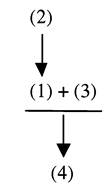
Now let’s investigate how good an argument it is. To do this we will work backwards from the conclusion. What is the argument for (4)? We see that it is supposed to follow from (1) and (3).
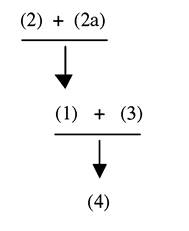
Does it validly follow? Could you deny (4) having accepted (1) and (3)? In fact, you should be able to prove that the inference from (1) + (3) to (4) is formally valid using statement logic. (Exercise: do that! Let M := there is a MOTION without a 1 2 [22] [23]cause, P := every PROPOSITION will be true or false; then this inference is: M → -∣P, P.,. -∣M.) This means we should accept the conclusion if we accept both (1) and (3). But there is a subsidiary single-inference argument for (1). Does it validly follow from (2)? Not as it stands; but it would be valid if we allowed an implicit premise, (2a) “if there is a motion without a cause, there is something that does not have an effective cause.” This seems true, and reasonable to assume as something too obvious to be worth stating. This would make the argument for premise (1) go as follows:(1) If there is a motion without a cause, not every proposition will be true or false. (For)
(2) what will not have effective causes will be neither true nor false, [and (2a) if there is a motion without a cause, there is something that does not have an effective cause].
Thus we have:
You have proved the inference from (1) and (3) to (4) valid. What about the inference to (1)? Rigorously, it is an argument in predicate logic. But we can approximate it in statement logic if we symbolize “there is a motion without a cause” by W, “every proposition is true or false” by P, and “everything has an effective cause” by E. Then the argument is basically This is valid—in fact it is an instance of
the rule of inference known as Hypothetical Syllogism, which we shall encounter later.
We can now give an evaluation of the argument. Since both inferences are valid, and (2a) is certainly true, then the only way we can resist the conclusion is for either (2) or (3) to be false, since these are the only other independent premises.
Personally, I would need further argument to convince me of the truth of (2). Interestingly, though, according to Cicero’s analysis, Epicurus effectively chose to accept (2) and deny (3), that every proposition is true or false: he introduced the idea of a causeless motion, or swerve, precisely to avoid the strict fatalism that Chrysippus embraced.Now let’s try some more complex examples, bringing together the techniques for analysis of real arguments we have learned so far: identifying inference indicators, premises, and conclusions; interpreting which parts of sentences are statements and which are phrases performing other functions, and rephrasing accordingly; construing parts of statements or rhetorical questions as statements; supplying missing premises and conclusions; and evaluating soundness of reasoning into validity of inferences and truth or
falsity of premises. We can restate all that as a procedure or method as follows:
(i) first, mark up the argument: bracket or box the∣inference indicator^, set the premises in, underline the conclusions, and double-underline the main conclusion.
(ii) supply any premises or conclusions that you consider to be implicit, i.e., necessary for the validity of an inference, and likely to be regarded as too obvious to be worth stating.
(iii) diagram the inference structure.
(iv) give an assessment of the validity of the argument. You need to evaluate whether each inference is valid, without necessarily being able to prove it by statement logic. Ask yourself, given what seem to be appropriate standards of evidence, would the premises be sufficient to convince me of the conclusion? (When you have been through this step, you may recognize the need for further implicit premises.)
Here’s an example:
In the long run, Mr. Lindsay argues, (1) lower inflation could make income distribution more equal. For one thing, (2) some of the measured gain in the incomes of the well-to-do has been caused by sharply higher interest income.
But (3) that income is partly compensation for the erosion of financial wealth from inflation and (4) would decline with declining inflation. For another, (5) the fact that housing would become more affordable should make the distribution of wealth more equal by spreading home ownership more widely.Here there are two independent lines of reasoning for the overall conclusion, introduced by “For one thing” and “For another.” This tells us that (1) is the overall conclusion, and (5) is the second reason given for it. But what of (2), (3), and (4)? (2) and (3) together entail (4), that the higher interest income of the wealthy would fall if inflation were lower, which is itself evidence for (1). This gives the following when it is marked up, with redundant material excised, and implicit material inserted:
(1) lower inflation could make income distribution more equal. ∣For one thing∣, (2). But (3) and (4). ∣For anothei∣, (5).
Diagram:
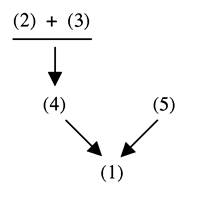
Evaluation:
Assuming (2) and (3) are true, (4) would seem to follow. This would make income distribution more equal, so (1) appears to follow validly from this. Again, if (5) is true, (1) seems to follow. So the argument appears valid.
(1) Nothing is demonstrable unless the contrary implies a contradiction. (2) Nothing that is distinctly conceivable implies a contradiction. (3) Whatever we conceive as existent, we can also conceive as non-existent. (4) There is no being, therefore, whose non-existence implies a contradiction. (5) Consequently there is no being whose existence is demonstrable.—David Hume, Dialogues Concerning Natural Religion (1779)
Here the inference indicators are “therefore” and “consequently” (which we box), and these indicate that the very last statement (5) is the overall conclusion, and that (4) is a premise for it. Does (4) entail (5) by itself? No, but it does entail it if (1) is true.
So (5) is inferred from (1) and (4) together. What about (4)? The “therefore” indicates that it follows from what precedes it, and it is readily seen that it follows from (2) and (3) together. This gives:(1) (2) (3) (4) 101" class="lazyload" data-src="/files/uch_group76/uch_pgroup316/uch_uch7361/image/image101.jpg">
Evaluation:
The inferences from (2) and (3) to (4), and from (4) and (1) to (5), seem valid. Can we then agree with the premises? (1) states a valid argument strategy (the reductio ad absur- dum, which we’ll study later), so we know this statement is true. I also cannot find any fault with (2) or (3), so I find myself obliged to accept Hume’s conclusion that we cannot demonstrate the existence of any being (including God) from first principles.
EXERCISES 5.3
Instructionsfor nos. 18-23: (i) mark up the argument: bracket or box the ∣ inference indicator^, number the statements (1), (2) etc., set the premises in, underline the conclusions, and double-underline the main conclusion', (ii) supply any premises or conclusions that you consider to be implicit, i.e., necessary for the validity of an inference and likely to be regarded as too obvious to be worth stating; (iii) diagram the inference structure', (iv) give an evaluation of the argument.
Example:
18. Democratic laws generally tend to promote the welfare of the greatest possible number; for they emanate from the majority of the citizens, who are subject to error, but who cannot have an interest opposed to their own advantage. The laws of an aristocracy tend, on the contrary, to concentrate wealth in the hands of the minority; because an aristocracy, by its very nature, constitutes a minority. It may therefore be asserted as a general proposition that democratic laws benefit more citizens than do aristocratic laws. —Alexis de Tocqueville, Democracy In America, ch. XIV, 1831
(i) (1) Democratic laws generally tend to promote the welfare of the greatest possible number; ∣for∣(2), (3) it is the wedge, v, that is the governing operator. IfB and F symbolize the component statements in (1), and L is “the light will come on,” (F2) and (F3) say quite different things; respectively,
(2) If the bulb has gone or the fuse has blown, the light won’t come on.
(3) Either the bulb has gone, or the light won’t come on if the fuse has blown.
Now often when we assert a disjunction we do not intend to rule out that both the dis- juncts might be true. Consider statement (1) again, for instance. The bulb’s having gone and the fuse’s having blown are two alternative explanations of the light’s not coming on, but they are not mutually exclusive possibilities. If it turned out that both explanations were correct, the real estate agent wouldn’t consider her statement (1) to be untrue. On the other hand, suppose she had said:
(4) Either my car keys are here in my HANDBAG or I must have LOCKED them in my car.
Here the alternatives are exclusive: if she found the keys in her handbag, she would infer that she had not locked them in her car.
This shows us that ‘or’ is used in at least two different ways in everyday language. The first statement is an example of the inclusive ‘or’: it includes the possibility that both the bulb is a dud and the fuse is blown. The second is an example of the exclusive ‘or’: it is understood to exclude the possibility that the keys might be both in the estate agent’s handbag and locked in her car. So we are confronted with a choice: Which of these two senses of ‘or’ should we take as the primary one for our purposes in logic? The Stoic logicians chose the exclusive sense; modem logicians have adopted the inclusive ‘or.’ Nothing important depends on the choice, since each can be expressed in terms of the other, using negation and conjunction too. Consequently we shall take the inclusive sense as basic, and adopt the following convention when symbolizing:
We shall always take disjunctions to be inclusive and symbolize them

Thus to assert a disjunction is to assert that one or the other or both the disjuncts are true; similarly, to suppose a disjunction is to suppose that one or the other or both the disjuncts are true; to deny a disjunction is to deny that either of the disjuncts is tme, i.e., to assert that neither of them is true. This motivates the rules of inference for disjunction that we will encounter in the next section.
We could, of course, have made the other choice, and taken the exclusive sense as basic. In fact the Stoic logicians of Ancient Greece did just this in formulating the first system of statement logic. Thus we could symbolize the exclusive ‘or’ by ©, and call any compound formed from A and B formed by the exclusive ‘or,’ A © B,1 an alternation (or exclusive disjunction). Having taken the inclusive sense as basic, however, we can still express the exclusive ‘or’ in terms of it. For the exclusive ‘or’ is either one or the other, but not both; in symbols:

Similarly, had we adopted the exclusive ‘or,’ we could have expressed the inclusive ‘or’ in terms of it: see exercise 5.
There is one case, however, where it does not matter whether we use the exclusive

Other uses of the word ‘or’ occur in ordinary language. One, the ‘or’ Ofequivalence, indicates that the two words it joins are equivalent in meaning, as in
The middle or soft commissure consists almost entirely of gray matter.[24]
Another is to express alternatives that are not presented as statements, especially in locutions involving “whether... or....”[25] Neither of these ‘ors’ will occur in an inferential context, however. When reasoning we would simply decide which of two terms marked by the ‘or’ of equivalence to use; and if the “whether... or...” occurred in the context of an argument, it would be recast as a regular disjunction: “either... or....”
So it is as well to be aware of these different ‘ors’; but you need not worry about them: unless you see a “but not both,” you may happily use the wedge in symbolizing arguments.

[1] Some logicians use the symbol Λ for the exclusive ‘or.’ It should be noted, however, that the conventions for logical signs are not yet uniform, and in many systems Λ is used instead of & to stand for ‘and’ and its synonyms.
• In English the word ‘or’ is often ambiguous between inclusive and exclusive senses. An exclusive disjunction (or alternation) is so called because it excludes the possibility that p and q are both true, whereas the inclusive ‘or’ includes this possibility.
• In symbolizing disjunctions, we always take them to be inclusive and symbolize them , unless they contain the phrase “but not both” (or an equivalent expression), in which case we shall symbolize them as
EXERCISES 6.1
1. Symbolize the following statements using the first letter of each capitalized word for the components:
(a) The man’s a SCOUNDREL, or my name is not AUGUSTA Davenport.—Philip Pullman, Count Karlstein
(b) The earth does not FEEL as if it is spinning, nor does the observational evidence SUGGEST any such thing.—Timothy Ferris, Coming of Age in the Milky Way, p. 34
(c)... all those things God revealed to the prophets, were revealed to them either in WORDS, or in VISIBLE forms, or in both words and visible forms.—Spinoza, Theological-Political Treatise ch. 1 (Curley, A Spinoza Reader, p. 12)
(d)... he will imagine now SIMON, or now JAMES,... but not both at once.—Spinoza, Ethics II, p. 126
(e) Neither REASON nor MATHEMATICS nor mAPS were any use to me.—Christopher Columbus (quoted from Ferris, Coming of Age, p. 55)
(f) If I speak in the TONGUES of men and of angels, but have not LOVE, I am a noisy GONG or a clanging CYMBAL.—Holy Bible, 1 Corinthians 13
(g) Anyone WITHOUT a labor book, or filling in his or her labor book INCORRECTLY, or making FALSE statements, will be PROSECUTED with the utmost vigor under the wartime regulations.—Boris Pastemak, Doctor Zhivago
(h) But if she LOST it, /Or made a GIFT of it, my father’s eye I Should HOLD her loathed and his spirits should hunt /After new FANCIES.—Shakespeare, Othello, Act III, Scene 4
(i) Either God EXISTS or there is no God.—Frederick Copleston, A History of Philosophy, p. 170 [Consider: is anything gained by making the exclusive character of this ‘or’ explicit?]
(j) Either we REINVENT our traditions of egalitarianism and liberalism to accommodate the realities of today’s global economy or... we will simply... either become another ECHO-IMAGE of the United States or become a region WITHIN it.—Richard Gwyn, Nationalism Without Walls: The Incredible Lightness of Being Canadian

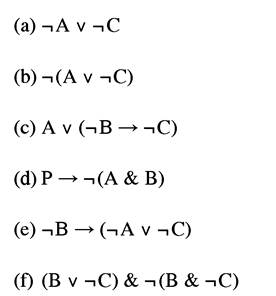
2. Identify the governing operator in each Ofthefollowing abstract statements:
3. For each of the following sentences that is or contains a disjunction, identify the disjuncts:
(a) Village greens or commons... are beloved features of many Vermont villages today... —Jan Albers, Hands on the Land
(b) Our own creations may soon turn on us and make us their slaves, or worse still, decide we are expendable.—John McCrone, review of QI: The Questfor Intelligence, Kevin Warwick
(c) The more reality or being each thing has, the more attributes belong to it.—Spinoza, Ethics II, p. 51
(d) Now, whether he kill Cassio, / Or Cassio him, or each do kill the other, / Every way makes my gain.—Shakespeare, Othello Act V, Scene 1
(e) It is estimated that between four and six tonnes of heroin is either processed in Turkey or transits through the country each month.—Guardian Weekly, September 2000
(f) The result of a professional hockey game should not be that we are lucky to escape paralysis or are lucky to have our eyesight, after wilful acts of violence.—Dallas Stars Center, Mike Modano
4. Render each formula (a)-(d) into a colloquial English Statement using the dictionary provided: 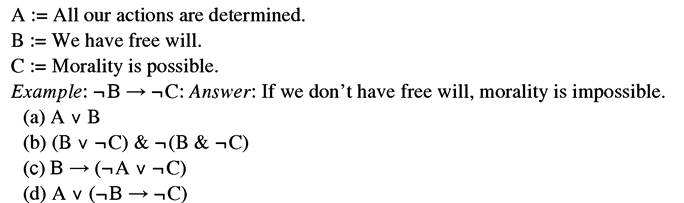
5. (CHALLENGE) As explained in the text, the Stoic logicians took as basic the exclu- 
6.2