RULES OF INFERENCE FOR CONJUNCTION
At the beginning of the last section we said that to assert a conjunction is to assert that both the conjuncts are true; and similarly, to deny a conjunction is to deny that both the conjuncts are true (i.e., to assert that at least one of them is false).
These two considerations motivate the rules of inference for conjunction. The first leads us to formulate two very obvious rules:Simplification (Simp)
From a conjunction, infer either one of its conjuncts.
In symbols: From p & q, infer p or infer q.
The inverse of this is
Conjunction (Conj)
From any two statements stated separately, infer their conjunction.
In symbols: From p and q stated separately, infer p & q.
The formal validity of these rules is trivial. We cannot assert that both p and q are true and then deny that p is true, or deny that q is true, on pain of contradiction. Likewise we cannot deny that p and q are together true having asserted them as premises without contradicting ourselves.
Here’s an example that puts both rules into action, a proof of the validity of the abstract argument:
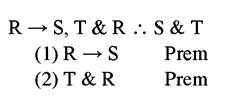
Here in order to Inferanythingfromthe conditional (1), we need to derive its antecedent first: 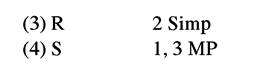
That’s half the conclusion. We also need

giving

With these two rules we can prove something intuitively obvious to us, namely that given p &q we can infer q8cp. (For those with an eye for connections with algebra, this proves the commutativity of &.) I’ll leave this as an exercise.
The second consideration mentioned above—that to deny a conjunction is to assert that at least one of the conjuncts is false—means that if one of them is known to be true, the other must be false. This is the grounds for the third rule of inference involving conjunction, first formulated by the Stoics as the third of their five basic argument schemata in the Third Century BCE:
Not both the first and the second
The first
Therefore not the second
For instance:
SNELL and DESCARTES cannot both have been the first to discover the Law of Refraction. Since Snell had discovered it earlier, it follows that Descartes was not the first discoverer of the law.

The formal validity of this argument is established as follows: it is contradictory to deny S & D and also to assert S and D; so it is contradictory to assert -∣(S & D) and S and also deny -∣D. This entails that the inference from -∣ (S & D) and S to -∣ D is formally valid by our definition. The rule of inference encapsulating the validity of this form is
Conjunctive Syllogism (CS)
From the denial of a conjunction and the assertion of one of its conjuncts, infer the denial of the other conjunct.
In symbols:
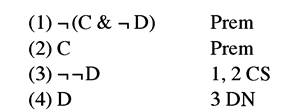
Here’s an example (abstracted from one of the exercises):
It is not true that God CAN act, yet DOES not. But God certainly can act. Therefore he evidently does.
Symbolized:

A proof would proceed as follows:
Here’s a harder example:
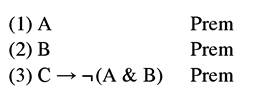
Nothing follows from these premises directly.
But looking at the conclusion you can see that we already have A, so we only need to prove -∣C. Now on examining the premises more closely, you can see that the first two give A B, which is equivalent to the negation of the consequent of (3), which will allow a Modus Tollens to -∣C. Thus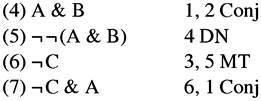
SUMMARY
• The rule of inference simplification (Simp) is
Fromp & q, infer either p or q.
From a conjunction, infer either one of its conjuncts.
• The validity of this argument form follows from our definition of formal validity: it is impossible for p to be false if p and q are both true.
• The rule of inference conjunction (Conj) is
From p and q stated separately, infer p & q.
From any two statements stated separately, infer their conjunction.
• The validity of this argument form follows from our definition of formal validity: it is impossible for p & q to be false if p and q are both true.
• The rule of inference conjunctive syllogism (CS) is
From -∣(p & q) andp,
From the denial of a conjunction and the assertion of one of its conjuncts, infer the denial of the other conjunct.
• The validity of this argument form follows from our definition of formal validity: it is impossible
13. In a cartoon, a man discovers an item in the newspaper:
Man: Uncle Phil! Didn’t you say the name of that doctor is Jackson Bamum Tufts? Uncle Phil: Yep, that’s the man. Is there somethin’ in the paper about him?
Man: Yes—a small item. He’s returning to Boston—from a three months stay in Switzerlandl
Uncle Phil: How can that be?
Man: That doctor couldn’t have been in Miami and Switzerland at the same time!
Uncle Phil: Omigosh!
What is Uncle Phil inferring? What rule of inference does this involve?
14.
In his Principles of Descartes ’ Philosophy, the great Dutch philosopher Bamch Spinoza presented one of Descartes’ arguments as follows:IfERROR were something positive, God would be its CAUSE, and by Him it would continually be PROCREATED. But this is absurd. Therefore error is nothing positive. By claiming that “this is absurd,” Spinoza is denying that God could be the cause of error and that error could be continually propagated by him. Use this information to symbolize and then prove the validity of this argument.
15. (CHALLENGE) In a rather rambling letter to the editor of Philosophy Now (no. 23, Spring 1999, p. 43), Don Crew writes:
“The position taken by my colleague Tristan Jones (Philosophy Now, no. 22) speaks of belief in an Omnipotent, Omniscient God and then adopts the Euclidian Cartesian position iGod cannot create a triangle with more than 180 degrees.’ This view is not consistent with the Theist position, that ‘for God all things are possible.’
If God cannot act he is not Omnipotent; if God can act and does not, he is not Good. Tristan Jones’ position is that of the non-realist; i.e., God is an anthropological phenomenon which provides social and psychological benefits to the believer.”
It’s hard to follow Crew’s reasoning. But let’s try this: Granting Crew the three implicit premises ‘God is OMNIPOTENT,’ ‘God is GOOD,’ and Tf God CAN and DOES act, then he REALLY exists,’ show that these together with the two statements contained in the first sentence of the second paragraph entail that ‘God really exists. ’
16. (a) Symbolize the explicit premise of the following enthymeme, rendering “if he were not” as “if there were a GOD who is not JUST”:
If there is a GOD, my dear Rhedi, he must necessarily be JUST; for if he were not, he would be the most WICKED and imperfect of all beings.—Baron de Montesquieu, Persian Letters
(b) Prove that if one grants Montesquieu the implicit premise that “there is a GOD and he is not the most WICKED and imperfect of all beings,” it follows from this together with his explicit premise (as rendered above) that “God must necessarily be JUST.”
17. (CHALLENGE) Prove the validity of the following argument, given by Leibniz in the early eighteenth century against Clarke’s claim that space is a property of God:
I have still other arguments against this strange imagination that space is a PROPERTY of God. If it be so, space belongs to the ESSENCE of God. But space HAS parts: therefore there WOULD be parts in the essence of God. [But this is not true.]
Here the “therefore” has to be interpreted as “in that case,” i.e., “if E and H.”
5.3