SYMBOLIZING CONJUNCTIONS
A conjunction is simply two statements joined by the statement operator ‘and,’ symbolized ‘&.’ The component statements are called conjuncts (from the Latin for things joined together).
We have already seen some examples in the exercises of chapter 2. For example, in the statement(1) “The DAYS of the Antichrist are finally at hand, and I am AFRAID, William!”
which we symbolize D & A, the conjuncts are D := “The DAYS of the Antichrist are finally at hand” and A := “I am AFRAID, William!” To assert a conjunction is to assert that both the conjuncts are true; similarly, to deny a conjunction is to deny that both the conjuncts are true, to suppose a conjunction is to suppose that both the conjuncts are true, and so forth.
‘And’ is not the only word we use in English to express conjunctions. Just as was the case with conditionals, there are many different ways of expressing them. Take, for instance, this statement by Stephen Jay Gould about a position he opposes:
(2) It’s a very deep position, but I also think it’s very deeply wrong.
When Gould asserts (2) he is asserting both that “It’s a very deep position” (P) and that (he thinks) “It’s very deeply wrong” (W). Similarly, anyone denying (2) would be denying that both statements are true (and thus effectively asserting that one or both of them is false). Note that the denial that both are true would be symbolized -∣ (P & W), and not -∣P & -і W, which would assert that both are false. Gould uses ‘but’ as opposed to ‘and’ to draw some contrast between the two. He might have expressed the same thing by
(3) Although it’s a very deep position, I think it’s very deeply wrong.
(4) Even though it’s a very deep position, I think it’s very deeply wrong.
(5) It’s a very deep position; yet I think it’s very deeply wrong.
(6) It’s a very deep position; however, I think it’s very deeply wrong.
(7) Not only is it a very deep position, but I also think it’s very deeply wrong.
All of statements (2) to (7) are expressed in standard form as
(8) It’s a very deep position, and I also think it’s very deeply wrong.
because this is the extent to which they could do work in an argument (as opposed to rhetoric). They all have the same logical force, if not the same rhetorical force. All are symbolized as P & W.
Here’s something I’ll be saying more than once: Language use is very plastic. Not every occurrence of ‘and’ should be symbolized by ‘&.’ Take the following threat issued by a character in one of Dickens’s novels:
(9) “Stand on your HEAD again, and I’ll CUT one of your feet off.”
The logical force of this is clearly the conditional H → C: “If you stand on your head again, then I’ll cut one of your feet off.” H & C would wrongly assert both that “You are standing on your head again” and that “I will cut one of your feet off,” losing the whole point of the threat. You just have to use some common sense in symbolizing. Two more examples of pseudo-conjunctions:
(10) Frankie and Johnny were sweethearts, (traditional folk song)
(11)... it meant having to try and steal that film back somehow. (Michael Ondaatje, The English Patient)
(10) is not equivalent to the conjunction of “Frankie was a sweetheart” and “Johnny was a sweetheart”; nor can (11) be read as conjoining “it meant having to try” with “steal that film back somehow.” Similar considerations apply to Heraclitus’ statement “The road up and the road down are one and the same.” In a similar vein, “I love pork and beans” is not the same as “I love pork and I love beans,” since what is loved is the combination, not each separately.
But sometimes, when what follows ‘and’ is not a statement, a conjunction really is what is meant. Thus
(12) “That goes for HARRY, and ME too.”
This would be paraphrased “That goes for HARRY, and that goes for ME too”: H & M.
Finally, there is a whole slew of statements that begin with ‘And’ or one of its synonyms, where the ‘And’ does not join two statements into a conjunction, but simply introduces the whole statement following.
The King James version of the Bible abounds with such statements, e.g.,(13)And the whole congregation of the children of Israel ASSEMBLED together at
Shiloh, and SET up the tabernacle of the congregation there.—Joshua 18: 1
You might be tempted to symbolize this as ‘& A & S,’ but that is ill-formed. Here only the second ‘and’ is our binary statement operator forming a conjunction. The first ‘And’ serves to connect this statement with those preceding it into a continuous narrative, and this is a function that an initial conjunction will often perform. Similarly, in the context of an argument, a beginning ‘And...,’ ‘But...,’ ‘Yet...,’ ‘Moreover,...,’ or ‘However,... ’ might also serve simply to link premises. Either way, it does not get symbolized. The proper symbolization of (13) is simply A & S (with outermost parentheses understood). Remember, each binary operator binds two statements and puts groupers around the outside, with the convention that the outermost groupers need not be explicitly written. Thus {A → [B & C]} is written A → [B & C].
SUMMARY
• A conjunction is any two statements joined by the binary statement operator ‘and.’ Symbolically, it is the compound statement p & q produced by the operation of the ampersand operator, on any two component statements, p, q, which are called coιιjuncts.
• In English a conjunction can be indicated not only by ‘and,’ but also by ‘but,’ ‘although,’ ‘even though,’ ‘yet,’ and equivalents.
• In writing the conjunction as p & q, the outermost groupers are understood. Remember, each binary operator binds two statements and puts groupers around the outside, with the convention that the outermost groupers need not be explicitly written. Consequently, when a conjunction is a component of a compound state- 
EXERCISES 5.1
1. Which of the following are conjunctions! For those statements that are, identify the conjuncts.
(a) And this is what I was trying to tell you, but you wouldn’t listen.
(b) He came into the room, put his hat on the peg, and slumped into a chair.
(c)Yet there was nothing we could do to persuade her.
(d) Your word is a lamp for my feet, and a light for my path.
(e) I hate vain thoughts, but I love your law.
(f) Let my soul live, and it will praise you.
(g) Although her teeth were crooked, she had lovely eyes, and a well-shaped nose. Example:
(a) Here the ‘And’ is not a binary operator. But the ‘but’ is. In standard form: this is what I was trying to tell you, and you wouldn’t listen.
2. Symbolize the following statements using the first letter of each capitalized word for the components, and the statement operators →, -∣, and &.
(a) She WETS her hands and COMBS water into her hair till it is completely wet.
(b) In the kitchen she doesn’t PAUSE but GOES through it and CLIMBS the stairs, ([a, b] from Michael Ondaatje, The English Patient)
(c) Names are to DISTINGUISH us from other men, and I am the ONLY man who exists or ever has existed.
(d) It ended, not in a NOZZLE as I almost expected, but in a HEAD of sorts.
(e) Fortunately, you might say, he shook me LOOSE, TEARING off the leg at the knee, and he didn’t SEE where the rest of me fell.
(f) I TIED up the stump and CRAWLED away, but Γm DONE, ([c-f] from George Gaylord Simpson, The Dechronization of Sam Magruder)
(g) Although Mulroney had PROMISED Canadians that his judicial appointments would be non-partisan, it was EVIDENT to Russell and Ziegel that this had been far from the case. (Stevie Cameron, On the Take)
(h) If you consider Japan as an EIGHT-hundred pound gorilla, the European community is a TWELVE-hundred pound gorilla, and far BETTER placed to benefit from the new opportunities in the old Soviet Union. (George Carver, Center for Strategic and International Studies)
(i) Of course, if Pluto were the ONLY object beyond Neptune, this explanation of its orbit, though COMPELLING in many of its details, would have remained UNVERIFIABLE.—Renu Malhotra, “Migrating Planets,” ScientificAmerican
(j)... if the members of some group have a COMMON interest or objective and if they would all be BETTER off if that objective were acHIEVED, it has been thought to follow logically that the individuals in that group would, if they were RATIONAL and SELF-INTERESTED, ACT to achieve that objective.—Mancur Olson, The Logic of Collective Action (F81) (H := that objective is acHIEVED)
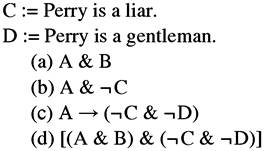
3. Render each formula (a)-(d) into a colloquial English Statement using the dictionary provided:
A := Cook is a liar.
B := Cook is a gentleman.
5.2
More on the topic SYMBOLIZING CONJUNCTIONS:
- SYMBOLIZING CONJUNCTIONS
- Contents
- Arthur R.T.W.. An Introduction to Logic: Using Natural Deduction, Real Arguments, a Little History, and Some Humour. Broadview Press,2016. — 456 p., 2016
- SYMBOLIZING
- STATEMENT OPERATORS