STATEMENT OPERATORS
In Statement Logic we are not concerned with compound statements of all kinds, but only a very delimited class of them. The point can be made by looking at some further examples from Eco’s The Name of the Rose:
(3) “I began to think [that] I had encountered a forgery.”
(4) “Ubertino could have become one of the heretics he helped bum, or [he could have become] a cardinal of the holy Roman church.”
Both of these are compound statements according to our definition.
In the first, any statement at all could have been substituted for “I had encountered a forgery” and the result would still be a meaningful statement. Similarly in the second, any statements could have been substituted for “Ubertino could have become one of the heretics he helped burn” and “he could have become a cardinal of the holy Roman church,” with a similar result. A good way of thinking of this is to imagine the words or phrases “I began to think that” and “or” as operators that work on statements to produce other statements. Such operators are usually called statement connectives (not a very good term, since the ones that operate on single statements do not “connect” them to anything!). We will call them statement operators.A statement operator is a word or phrase which operates on a statement or statements to form a compound statement.
Statement operators that form a compound by operating on only one statement are called unary; those that join together a pair of statements are called binary.
Thus the phrases “I believe that,” “It must be concluded that,” “It is not the case that” are all examples of unary operators: they turn single statements into other single compound statements. On the other hand, “... or...,” “... and...,” and “from... it follows that...,” are binary operators: each joins a pair of statements into a compound statement.
Now of all the myriad possible statement operators there are a few that hold special interest for us in statement logic.
Naturally these include the inference indicators we have already encountered, that is, the premise- and conclusion-indicators: “Consequently...,” “Therefore...,” “It follows that...,” “... since...,” and so forth. But in addition there are those that typically join together statements into the compound statements that constitute the premises and conclusion of commonly occurring single-inference arguments.There are precisely five of these operators that are basic to logical reasoning. They are: 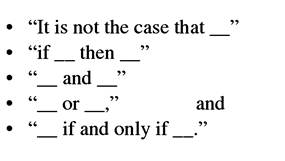 These five are distinguished from other phrases used to make compound statements by the fact that the truth value—that is, the truth or falsity—of any compound formed by them is a function only of the truth or falsity of their component statements. That is, for each combination of the truth values of the components there will be a unique truth value—true or false—of the compound. Consequently, these five operators are called truth-functional operators.
A truth-functional operator is one that forms a compound statement whose truth value is a function of the truth values of the component statements.
All other statement operators are (surprise!) non-truth-functional.
This distinction is best illustrated through examples. Statement (1) above is a compound statement formed from the phrase “Benno admitted that_______________________________ ” operating on the component statement “his enthusiasm had carried him away.” So “Benno admitted that_______ ”
is a unary operator. But when we prefix it to some other statement p, the truth value of the resulting compound statement “Benno admitted that p” depends on whether p is one of those statements that Benno admits! Contrast this with the compound formed from prefixing “[Benno’s] enthusiasm had carried him away” by the unary operator “It is not the case that
(5) “It is not the case that Benno’s enthusiasm had carried him away.”
Here if the component is true, the compound is clearly false; and if the component is false, the compound is true; and this is so for any statements that ½,e care to prefix with this operator.
This is what makes “It is not the case that ” a truth-functional operator.Similar (but not so trivial) considerations apply to the four binary truth-functional operators. We shall investigate how their compounds’ truth values vary with the components’ in a later chapter.
We have already seen how it is convenient to abbreviate statements by capital letters. In the same way it helps to have abbreviations for the five truth-functional operators. So we introduce special symbols for them, writing
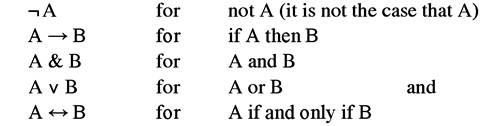
Here A and B stand for certain individual statements—any statements, compound or simple. Thus in A → B, statement A could be a compound statement. For instance, take the following statement by the ancient Greek Antiphon:
(6) If someone were to bury a bed and the rotting wood came to life, it would become not a bed, but a tree.—A Presocratics Reader, p. 105
Here if A is “someone buries a bed and the rotting wood comes to life,” and we symbolize “it becomes not a bed, but a TREE” by T, this gives A → T.[14] But A is itself a compound of two statements “someone is BURYING a bed” (B) and “the rotting wood came to LIFE” (L). So we may symbolize it as B & L. This would make the whole statement
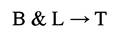
Looking at this formula, you may be wondering why you suddenly feel hungry. But you should also notice that it is ambiguous. If you plug back in the component statements, you could get the different statement
(7) Someone is burying a bed, and if the rotting wood were to come to life, it would become not a bed, but a tree.
This statement asserts that someone is actually burying a bed, whereas Antiphon was making no such claim. The ambiguity of formulas like B & L → T is easily removed by using parentheses, just as we do in arithmetic and algebra. The formula 3 + 2/5 can be disambiguated by distinguishing (3 + 2)/5 from 3 + (2/5): these yield the different values 1 and 3.4.
Similarly Antiphon’s statement (6) should be symbolized
whereas statement (7) is symbolized

Here I am using the notation (F6), for example, for the formula symbolizing statement (6). I have also introduced the convention that the capital letter symbolizing each individual statement will be the first letter of the capitalized word (sometimes part-word) in that statement. I will follow this convention from here on in this book. (I will make sure, however, that different statements are symbolized by different letters.) Thus the formula symbolizing statement (5), “It is not the case that Benno’s ENTHUSIASM had carried him away,” is
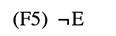
Note that we do not symbolize statement (5) by E, just because it is a negative statement, a denial. This invokes a further convention regarding symbolizing. This is that all statements Af Bf Cf... are to be positive assertions, rather than denials. Again analogously with algebra, the unary operator i-∣, does not need parentheses. There is nothing to be gained in clarity by writing ‘Not E’ as -∣ (E), rather than just plain -∣E. Nor would there be any gain in symbolizing “It is not true that something NEW had not occurred” by -∣ (—ι N), as opposed to plain -∣-∣N. On the other hand, parentheses are necessary for the negation of E & F, that is, —∣ (E & F), to distinguish it from -∣E & F.
Finally, there is no gain in clarity from writing parentheses around the outside of the whole of a compound statement standing by itself, e.g., by writing (F6) as
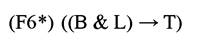
Nevertheless, we can understand such parentheses as being there implicitly in (F6) without having to write them in.
This means that it is neater to think of the binary operators as always introducing parentheses (or equivalent groupers, like [brackets] and {braces}), with the understanding that the outermost ones do not need to be written in explicitly. All of this can be summed up neatly by the following set of rules:Rules of statement formation 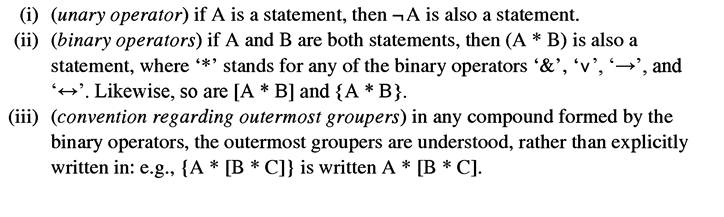
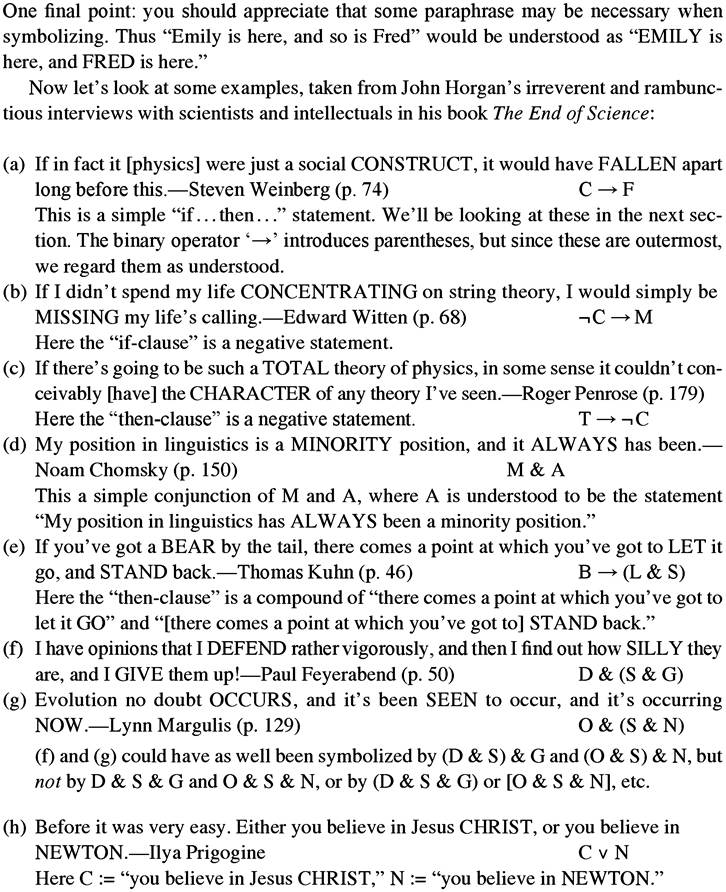
SUMMARY
• One statement is a component of another if substituting it within the original by any other statement whatever still yields a meaningful statement.
• A compound statement is any statement that contains one or more component statements.
EXERCISES 3.1
!.State whether each of the following statements from Michael Ondaatje’s The English Patient is simple or compound. Identify the component statements in each compound statement.
(a) She heard a far grumble of thunder, (p. 62)
(b) If a man leaned back a few inches he would disappear into darkness, (p. 143)
(c) In Canada pianos needed water, (p. 63)
(d) We stood up at the end and you walked off the table into his arms. (p. 53)
(e) He is a writer who used pen and ink. (p. 94)
Example:
(e) “He is a writer” is a statement, but is it a component statement? If we substitute for it, say, iiMalebranche was born in Paris,” we get iiMalebranche was bom in Paris who used pen and ink,” which is not meaningful. So it is not a component statement of (e), which is therefore simple.
2. Identify any statement operators in the following statements by various scientists quoted by John Horgan in The End of Science. In each case identify whether it is truth-functional or non-truth-functional, and whether it is binary or unary.
(a)[Bohm] insisted that reality was unknowable, (p.
90)(b)We still live in the childhood of mankind.—John Archibald Wheeler (p. 83)
(c) As we have discovered more and more fundamental physical principles, they seem to have less and less to do with us.—Steven Weinberg (p. 73)
(d) If Edward Witten is a philosophically naive scientist, Weinberg is an extremely sophisticated one... (p. 72)
(e) Since I know a little bit about global economic models, I know they don’t work! —Philip Anderson (p. 210)
(f) The situation cannot declare itself until you’ve answered the question.—John Archibald Wheeler (p. 82)
(g)It’s a very deep position, but I also think it’s very deeply wrong.—Stephen
Jay Gould (p. 136)
Example:
(g) ‘But’ is a binary operator, connecting “It’s a very deep position” with “I also think it’s very deeply wrong.” Since the whole statement can’t be true if either of the components is false, ‘but’ is truth-functional. “I also think it’s very deeply wrong” is also a compound statement, though, formed from the unary operator T also think [that]’ and “it’s very deeply wrong.” T also think [that]’ is clearly non-truth-functional.
3. Symbolize the following statements from Eco,s The Name of the Rose:
(a)“If from this conjunction a BABY was bom, the infernal RITE was resumed.” (p. 63)
(b)“Providence did not WANT futile things glorified.” (p. 127)
(c) “If the window had been OPEN, you would immediately have THOUGHT he had thrown himself out of it.” (p. 29)
(d) “The DAYS of the Antichrist are finally at hand, and I am AFRAID, William!” (p∙ 66)
(e) “In the BEGINNING was the Word, and the Word was WITH God, and the Word was GOD.” (p. 3)
(f) “I could sit at the TABLE with the monks, or, if I were EMPLOYED in some task for my master, I could stop in the KITCHEN.” (p. 105)
(g) “If it was STIRRED properly and promptly, it would remain LIQUID for the next few days, thanks to the cold climate, and then they would make BLOOD puddings from it.” (p. 77)
(h) “Adelmo THREW himself of his own will from the parapet of the wall, struck the ROCKS, and SANK into the straw.” (p. 103)
(i) “If Adelmo FELL from the east tower, he must have GOT into the library, someone must have first STRUCK him so he would offer no resistance, and then this person must have found a way of CLIMBING up to the window with a lifeless body on his back.” (p. 103)
3.2
More on the topic STATEMENT OPERATORS:
- CONSISTENCY AND COMPLETENESS (challenge level)
- CONDITIONAL STATEMENTS
- DERIVED RULES
- Opportunism, Appropriable Quasi-Rents, and Exploitative Exchange
- CONSISTENCY AND COMPLETENESS
- THE BRIEF TRUTH TABLE METHOD
- Bordering on Crisis