CONDITIONAL STATEMENTS
Anyone who has watched or listened to a baseball game will be familiar with this kind of post-game analysis:
(1) If he makes the CATCH, they’re OUT of the inning.
This is about a crucial play that happened hours before.
Translated out of baseball-speak into English it means(2) If he had made the CATCH, they would have been OUT of the inning.
(But of course, he didn’t; the opposing team capitalized on his error and scored seven unearned runs.) Baseball-speak has no sense of the subjunctive whatever. It also lacks tenses, expressing all actions, past, present, or future as taking place in a kind of timeless present. Now this may be a regrettable impoverishment of language, but it does have the merit of making clear what follows from what. And since that’s what we’re concerned with in logic, we do exactly the same here when we symbolize statements. We make no distinction between the two statements above, symbolizing them both as
(Fl) C →O
In fact the same formula would symbolize a great variety of English sentences:
(3) Had he made the catch, they would have been out of the inning.
(4) His having made the catch implies they’d be out of the inning.
(5) Should he make the catch, they’ll be out of the inning.
(6) They would have been out of the inning, if he had made the catch.
(7) Provided he makes the catch, they’re out of the inning.
(8) They’re out of the inning, provided he makes the catch.
(9) His making the catch will result in their being out of the inning
(and even, in baseball-speak,
(10) He makes the catch, and they’re out of the inning.
—though this way of expressing a conditional is particularly confusing if you’ve just turned on the radio. Are they saying he made the catch or not?).
(2) through (10) can be re-expressed as statement (1), which is said to be in standard form.
Conditional statements are so often involved in logical reasoning that it is convenient to have some terminology for talking about them. The “if-clause”—here “he makes the catch”—is called the antecedent, Latin for that which comes before (the arrow). The “then-clause” (in this case the ‘then’ is tacit) is called the consequent—represented here by “they’re out of the inning.”
The important thing to note here is that the antecedent, despite its name, does not always come first in a natural language statement. It is the statement following the word ‘if’ (or ‘provided that,’ or whatever phrase is equivalent to it). It comes first logically, in that it states the condition for the other statement’s holding. So don’t just blindly symbolize “They’re OUT of the inning if he makes the CATCH” as O → C: that’s wrong. Put the statement in standard form, then symbolize.
The crucial thing we are trying to capture about conditionals in formal logic is the notion of “following from.” The one thing we can’t have if the consequent follows from the antecedent is for the antecedent to be true and the consequent false. This is what makes the operator ς→, truth-functional: it operates on the antecedent and the consequent in such a way that there is no statement of the form “antecedent consequent” with a true antecedent and a false consequent. Such a conditional is called a truth-functional or a material conditional. The subject of conditionals is complex and philosophically interesting, and whole books have been written on it. In ordinary discourse there is generally a meaning-relationship or some relation of relevance between the antecedent and the consequent. Thus “If you fall down those steps, you will hurt yourself.” Such a relationship is not necessary, however, for the truth-functional operator: it simply has to preserve the fact that a true antecedent does not lead to a false consequent.
Of course, not every statement containing the word ‘if’ is a conditional.
(I wondered if you’d noticed. It looks as if you’re following all this very well. As if you wouldn’t, with your intelligence!) The main culprits seem to be ‘ifs’ that could be replaced by ‘wheth- ers,’ and ‘ifs’ that could be replaced by ‘thoughs.’ “As if...” and “What if... ?” introduce fictional scenarios, and really shouldn’t cause you any confusion. The combinations ‘even if’ and ‘only if’ require more discussion, though, and I’ll come back to these later.A slightly more insidious bogus conditional is a kind of literary device, which is easier to present by way of example than to explain:
If Einstein had succeeded in transforming time into space, Godel would perform a trick yet more magical: He would make time disappear. (Palle Yourgrau, A World Without Time [Cambridge: Basic Books, 2005], p. 6)
Obviously it is not being asserted that GodeTs performing this trick is somehow conditional on Einstein’s accomplishment, which is in fact being taken for granted here. The ‘if’ here seems to be roughly equivalent to ‘whereas.’
Finally, there are complex conditionals, those whose antecedents or consequents are themselves conditional statements. In symbolizing these, it is prudent to proceed on a step-by-step basis:
(i) Symbolize the component statements.
(ii) Put all the conditionals in their standard “If C then O” form.
(iii) Symbolize the conditionals from the innermost ones outwards.
Here’s an example:
If US Shipyard's own bid to acquire the property FAILS, the company would be interested in a LEASE so long as the payments are REASONABLE.
(i) IfF, then L so long as (i.e., provided that) R.
(ii) If F, then if R, then L.
(iiia) IfF, then (R → L)
(iiib) F → (R → L)
SUMMARY ________________________________________________________________
• A conditional statement is a statement asserting that one statement (say, B) is conditional on another (say, A): if A then B. The ‘if statement A is called the antecedent, the dependent statement B is called the consequent.
• A truth-functional or material conditional is one such that a true antecedent does not lead to a false consequent.
• Complex conditionals are those whose antecedents or consequents are themselves conditional statements.
EXERCISES 3.2
4. Which of the following are conditional statements! Rephrase any such statements that are not in standard form.
(a) We will refund in full if the article is defective.
(b) Were I to say that, I would be wrong.
(c) You are looking at me as if you know something.
(d) If I were a carpenter and you were a lady, would you marry me anyway?
(e) You may enter provided you are a member.
(f) Since you ask politely, I will explain.
5. Symbolize the following conditional statements using the first letter of each capitalized word for the components, which must all be positive statements:
(ti) If you TRAVEL every path you will not FIND the limits of the soul.—Heraclitus
(b) If I had a HAMMER, there’d be no more FOLK singers.—comedian Billy Connolly
(c) If Indonesia does not END the violence, it must INVITE the international community to assist in restoring security.—US President Bill Clinton
(d) Nobody is going to want to continue to INVEST there if they’re going to ALLOW this sort of travesty to go on.—US President Bill Clinton
(e) If God did not EXIST, it would have been necessary to INVENT him.—Voltaire
(f) If something EXISTS without any effect at all, its existence is NEGLIGIBLE.— early Buddhist doctrine
(g) Were I the MOOR, I would not be IAGO.—Shakespeare’s Othello
(h) If there were no CHRYSIPPUS, there would be no STOA.—Stoic philosopher Chrysippus
(i) I am extraordinarily PATIENT provided I get my OWN way in the end.—British PM Margaret Thatcher
(j) If an argument is VALID, then, as long as its premises are TRUE, it is also SOUND.—definitions of validity and soundness
(k) Should the Red Sox SWEEP the Yankees in the weekend series, they will get the WILD card, provided the Blue Jays LOSE tomorrow.
(l) If you think you UNDERSTAND it [quantum theory], that only shows you don’t KNOW the first thing about it.—Niels Bohr
6. Render each formula (a)-(d) into a readable English Statement using the dictionary provided;
C := The standings given in the paper are CORRECT.
S := The Red Sox SWEEP the Jays in their weekend series.
W := The Athletics will qualify for the WILD card.
T := The Athletics win TWO more games.
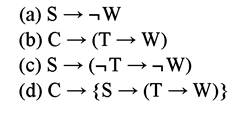
7. Symbolize the following conditional statements from Shakespeare’s Othello, Act II,
Scene 3, using the first letter of each capitalized word for the components:
(a) IAGO: If I can FASTEN but one cup upon him,
With that which he hath drunk tonight already,
He’ll be as full of QUARREL and offense
As my young mistress’ dog.
(b) OTHELLO: If I once STIR,
Or do but LIFT this arm, the best of you
Shall sink in my REBUKE.
3.3