ARGUMENT FORM AND SUBSTITUTION INSTANCE
The ancient Buddhists denied that there is some unchanging substance or matter underlying all the changing qualities we observe. Their view was that since qualities change from one moment to the next, the correct way to express this is to say that there are different things at each different moment.
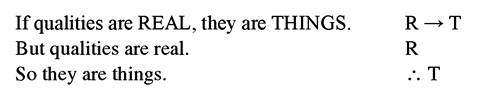
That is, they were committed to the premise thatIf qualities are REAL, they are THINGS.[15]
which we may symbolize R → T. Interestingly, their main opponents, the Sankhyas, also agreed with this statement, but had an entirely different view of the world. They denied that qualities were things, and consequently asserted the unreality of the changing qualities that we see, claiming that only eternal matter is real.
In the terminology explained above, then, the Buddhists held the antecedent of the conditional to be true—in logical parlance, they affirmed the antecedent of the conditional—and therefore inferred its consequent. That is, they argued:
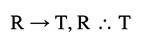
It’s convenient to have a way of writing the symbolization of a single-inference argument like this all on one line, which we do as follows, separating the premises by commas:
This inference is as basic as you can get in logic. All languages have some counterpart to the conditional, and it simply means that the consequent follows from the antecedent. Thus anyone who affirmed a conditional and its antecedent but refused to allow that the consequent followed, could not be said to have understood what a conditional means. In other words, it is impossible to deny the validity of inferring the consequent from a conditional and its antecedent. We can see this by reverting to our definition of formal validity: no argument of this form can have all true premises and a false conclusion, that is, the conditional and its antecedent both true and the conclusion false.
The argument form was well summarized by Chrysippus, a Stoic logician teaching in Athens in the third century BCE, who proposed five basic argument schemata, of which this was the first:
If the first, then the second
The first
Therefore the second
Here “the first” and “the second” are placeholders for any individual statements. We’ll use lower-case letters p, q, etc., instead. These are called statement variables, by analogy with the variables in algebra. They stand for any statements, whereas the capital letters we have used to represent individual statements are analogous to constants. Any individual argument having a given form is said to be an instance or substitution instance of that form. The premises and conclusions of the argument must be substitution instances of the corresponding variables. For example, the Buddhists’ argument is an instance of the valid argument form
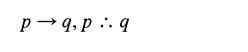
since R is substituted everywhere forp, and T is substituted everywhere for q. Similarly, the abstract argument

is also an instance of this form, with -∣E substituted for p and (B v C) for q.
An argument is a substitution instance of a given argument form if it is obtainable from the form by systematically substituting each occurrence of a given statement variable in the form by the same individual statement, whether simple (e.g., P), or compound (e.g., QvR).

The rule of inference encapsulating the above valid argument form is known by its Latin name, modus ponens (the mood that affirms the antecedent).[16]
Modus Ponens (MP)
From a conditional statement and its antecedent, infer the consequent.
In symbols:
From p → q and p, infer q.
This rule of inference is so fundamental and so obvious that it is virtually never explicitly appealed to in natural reasoning, except possibly when you are really beating an illogical opponent over the head with the illogic of his reasoning.
But we can’t get very far with more complex arguments unless we include it among the basics. Once we have basic rules of inference like this, though, we can prove the validity of more complex arguments. This is the idea behind natural deduction, where we set up formal proofs in the style of geometrical proofs. Let’s look at an example.Imagine a Buddhist arguing with a Sankhya as follows:
If qualities are OBSERVABLE then they must be REAL. So you should accept that qualities are THINGS, since you accept that if they are real they are things.
This is an enthymeme with a suppressed premise “qualities are observable.” We symbolize it as follows:

The idea of a formal proof is simple: we aim to derive the conclusion on the last line. First we state the premises on separate lines, then any subsequent line is derived from those above it by applying our rules of inference:
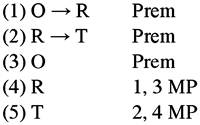
Notice that in the right-hand column we give the justification for each line. The premises are labelled ‘Prem.’ Line 4 is obtained from lines 1 and 3 by an application of Modus Ponens, and line 5 is similarly obtained from lines 2 and 4. Tacitly, we are applying a procedure first identifiedby the Stoics, called the dialectical rule: “if we have premises that yield a conclusion, then we have in effect also the conclusion among the premises, even if it is not explicitly stated.” So far as we know, the Stoics did not set up formal proofs, but instead proved the validity of other argument forms schematically by repeatedly applying this rule together with their five basic rules of inference. Clearly, this amounts to the same thing. A proof such as the one above proves the formal validity of every inference from the premises to a succeeding line derived by valid rules of inference, and therefore the formal validity of an argument from the premises to the conclusion of the last line.
3.3.2