AFFIRMING THE CONSEQUENT
In the witch scene from Monty Python and the Holy Grail, already encountered in chapter 2, a crucial part of Sir Bedevere5s reasoning is this:
Bedevere: Tell me, what do you do with witches?
Crowd: Burnthem!
Bedevere: And what do you bum apart from witches?
Crowd: More witches!...
[pregnant pause].... Wood?Bedevere: So why do witches bum?
Crowd: 5Cos they’re made of wood?
Bedevere: Good!
Sir Bedevere seems to be encouraging the crowd to reason along these lines:
If witches are made of wood, they’ll bum. Witches bum. Therefore they’re made of wood.
Obviously, this is invalid reasoning, as we can see by considering another argument of the same form:
If airliners were lighter than air, they’d fly above the ground. Airliners fly above the ground. Therefore they’re lighter than air.
This argument has the same form as Sir Bedevere5S. All its premises are tme, yet its conclusion is false. So the form is invalid. Hence, any argument that has this form (but is not also an instance of some other valid form) is invalid. This is the case for Sir Bede- vere’s argument. We can also see it is invalid by applying the root definition of validity: even if we were to accept all its premises, this would still be compatible with denying the conclusion.
This invalid form of argument is beguilingly similar to modus ponens. In the latter we affirm the antecedent of the conditional in order to infer its consequent; here we affirm the consequent of the conditional in order to make the faulty inference to its antecedent. Hence the name of the fallacy:
Fallacy OfAffirming the Consequent (FAC) 
The Python argument is intended for humorous effect. Yet the mistake is embarrassingly common. Here’s a somewhat controversial example.
Few scientists have reasoned with the same kind of logical rigour as Sir Isaac Newton. Nevertheless, he appears to have been guilty of something like this fallacy on one occasion. When Edmond Halley (of comet fame) came from London to visit the reclusive professor in his rooms at Cambridge in 1684, he asked him what curve a planet would describe if it was attracted to the Sun by a force reciprocal to the square of its distance. Newton immediately replied that it would be an ellipse, but, on failing to find his calculation among his papers, promised to redo the calculation and send it to Halley. The end result was perhaps the greatest scientific classic of all time: Newton’s Principia. But as his opponents pointed out to his embarrassment, what Newton proved in the first edition of his Principia was that if the curve was an ellipse, the law of force would be the inverse square law—the converse of what Halley had asked for. In effect Newton was arguingIf the curve is an ellipse, the law of force will be the inverse square law. Thus given Halley’s assumption that the law of force is the inverse square law, it follows that the curve is an ellipse.
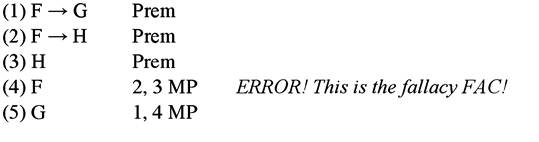
This fallacy also occurs (all too often) in formal proofs done on autopilot—like this:
SUMMARY ______________________________________________________________
• In stating argument forms we use placeholders for any individual statements called statement variables, denoted by the lower case letters p, q, etc. By analogy with the variables in algebra, they stand for any statements, whereas the capital letters we have used to represent individual statements are analogous to the particular values of the variables in algebra.
• An argument is a substitution instance of a given argument form if it is obtain
able from the form by systematically substituting each occurrence of a given statement variable in the form by the same individual statement, whether simple (e.g., P), or compound x x _ ’ is a substitution
instance of the form
• The rule of inference modus ponens (MP) is
From p → q and p, infer q.
From a conditional statement and its antecedent, infer the consequent.
• The validity of this argument form follows from our definition of formal validity: it is impossible for q to be false if p → q and p are both true.
• The argument form is INVALID, and is known as the fallacy of
affirming the consequent (FAC).
EXERCISES 3.3
8. Prove the validity of the “How do you know she’s a witch?” argument from Monty Python’s Holy Grail, using the symbolization suggested;
If she’s MADE of wood, she’s a WITCH. If she weighs the same as a DUCK, she’s made of wood. She weighs the same as a duck. Therefore, she’s a witch.
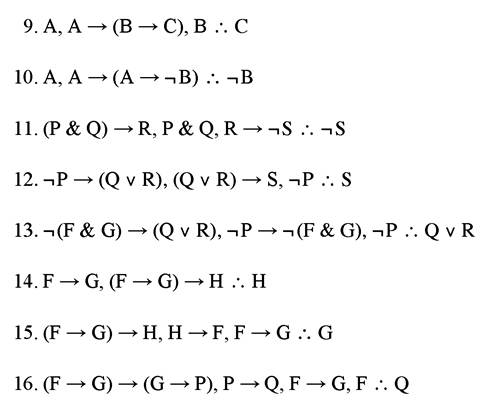
Prove the validity of the following abstract arguments:
17. President Clinton, breaking a long silence over the atrocities in East Timor, was quoted as saying:
“It would be a PITY if the Indonesian recovery were CRUSHED by this. But one way or the other, it will be crushed by this if they don’t FIX it.”—The Boston Globe, Sept 10, 1999
By symbolizing and constructing a formal proof, show what follows from the President’s remarks if one adds the assumption that “they don’t fix it.”