NEGATIONS
The negation of a statement is what we get when we precede it by the operator “It is not the case that...” The latter is a truth-functional operator, symbolized by the logical negation symbol, i-∣,.
There are of course several ways of making a negation in English or any other natural language. Take the following statement from Jimi Hendrix’s 1983 (a merman I should turn to be):(1) I can HEAR Atlantis full of cheer.
If we symbolize this by H, then its negation -∣H would symbolize any of the following variants:
(2) I can not hear Atlantis full of cheer.
(3) I can’t hear Atlantis full of cheer.
(4) It is not the case that I can hear Atlantis full of cheer.
(5) It is false that I can hear Atlantis full of cheer.
(6) It is untrue that I can hear Atlantis full of cheer.
(2)-(6) are all examples of negative statements. As stated in the previous chapter, our convention is that upper case letters symbolize positive assertions only, so that we must use when symbolizing negative statements. As we also saw, no parentheses are used between
 and the statement it operates on. Thus if M symbolizes the statement “I MIND,” and S “SIX turned out to be nine,” the statements below are symbolized as follows:

On the other hand, parentheses are always understood as occurring whenever the four binary operators join statements into compounds, even if they are not explicitly written. Thus the formula -і (S → -∣M) symbolizes
(10) It is false that I don’t mind if six turned out to be nine.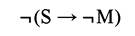
4.1.2
More on the topic NEGATIONS:
- NEGATIONS
- CONTRADICTORIES
- MODUS TOLLENS AND DOUBLE NEGATION
- PROOF STRATEGIES
- Arthur R.T.W.. An Introduction to Logic: Using Natural Deduction, Real Arguments, a Little History, and Some Humour. Broadview Press,2016. — 456 p., 2016
- Contents
- CONSISTENCY AND COMPLETENESS (challenge level)
- DECOMPOSITION RULES
- THE TRUTH TREE METHOD
- SYMBOLS, FORMULAS, AND WFFS