MODUS TOLLENS AND DOUBLE NEGATION
A second rule of inference identified by Chrysippus in ancient Athens corresponds to the valid argument form:
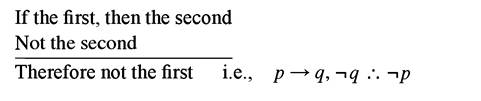
Here, given the conditional, one denies the consequent, and therefore infers the negation of its antecedent:
Modus Tollens (MT)
From a conditional statement and the negation of its consequent, infer the negation of its antecedent.

If we adopt the Principle of Bivalence, according to which either a given statement is true or its negation is, then the validity of this argument form follows from the validity
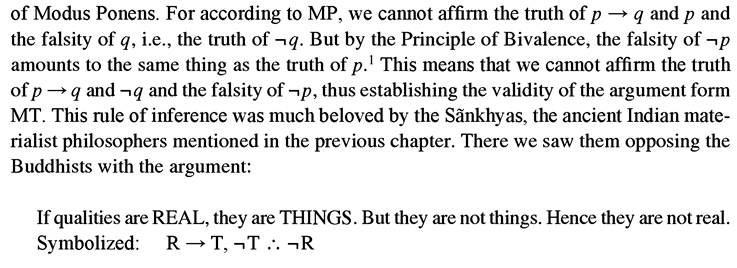
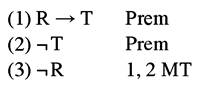
This is an instance of the argument form modus tollens, with the individual statement R substituted for the statement variable p and T substituted for q. Its proof is correspondingly trivial:
Often, however, we will need to substitute negations of statements for one or both of the variables p and q. Modus tollens arguments of this type are called mixed modus tollens arguments. The Sankhyas, it seems, were particularly fond of them, for they expressed the essence of their whole doctrine as a series of five mixed modus tollens arguments. The first of these was:
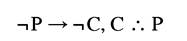
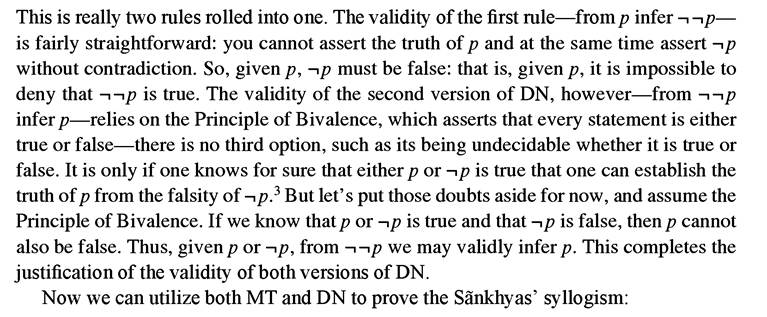
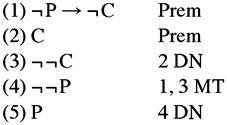
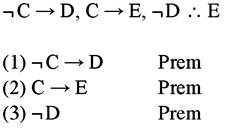
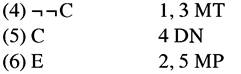
If the effect did not PRE-EXIST in its material cause, it could not be CREATED (since nothing can be created out of nothing). However, it is created. Therefore it does pre-exist in its material cause.[17] [18] This is a 2-inference argument. We’ll ignore the subsidiary argument for the conditional premise for now, and concentrate on the inference to the main conclusion from the conditional together with the second statement, which we may symbolize: Now if we try to prove this, we have to substitute -∣P for the statement variable p and -∣C for the variable q in the conditional. Double Negation (DN) From any statement infer the negation of its negation, and vice versa. Note that both lines (3) and (5) are necessary. We have a tendency to do DNs in our heads. But in a formal proof every inference must be made explicit. As another example, I’ll prove the validity of the abstract argument: [19] 4.2.2

More on the topic MODUS TOLLENS AND DOUBLE NEGATION:
- Arthur R.T.W.. An Introduction to Logic: Using Natural Deduction, Real Arguments, a Little History, and Some Humour. Broadview Press,2016. — 456 p., 2016
- Contents