CONTRADICTORIES
There’s one subtlety to beware of in symbolizing negations, concerning statements like the following:
(11) Some people can’t get ENOUGH.
The temptation here is to symbolize this as -∣E, where E represents
(12) Some people can get enough.
But (12) is not the negation of (11). It does not say that (11) is false. In fact, both statements could easily be true. The negation of (11) is
(13) It is not the case that some people can’t get enough.
which (as you will see, if you think carefully) is equivalent to
(14) Everyone can get enough.
The negation of (12), on the other hand, is
(15) It is false that some people can get enough.
which is equivalent to
(16) No one can get enough.
From this we can see that in some cases a simple ‘not’ in a statement does not always have the force of a negation. If a statement is true, its negation must be false; and con-
versely, if a statement is false, its negation must be true. In other words, a statement and its negation must contradict one another. The notion of contradictory statements is captured in the definition:
Two statements p and q are contradictories if the truth of p is incompatible with the truth of q, and the falsity of p is incompatible with the falsity of q.
Thus of the preceding statements, (11) and (13) are contradictories, as are (11) and (14), (12) and (15), and also (12) and (16). But (14) is not the contradictory of (16). For although the truth of “Everyone can get enough” is incompatible with the truth of “No one can get enough,” both the statements could be simultaneously false. Contrariwise, (11) and (12) could both be true, even if they could not both be false. So in each of these cases we are dealing with an opposition that is something less than outright contradiction. We will come back to these types of opposition in chapter 18 below.
SUMMARY
• If S symbolizes a given statement, then -∣S symbolizes its negation: “it is not the case that S,” or an equivalent.
In general, -∣p is the negation of p.• Any two statements p and q are contradictories if the truth of p is incompatible with the truth of q, and the falsity of p is incompatible with the falsity of q.
EXERCISES 4.1
1. Symbolize the following statements using the first letter of each capitalized word for the components:
(a) Atheists are not our PREACHERS.—Edmund Burke
(b) We are not AFRAID to follow truth wherever it may lead, nor to TOLERATE any error so long as reason is left free to combat it.—Thomas Jefferson
(c) Newton seems not to have entirely NEGLECTED the study of metaphysics.— Jean Le Rond d’Alembert
(d) It is impossible that men should not at length have REFLECTED on so wretched a situation.—Jean-Jacques Rousseau (R := “Men should have reflected..interpret “it is impossible that” as “it is not the case that”)
(e) The British are not the CONVERTS of Rousseau, not the DISCIPLES of Voltaire.—Edmund Burke (there’s an implicit ‘and’ here)
(f) If you TRAVEL every path you will not FIND the limits of the soul.*—Heraclitus
(g) If I had a HAMMER, there’d be no more FOLK singers.*—Billy Connolly (*remember, F should be a positive statement)
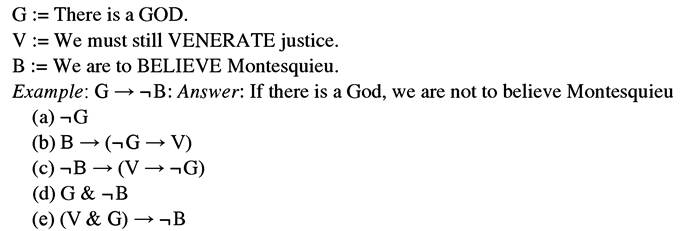
2. Render each formula (a)-(e) into a readable English Statement using the dictionary provided;
3. Which pairs of the following statements are contradictories?
(a) He tied the laces on his right shoe.
(b) He untied the laces on his right shoe.
(c)He did not tie the laces on his right shoe.
(d) He tied the laces of both his shoes.
(e)He didn’t untie the laces on his right shoe.
4.2