DENYING THE ANTECEDENT
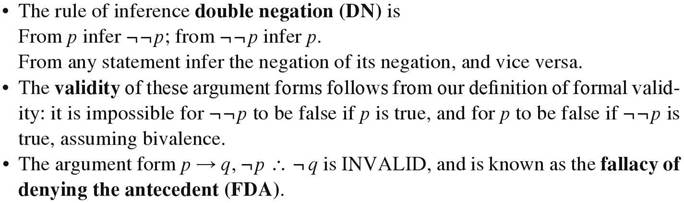
Symmetry demands a fallacious form of argument standing in the same relation to modus tollens as the fallacy of affirming the consequent does to modus ponens. I wouldn’t dream of disappointing symmetry; here it is:

Again, we are all capable of committing this fallacy, even though it is hoped we could recognize our mistake immediately it was pointed out.
Alan Turing gives an example of this kind of fallacy in his seminal article on artificial intelligence. In considering some objections, he frames the following argument (while conceding that it is never quite stated in such a glaringly fallacious way):[20]If each man had a definite set of rules of conduct by which he regulated his life he would be no better than a machine. But there are no such rules, so men cannot be machines.— Alan Turing, “Computing Machinery and Intelligence,” Mind, 59, 1950, p. 452.
That is, adopting some obvious symbolization,
Clearly, this is an instance of the INVALID form denying the antecedent, FDA.
SUMMARY
• The rule of inference modus tollens (MT) is

From a conditional statement and the negation of its consequent, infer the negation of its antecedent.
• The validity of this argument form follows from our definition of formal validity:
it is impossible for -∣p to be false il are both true, assuming biva
lence.
EXERCISES 4.2
4. The great Dutch physicist Christiaan Huygens opposed the Cartesian idea that light propagates instantaneously through the ether by an action passed from one spherical ether particle to the next, arguing that instead it must be transmitted successively:
“For if the movement were not transmitted SUCCESSIVELY, the spheres would all move TOGETHER at the same time, which does not happen.”—C.
Huygens, Treatise on Light, p. 13; quoted from Sabra’s paraphrase in Theories OfLightfrom Descartes to Newton (Cambridge: Cambridge UP, 1981), p. 211Symbolize and then prove the validity of Huygens’s argument.
Prove the validity of the following abstract arguments: 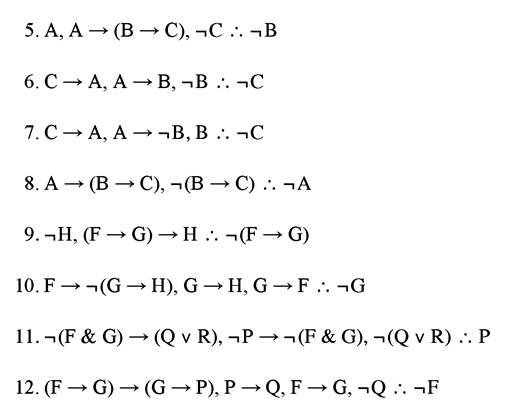
13. Each of the following passages contains or reports an argument that is an instance ofeither MP, FAC, MT, or FDA. Identify which it is:
(a) IfDion is a horse, then Dion is an animal. But Dion is not a horse. Therefore Dion is not an animal.—an old example of the Stoics’
(b) Men have been perplexed in well-nigh every age by a sophism which the ancients called the “Lazy Argument,” because it tended towards doing nothing, or at least towards caring for nothing and only following one’s inclination for the pleasure of the moment. For, they said, if the future is necessary, that which must happen will happen, whatever I may do. But the future, so it is said, is necessary...— Leibniz, Theodicy, 1710 (Huggard trans., p. 54)
(c) If Pluto, according to Halliday’s calculations, had a diameter of more than 4,200 miles, then an occultation would have occurred at MacDonald, and the records clearly indicated that it did not. Thus Pluto must be that size or smaller; it cannot be larger.—Thomas Nicholson, “The Enigma of Pluto,” Natural History, March 1967
(d) A theoryless position is possible only if there are no theories of evidence. But there are theories of evidence. Therefore, a theoryless position is impossible.—Henry Johnstone, Jr., “The Law of Non-Contradiction,” Logique et Analyse, n.s. vol. 3, 1960
(e) Total pacifism might be a good principle if everyone were to follow it. But not everyone does, so it isn’t.—Gilbert Harman, “The Nature of Morality”
(f) And there is nothing good or bad by nature. For if good and bad exist by nature, then it must be either good or bad for everyone, just as snow is something cold for everyone.
But there is nothing which is good or bad for everyone in common; therefore, there is nothing good or bad by nature.—Pyrrho, from Diogenes Laertius’ Life of Pyrrho (Inwood and Gerson, Hellenistic Philosophy, p. 181)(g) I do know that this pencil exists; but I could not know this, if Hume’s principles were true; therefore, Hume’s principles, one or both of them, are false.—G.E. Moore, Some Main Problems of Philosophy
(h) If number were an idea, then arithmetic would be psychology. But arithmetic is no more psychology than, say, astronomy is. Astronomy is concerned, not with ideas of the planets, but with the planets themselves, and by the same token the objects of arithmetic are not ideas either.—Gottlob Frege, Foundations OfArithmetic
(i) (29) Pilate then went unto them, and said, What accusation bring ye against this man? (30) They answered and said unto him, If he were not a malefactor, we would not have delivered him up unto thee.—Holy Bible, John 18: 29-30 [this is an enthymeme]
14. Prove the validity of Cameades the Academic’s argument against fate:
“If there are ANTECEDENT causes for everything that happens, then everything happens within a closely knit WEB of natural connections. If this is so, then NECESSITY causes everything. And if this is true there is nothing in our power. There is, however, something in our POWER. But if everything happens by FATE, everything happens as a result of antecedent causes. Therefore, it is not the case that whatever happens happens by fate.”—Cicero, On Fate (quoted from Inwood and Gerson, Hellenistic Philosophy, p. 130)
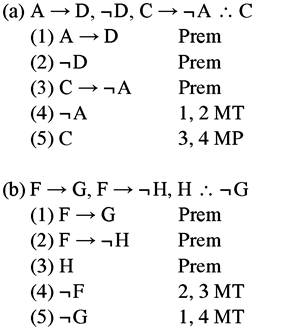
15. The following “proofs” (of invalid abstract arguments) contain mistakes in the application of rules of inference; (a) contains one, (b) two. Identify them:
16. James R. Brown writes that the central argument of David Bloor’s book, Knowledge and Social Imagery, is “that it is not evidence, but instead social factors, which cause belief.” He then reasons: “If Knowledge and Social Imagery is right, then it is destined to have no direct impact on intellectual life.
But since it has had an impact, it must be false” (James R. Brown, The Rational and the Social [London: Routledge 1989], p. 42). This argument may be reconstructed as follows:If Bloor’s central argument is RIGHT, then it is not EVIDENCE which causes belief. But in that case Bloor’s argument could have no IMPACT on intellectual life. Since it has had such an impact, it must therefore be wrong.
Symbolize and then prove the validity of Brown’s argument.
17. A former logic student of mine wrote to inform me that the course material for prepping for a police entrance exam he was to sit contained the following question:[21]
“If I go to university, then I can become an engineer. I am not going to go to university.”
Which of the following should I conclude from this?
A) There are other university courses.
B) I can become an engineer through other avenues.
C) I will not be an engineer.
D) None of the above.
They give C) as the right answer. Is it? If not, why not?
4.3