INFERENCE AND IMPLICATION
Logicians make a sharp distinction between inference and implication. It is regarded as one of the cardinal sins of logic to confuse the two, although in everyday speech we tolerate a fair amount of looseness in the use of the words ‘infer’ and ‘imply.’ The basic distinction is that inferring is drawing a conclusion from a statement or set of statements: it is something people do', whereas implying is a relation between statements', this relation can hold whether or not anyone makes or accepts the statements concerned.
It is true that we can talk about someone’s implying something by a certain statement; but this is elliptical for the statement that person makes implying some other statement. Even in everyday usage, it is a gross mistake to talk of one statement’s inferring another.Still, there’s a close relation between inferences and implications that is worth looking further into. What is the difference between the following?
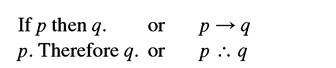
I can still remember when I was learning logic (back in the last millennium) this was something that really stumped me. The similarity may seem overwhelming: both assert that one statement, q, follows from another, p. There is a fundamental difference, though, as I was to Ieam from my tutor: in the first case, it is simply the notion of consequence that is being asserted, i.e., that q follows from p. In the second case, p is being asserted, and q is being asserted to follow from it.
An example may help clarify. Suppose someone were to say

This is not at all the same as saying 
The first statement simply asserts a consequence of the idea of the mind’s being able to act on the brain.
It could just as well be asserted by an opponent of this view as by a materialist. But the second asserts both that the mind does act on the brain, and that as a consequence it must be material.The context of such statements as (1) is of course all important in deciding how to interpret them. If (1) were said in a context in which A is being taken for granted, then it could be interpreted as an enthymematic argument inviting us to infer M:

The fact that such enthymemes are common perhaps accounts for the confusion we have between (1) and (2). On the other hand, though, if (1) were uttered in a context where everyone agreed that M is absurd, then it could be interpreted as a different enthymeme, one in which we were expected to infer the falsity of the antecedent:

Closely related to the above confusion is the confusion between ‘if’ and ‘since.’ Contrast
(3) The mind must be MATERIAL, if it ACTS on the brain.
with
(4) The mind must be MATERIAL, since it ACTS on the brain.
Statement (3) is equivalent to statement (1) and has the same symbolization, A → M. Statement (4) is equivalent to statement (2) and has the same symbolization, Thus the argument
SNELL and DESCARTES cannot both have been the first to discover the Law of Refraction. Since Snell had discovered it earlier, it follows that Descartes was not the first discoverer of the law. 
SUMMARY
• Inference and implication are both concerned with one statement’s following from another. The difference is that inferring is drawing a conclusion from a statement or set of statements: it is something people do’, whereas implying is a relation between statements: this relation can hold whether or not anyone makes or accepts the statements concerned.
• This is related to the difference between an argument such as A.,. M and the corresponding conditional statement A → M. In the argument A is asserted, and M is asserted to follow from it; in the conditional, neither A nor M is asserted: all that is asserted is that M follows from A, or that A implies M.
EXERCISES 4.3
18. Symbolize the following three arguments:
(a) I THINK, therefore I AM.
(b) If there are no proofs, then there are proofs, since there are no proofs if and only if there is a proof of that. [P := there are proofs]
(c) If an infinite aggregate were a TRUE whole, it could not be EQUAL to its proper PART. But it is equal to its proper part. This implies that it is not a true whole.
For the following three arguments, (i) identify what is wrong with the symbolization given, (H) give a correct symbolization and (Hi) a proof of validity.
19. Johnson cannot be PRAISED for leading a successful campaign, since he LIED. You can’t be praised for being successful if you lie.

20. Since the polar ice caps are MELTING, we know there is GLOBAL warming. For if the ice caps are melting, the temperature of the seas must be unusually HIGH. Their temperature would not be high without global warming.

21. (CHALLENGE) If Bloor’s argument has been INFLUENTIAL, then it is EVIDENCE which causes belief. So, since Bloor’s argument has been influential, and if that argument is CORRECT it is not evidence which causes belief, Bloor’s argument must be incorrect. 
Chapter Five