THE TRUTH TREE METHOD
In this chapter we examine a different way of analyzing sequents and arguments (and their schemas) using a new format, called a “truth tree.” The diagrams are called trees because they look like a kind of stick-figure tree turned upside down—or, as I prefer to think of them, a tree stump and roots right side up.
Like the truth table methods we considered in the previous chapter, the truth tree method is a decision procedure, enabling us to determine formal invalidity as well as formal validity by entirely mechanical means, as well as to determine whether statements are tautologous, self-contradictory or contingent, or logically equivalent. Its advantages are its ease of use and visual appeal, the close correspondence of its rules with the rules of inference with which we are familiar, and its easy generalizability to predicate logic (see chapter 23 below). Also, unlike the truth table method, it may also be extended to some other more general kinds of arguments we’ll be coming to later.The basis of the Truth Tree method for determining formal validity is the same as that of the BTT method: we suppose all the premises are true and the conclusion false. If this supposition pans out, the argument is formally invalid, and as a bonus we find out what set of truth values for the components would make the premises true and conclusion false. If it does not pan out, that is, if every branch of the tree ends in an inconsistency, the argument is formally valid. The difference is that the “forcing” of values that are consistent with the initial assignments is explicit, and laid out vertically. Before introducing the method formally, let’s run through a simple example to show the gist of the method. Take the sequent 
First, we write out the premises, and beneath these, the negation of the conclusion.
(These statements comprise the ‘stump.’) We draw a line under this (which you can think of as the ground), as follows: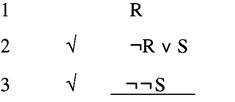
Then we proceed to derive what we can from this, branching every time we have a choice of options:
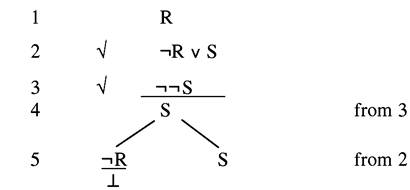
It’s always best to treat those compound statements first that do not involve any branching possibilities. So first, on line 4 we note that S follows from -∣-∣S by DN. Every time we decompose a compound statement we put a √ to the left of it to indicate that it has been decomposed. Now we have exhausted all the information except that contained in line 2, which entails two possibilities, so the tree (or root) branches. So on line 5 we write down the alternative possibilities, one in each branch, ticking line 2 as we do so. In the left hand branch of the tree we derived -∣R; but this is incompatible with R on line 1. So we have a logical contradiction, denoted by 1, and that branch closes (as indicated by the short line above the 1). The right hand branch does not close, but we have exhausted all the information: there are no compound statements that remain unticked, they have all been decomposed. So S’s being true must be compatible with our starting assumptions. In other words, the premises are consistent with the denial of the conclusion, so the argument is formally INVALID. Moreover, the tree diagram shows us that it is the possibility of S’s being true (as well as R’s being true) that would render the premises true and the conclusion false.
Now let’s see what happens if we investigate a valid sequent by this method. Let’s take (2) A,-∣(A &-∣B) H B
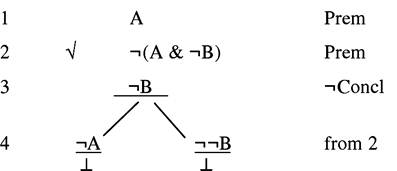
Here A (the first premise) and -∣B (the negation of the conclusion) cannot be decomposed any further.
Regarding the second premise, -∣(A & -∣B) is equivalent to -∣A v -∣-∣B by one of De Morgan’s Laws, which accounts for the branching alternatives of -∣A and -і-іB. But -і A contradicts A above it, so this branch closes. In the other branch, -∣-∣B contradicts -∣B above it, so this branch also closes. We conclude that the premises are incompatible with the negation of the conclusion, so that the sequent is VALID. As for the validity of arguments, as opposed to sequents: If a given sequent is valid, this means the argument corresponding to it Isformally valid.Let’s look at a couple more examples.
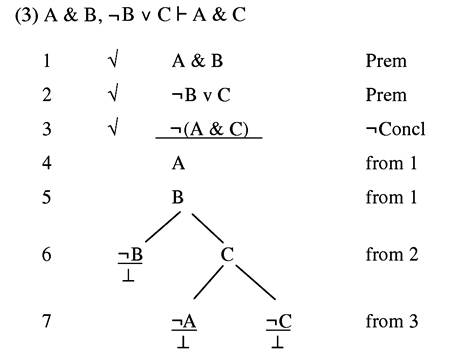
Here lines 4 and 5 represent the decomposition of A & B from line 1. When we decompose -∣B v C from line 2 we get a branching into the two possibilities and C on line 6.
 , however, is inconsistent with B above it, so this path through the tree closes.
Then we have to see what to do with line 3. If not both A and C, then by De Morgan’s, it must be not one or not the other, so this gives us another branching intc C on
C on
line 7. But A is inconsistent with A on line 4, which lies on the path back up the tree to the premises. And
 C is inconsistent with C on line 6, which also lies on the same path. So both these remaining paths close. Again, we conclude that the premises are incompatible with the negation of the conclusion, so that the sequent is VALID.
Now let’s look at an argument form:
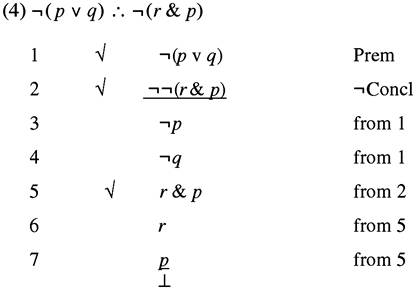
Here lines 3 and 4 exploit another of De Morgan’s Laws, that not either p or q is equivalent to neitherp nor q, i.e., notp (line 3) and not q (line 4).
Line 5 follows from line 2 by a DN equivalence, so that both r and p must be true. But this is incompatible with -∣p on line 3, so we have a contradiction. Thus the argument form is VALID.To summarize the truth tree method of determining the validity of a sequent:
• Write each premise on a separate numbered line; then write the negation of the conclusion on the last Hne of the “stump,” and underline (draw in the “ground”).
• Now on succeeding lines, conclude what follows from each of the statements of the trunk and their consequences in terms of the truth or falsity of the component statements. Tick each compound statement when it has been decomposed.
• Once a tree has branched, if you apply a decomposition rule to a compound statement above the branching, you must do the decomposition in all the different branches on the same horizontal line.
• Statements that cannot be further decomposed are called literals; they will be either component statements or negations of component statements.
• A path through the tree is the collection of all the statements from the bottom of a branch up to the top of the trunk (first premise).
• Inspect each path of the tree as you proceed. If on the same path there occurs both a statement and the negation of that statement, then the path closes, as indicated by a short line at the bottom of the path with a under it. Any path that does not close is said to be open.
• Proceed in this way until all the statements on any remaining open paths are either ticked compounds or literals. Any such remaining open path is then said to be a complete open path.
• When all the paths of a tree are either closed or complete open paths, the tree is said to be complete.
• If all the paths of a complete tree are closed, then the sequent is valid.
• If there are any complete open paths in a tree, then the sequent is invalid. The combinations of literals that make the premises true and the conclusion false can be read off each complete open path of the tree: all positive component statements on the path have the value T, and all negations on the path yield the value F for the statements they negate.
14.1.2
More on the topic THE TRUTH TREE METHOD:
- CONSISTENCY AND COMPLETENESS
- Afterword
- Notes
- The Validation of Signs
- Dismantling classification: Jonathan Z. Smith
- Ancient Greece, Cradle of Western Peace and Peacemaking?
- Venture Beyond Text[776] [777]