THE BRIEF TRUTH TABLE METHOD
If it’s easy to make an error in an eight-row truth table like the one above for the argument  involving three statements, it is even easier when there are four or more component statements involved, and thus sixteen or more rows of truth values.
BriefTruth Table Method (BTT):
First assign T for each of the premises and F for the conclusion (this corresponds to supposing that the argument is invalid). Then work backwards, seeing whether there are any values for all the component statements that will result in these initial assignments—that is, whether there is a row in a completely filled-in truth table that gives us these values, premises T and conclusion F.
• If there is, then you have found a row that demonstrates invalidity, and the argument is invalid.
• If there isn’t, that is, if every assignment of values produces an inconsistent set of truth values for the component statements, then the argument is valid.
In working back from the original assignment, you are working from the outside inwards, as opposed to how we have been proceeding so far, from the inside outwards.
The general strategy is to take assignments that force values first. For instance, is false, we
 know that P must be true and Q false. If P & Q is true, we know both P and Q must be true.
This is how the method would work applied to the above example:
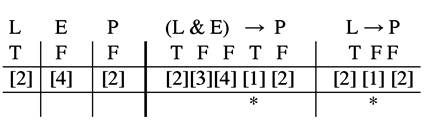
Here the number in square brackets denotes the step in the calculation: [1] is the step of assigning T to the premises and F to the conclusion; in step [2] the falsity of the conclusion forces L to be T and P to be F; and in step [3], we deduce that since (L & E) → P is T and its consequent F, its antecedent L & E must be F. Finally, [4], if L & E is false but L is true, E must be false. This gives us a consistent set. Therefore the argument is INVALID.
• Remember a consistent set proves invalidity of the form, whereas showing that there is no such consistent set proves validity.
This is contrary to our unthinking instincts. But it is because a consistent set gives a row in a truth table with all premises T and conclusion F; whereas to show that there is no such consistent set of truth values for the components is to show that our original supposition of invalidity was false.
Here’s an example of a valid argument. Sir Isaac Newton is often credited with a materialistic worldview in which matter directly acts on all other matter at a distance, through the mediation of the innate force of gravity. The real historical Newton would beg to differ. In a letter to Richard Bentley OfFebruary 1692/93, Newton wrote:
It is inconceivable that brute inanimate matter should, without the mediation of something else which is not material, operate upon and affect other matter without mutual contact, as it must be if gravitation, in the sense of Epicurus, be essential and inherent in it. And this is one reason why I desired you not ascribe innate gravity to me.
That gravity should be innate, inherent, and essential to matter, so that one body may act upon another at a distance through a vacuum, without the mediation of anything else, by and through which their action and force may be conveyed from one to another, is to me so great an absurdity that I believe no man who has in philosophical matters a competent faculty of thinking can ever fall into it.[59]One interpretation of Newton’s argument:
If gravity is INNATE in matter and is not MEDIATED by something immaterial, then it can ACT on other matter only if there is mutual CONTACT. But there is no mutual contact, and it still acts on other matter. Hence, if gravity is innate, it is mediated by something immaterial.[60]

inconsistent set: therefore the argument is valid
(Again I have put the numbers in square brackets so you can follow the reasoning. You do not need to put them in when giving an answer, although it will certainly help your instructor to find any mistakes you might make.)
One shortcoming of the BTT method is this. The truth values of the components do not always get forced by the initial assignment of T to the premises and F to the conclusion. In such cases, we have to run through the possibilities for the remaining unforced components’ truth values ourselves. Thus we end up with at least 2, possibly 4 or more, lines of what would have been the full truth table.
Here is an example of a case where this happens: In a Star Trek episode, the crew of the starship Enterprise is held captive by a powerful computer. The crew escapes when one of them has the wit to try out a version of the Liar Paradox[61] on the computer, by telling it “I am lying.” Presumably the computer, which consequently blows a fuse, reasons as follows: 

These are all the values that get forced. To proceed any further, we must assign values of
T or F to L.
Let’s try assigning a value T to L; i.e., suppose L is true: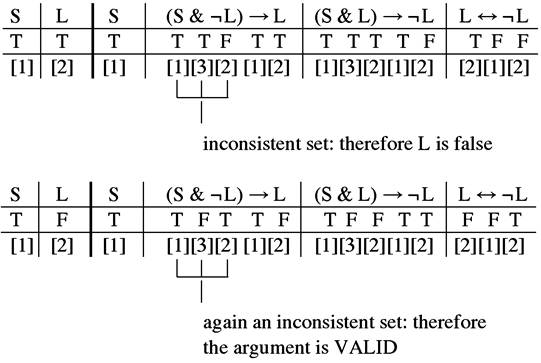
To recap: this is a reductio within a reductio. We tried supposing the argument is invalid. This did not force a conclusion. So we tried supposing that L is true. This led to a contradiction; therefore L is false. From this we derived a contradiction. Therefore the original supposition was incorrect: the argument is valid.
In general, if you are stuck in the BTT method, you have to take one component and try each of its values (T and F) on two different rows.
• If both rows are inconsistent, the argument is VALID.
• If one or both rows are consistent, the argument is INVALID.
This may seem complicated. If it seems too complicated, in a case like this we can easily do a full truth table, since it has only four rows. Alternatively, there is another method which applies to all cases, and which, like the FTT method, is a decision procedure (it always produces results up or down directly): the method of Truth Trees. But that is the subject of our next chapter.
SUMMARY
• In the Brief Truth Table method (BTT), we suppose the argument or sequent has an invalid form, writing T under each premise and F under the conclusion, and working backwards; if this leads to a consistent set of truth values for the constituent statements, it is indeed invalid; if not, it is valid.
• Sometimes this supposition does not force the values of all the component statements; in such a case, you must systematically exhaust the possible truth values for the remaining component statements to see whether it issues in a consistent set.
EXERCISES 13.3
For each of the following, determine whether the argument is valid or invalid using the brief truth table method: 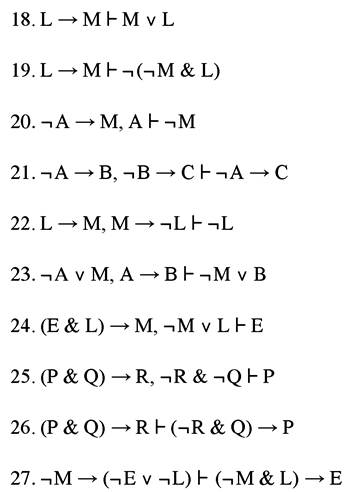
For each of the following, determine whether the argument is valid or invalid using either the full or the brief truth table method'.
28.1 have already said that he must have gone to KING’S Pyland or to CAPELTON. He is not at King’s Pyland, therefore he is at Capleton.—Arthur Conan Doyle, Silver Blaze
29. If this argument is an instance of the FALLACY of affirming the consequent, then it is not VALID. This argument is not an instance of the fallacy of affirming the consequent. Therefore it is valid.—adapted from Cohen and Copi’s Introduction to Logic
30. And certainly if its ESSENCE and POWER are infinite, its GOODNESS must be infinite, since a thing whose essence is finite has finite goodness.—Roger Bacon, Opus Majus
31. The INSTRUMENTALIST interpretation of quantum mechanics is correct if POSITIVISM is true; but positivism is false; hence, since REALISM is true if instrumentalism is false, we must interpret quantum theory realistically.—a version of an argument in a student paper
32. This and the following problem are further different interpretations of the reasoning of Newton in his letter to Bentley quoted in the text:
If gravity is INNATE in matter and is not MEDIATED by something immaterial, then it can ACT on other matter only if there is mutual CONTACT. But there is no mutual contact. Hence, if gravity is not mediated by something immaterial, it cannot be innate.
33. If gravity is INNATE in matter, matter acts on other matter without mutual CONTACT and without the MEDIATION of anything else. But matter acts on other matter either through mutual contact, or through the mediation of something else. Hence, gravity is not innate in matter. (C := matter acts by mutual contact, M := it acts through the mediation of something else.)
34. (CHALLENGE) (a) The Sheffer Stroke operator is defined as
q). Using this definition, determine the truth table for the Sheffer Stroke Operator. In exercise 14 of the previous chapter, we determined the following equivalences. Verify them using truth tables:
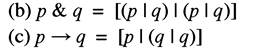
35.
(CHALLENGE) (a) Peirce’s Arrow Operator is defined as
Using this definition, determine the truth table for Peirce’s Arrow Operator. Using truth tables, verify these equivalences established in the previous chapter: 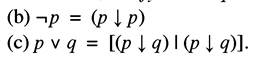
36. (CHALLENGE) The following passage from P.C.W. Davies’s God and the New Physics contains an argument. Using the key below, identify the argument, supplying any implicit premises you deem necessary, and prove its validity using a truth table method'.
The biblical version of the creation of the universe ςon the first day’ is vague about exactly what was involved. There are actually two accounts of creation, but neither explicitly mentions that the material from which the stars and planets, the Earth, and our own bodies are made, existed prior to the creation event. The belief that God created this cosmic material out of nothing is a longstanding part of Christian doctrine. Indeed, it seems to be demanded by the assumption of God’s omnipotence, for if God did not create matter, it would imply that he was limited in his work by the nature of the raw material available to him.
[M := God created MATTER out of nothing, O := God is OMNIPOTENT (all-powerful), L := God was LIMITED in his creation of the universe by the nature of the raw material available to him.]