INVALID ARGUMENT FORMS
Consider the argument:
SAMARKAND is in Uzbekistan. UZBEKISTAN is in Central Asia.
.,. Samarkand is in CENTRAL Asia.
All these statements—premises and conclusion—are simple statements: they have no parts that are also statements, and therefore no components.
So the symbolization of the argument in statement logic is:
And suck it does. The truth table test for statement logic gives a thumbs down on its validity: since no truth-functional connection between the premises and conclusion is revealed, it certainly appears possible for S and U to have the values T whilst C has the value F. It is an instance of the invalid form Nevertheless it does not seem
possible for the original argument to have all true premises and false conclusion. So we judge the argument itself to be valid, even though it is an instance of the invalid form p,  Thus it is true to say
• An argument that is an instance of a valid argument form Isformally valid.
but false to say
• An argument that is an instance of an invalid argument form Isformally invalid.

Later in the book we shall see that our original argument about Samarkand can be symbolized in Relational Logic in such a way as to show that it, too, is an instance of a valid form.
What all this means, as explained in chapter 2, is that we cannot conclude that an argument is formally invalid simply because it is an instance of an invalid form. It has to be the case that it is also not an instance of any valid argument form:
An argument is formally invalid if it is both (i) an instance of an invalid argument form and (ii) not an instance of any valid argument form.
Another example to drive the point home:
If the old lady has any living relatives, her nephew is still alive. But she has no living relatives. Therefore her nephew is no longer alive.

Antecedent. However, the denial of the conclusion yields “her nephew is still alive,” and this is incompatible with the conjunction of the premises, the second of which asserts that the old lady has no living relatives. So the argument is valid. The conclusion follows from the second premise together with the implicit premise that her nephew is a relative of hers. We’ll see what valid form this is an instance of when we study Predicate Logic.
That said, you may take it that none of the instances of invalid forms in the exercises is also an instance of a valid form (unless you are explicitly told otherwise. That is, unless instructed otherwise, you may assume that instances Ofinvalidforms are invalid, as we have tacitly assumed until now.
On the other hand, if we are dealing not with an argument or sequent, but directly with an argument form, the Truth Table method will determine validity or invalidity straightforwardly:
An argument form is invalid if and only if there is at least one instance of the form which is invalid.
For example, the Truth Table method conclusively establishes the invalidity of the form 
SUMMARY
• An argument is formally invalid if it is both (i) an instance of an invalid argument form and (ii) not an instance of any valid argument form.
• An argument form is invalid if and only if there is at least one instance of the form which is invalid.
• An argument or sequent is an instance of an invalid form iff there is at least one line in its truth table with all true premises and a false conclusion.
EXERCISES 13.2
Using the full truth table method, determine whether each of the following sequents is valid or invalid:
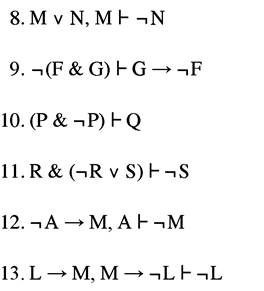
14.
In the text I analyzed the inference involved in the first version of Monty Python’s “Piranha Brothers’” protection racket, which they called “The Operation,” showing by a truth table that the inference was invalid. Provide a similar analysis of (a) the second and (b) the third versions, “The Other Operation,” and “The Other Other Operation.” Do they both involve invalid inferences too?“The Other Operation”: In this racket they selected another victim and threatened not to beat him up if he didn ’t pay them. One month later they hit upon “The Other Other Operation.” In this the victim was threatened that if he didn’t pay them they would beat him up. This, for the Piranha brothers, was the turning point.
15. An argument is symbolized Show that this is a substitution
instance of both Modus Tollens and the Fallacy of Denying the Antecedent. Is the argument valid or invalid?
16. Using the Full Truth Table method, prove the validity of the following sequents:

17. (CHALLENGE) In the text to this chapter I wrote that the truth table for “says
“says
that a conditional is false only if the antecedent is true and the consequent false. From this it follows that (a) the conditional is true if the consequent is true, and (b) the conditional is true if the antecedent is false.” Using the symbol C for “the conditional is true,” S for “the consequent is true,” and A for “the antecedent is true,” symbolize the two arguments that the conclusions (a) and (b) follow from that premise, and prove that they do follow validly (i), (ii) by the truth table method, and (iii), (iv) by constructing two formal proofs.
13.3