THE FULL TRUTH TABLE METHOD
In chapter 2 we said that an argument form is valid if and only if there can be no instance of it with all premises true and conclusion false: that is, iff it is impossible for an argument of this form to have all its premises true and its conclusion false.
The method of truth tables gives a way of determining this, since what we are doing is exhausting all the possible combinations of truth values of statements. This can be applied to the statements that constitute the premises and conclusion of an argument, and we can see by inspection whether any assignment of truth values to the component statements gives us a row with all premises T and conclusion F.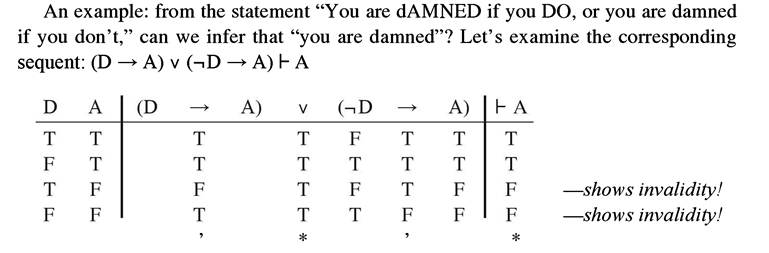
I have put an asterisk under the main operator of each premise (here there’s only one) and another under the conclusion (which is here just A). Now we read across the rows to see if there are any where the premises are all true and conclusion false. There are two rows here, rows 3 and 4, where the premise is true and the conclusion false. This shows that, given this premise, whether or not “you do it,” it could be false that you are damned.
If this result seems surprising, it’s probably because you are subconsciously correcting the premise to the common adage, “You are dAMNED if you DO and damned if
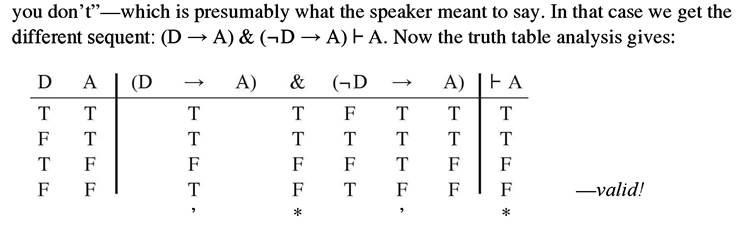
In this case we find that the premise on both rows 3 and 4 is now false: but so is the conclusion. Now there are no rows in which a true premise leads to a false conclusion. So, since we have exhausted all the possibilities, no argument of this form can have all premises true and the conclusion false, so the argument must be formally valid.
As a little light relief, let’s return to our logic gurus, Monty Python.
In a sketch about the gangster brothers Doug and Dinsdale Piranha, the presenter delivers the following biographical vignette as a spoof on television documentaries:When the Piranhas left school, they were called up but were found by an Army Board to be too mentally unstable even for National Service. Denied the opportunity to use their talents in the service of their country, they began to operate what they called “The Operation.” They would select a victim and then threaten to beat him up if he paid them the so-called protection money. Four months later they started another operation, which they called “The Other Operation.” In this racket they selected another victim and threatened not to beat him up if he didn ’t pay them. One month later they hit upon “The Other Other Operation.” In this the victim was threatened that if he didn’t pay them they would beat him up. This, for the Piranha brothers, was the turning point.[58]
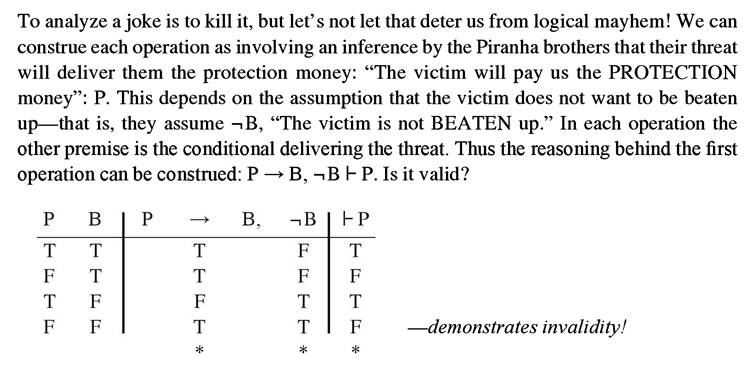
The truth table shows that both premises could be true and the conclusion false even though the victim does not pay and does not get beaten up—as we should have expected. Similar analyses of “The Other Operation” and “The Other Other Operation” are left as exercises.
So far, we’ve been looking at examples of statements and arguments involving only two component statements. As we saw, if we have n component statements, we need 2n rows in the truth table. Thus when there are three component statements in an argument, we need eight rows. Let’s look at an example:
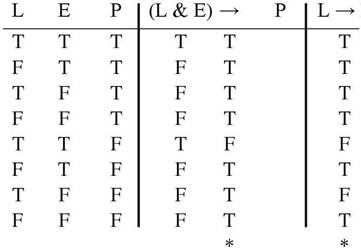
If 4 is LESS than 6 and all EVEN numbers less than 6 are prime, then 4 is PRIME. Therefore, if 4 is less than 6, it is prime.
P
—demonstrates invalidity!
Here line 7 shows that if “4 is LESS than 6” is true, but “all EVEN numbers less than 6 are prime” and “4 is PRIME” are both false, the premise would be true and the conclusion false. So it is possible for the premise to be true and the conclusion false. Therefore the argument is invalid. This is the Full Truth Table method of determining validity, or FTT method, for short.
13.2.2