DECOMPOSITION RULES
Now there is just one more thing we need to do to complete the formalization of the method: to make explicit the justification for breaking down the compound statements. On each line where a compound statement has been decomposed we have indicated this with a √ to the left of the compound in question.
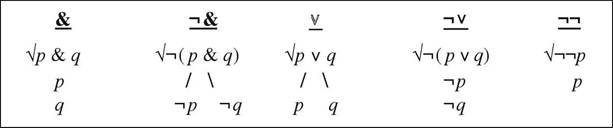
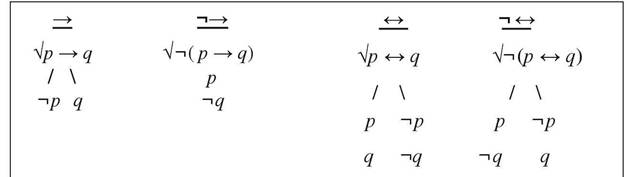
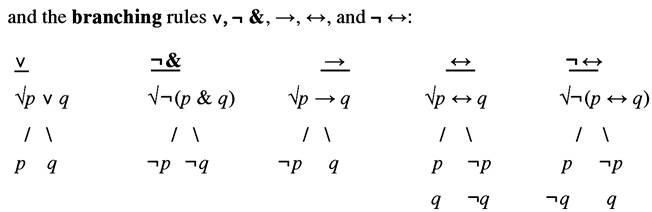
But now we need to make explicit the rules of decomposition over on the right. For Statement Logic there are nine rules in all, one for each of the four binary operators, and one for the denial of each of the five operators (including the unary one, Let’s look first at those involving &, v, and
Decomposition Rules for Ampersand, Wedge and Not

Decomposition Rules for Arrow and Double-Arrow

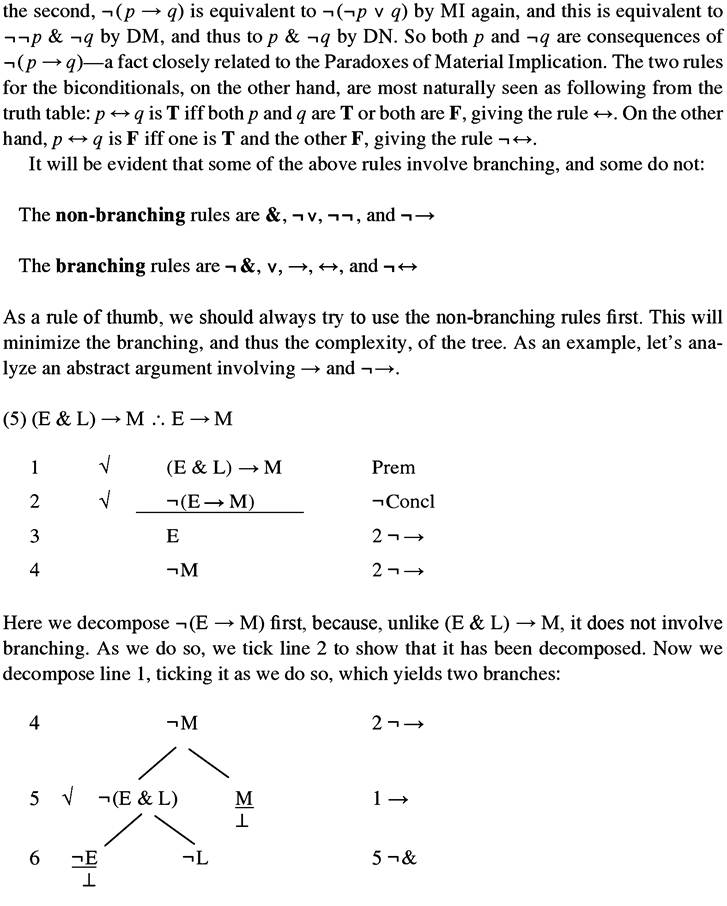
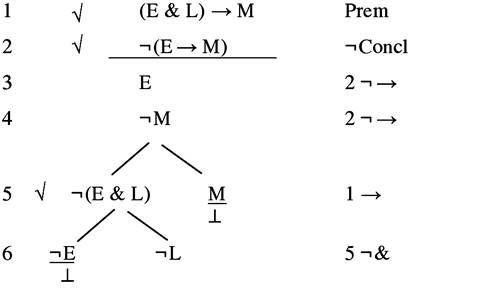
On line 5, M contradicts 1 from line 4 so that branch closes. We then decompose the negation of the conjunction on line 6, involving a further branching. On line 6,
 contradicts E further up the branch on line 3. But when we trace
 up its branch, we find no L to contradict it, so it does not close.
been ticked off, or is a simple statement or negation of one. So the branch is a complete open one. This means that the argument is formally INVALID.
The full tree is as follows:
Compare this tree with the tree (also correct, but slightly more complicated) that we would have obtained by first decomposing line 1, involving a branching rule (remember, once the tree has branched, we must apply the same rule to a compound statement above the branch in each branch horizontally):
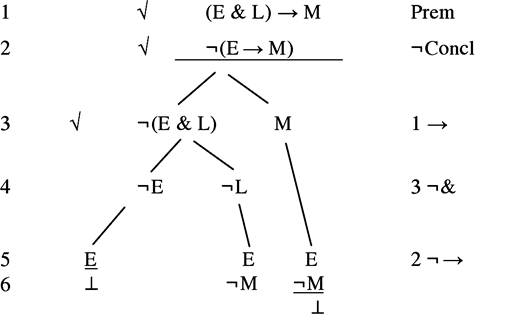
In both diagrams the literals on the remaining open path are so that E’s
being true and L and M false are truth value assignments that make all the premises true and the conclusion false.
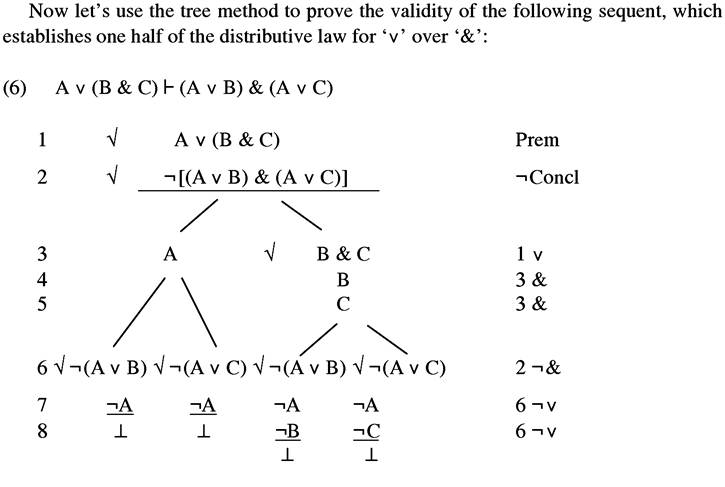
Here we have two statements that require branching rules, but A v (B & C) appears simpler, so we do that first, using the decomposition rule v on line 3. Next we break down B & C using the rule for & on lines 4 and 5, before proceeding to analyze
(A V C)]. Now when we apply the branching rule to it we already have two open branches, so we have to apply
 to each of these branches, giving us 4 branches on line 6. Applying
 to the compounds in both branches on the left, we immediately find that those paths close, because the
 in each of them contradicts A previously derived on that path.
 contradicts B obtained above it on that path, and
 contradicts C obtained above it on that path. Thus all the paths close, so the sequent is formally VALID.
 Here’s a made-up example of an argument whose validity we can test by this method.
(7) If the UNITED States pulls out of Afghanistan then either the BRITISH will have to commit troops for the long term or the CANADIANS will. If the British do make such a commitment, the US will not pull out. But if it is put to a VOTE of Canadian public opinion, the Canadians will not commit troops to Afghanistan for the long term. Therefore, if the US pulls out its troops, Canada’s commitment of troops for Afghanistan in the long term will not have been put to the vote.
Symbolized:
Again, applying the rule of thumb that we should use non-branching rules before branching ones, we decompose premise 4 first:
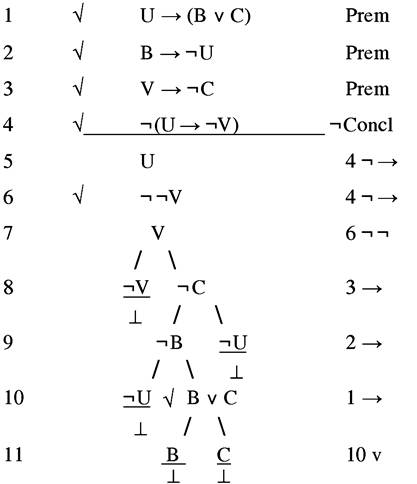
Here on line 8 contradicts V above it on line 7, in lines 9 and 10 is contradicted by U above them in the same path on line 5; B on line 11 is contradicted by
 above it in the same path on line 9, as is C by
 ' above it in the same path on line 8. Thus all the paths close. We have a VALID argument.
SUMMARY
• The truth tree method is a way of determining invalidity as well as validity of a sequent by entirely mechanical means.
It can also be used to determine whether statements are tautologous, self-contradictory or contingent, or logically equivalent. An argument is formally valid or invalid if and only if its corresponding sequent is valid or invalid.• The truth tree method proceeds by assuming the premises true and the conclusion false, and seeing whether a contradiction follows. You start out from the premises together with the negation of the conclusion, and derive whatever can be derived from them by the rules of decomposition.
• The rules of decomposition are of two kinds: 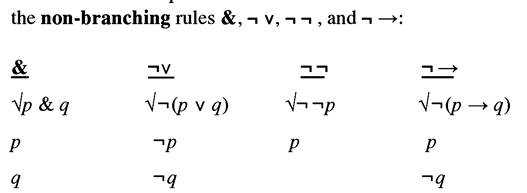

• If on the same path there occurs both a statement and the negation of that statement, then the branch closes (and with it the path), as indicated by a short line at the bottom of the path with a ± under it. Any path that does not close is said to be open.
• Statements that cannot be further decomposed are called literals; they will be either component statements or negations of component statements. If all the statements on a path that has not closed are either compounds that have been decomposed or literals, the path is said to be a complete open path.
• If all the paths of a complete tree are closed, then the sequent is valid.
• If there are any complete open paths in a tree, then the sequent is invalid. * 1 2 3 4 5 6 7 8 9
EXERCISES 14.1
Apply the Method of Truth Trees to determine whether or not each of the following sequents is valid: 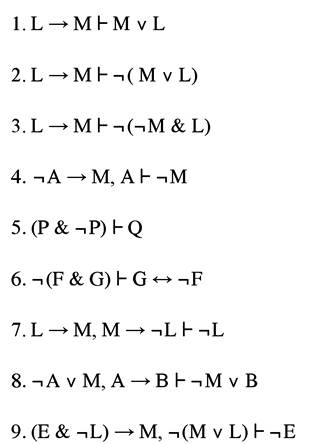
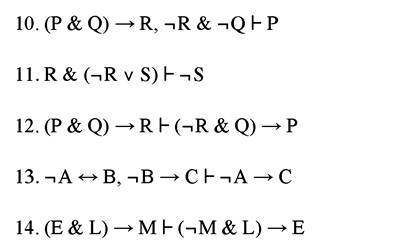
For exercises 15-20 (= 28-33 of chapter 13), symbolize the argument contained in each passage, and then apply the Method of Truth Trees to determine whether it is formally valid:
15.1 have already said that he must have gone to KING’S Pyland or to CAPLETON.
He is not at King’s Pyland, therefore he is at Capleton.—Arthur Conan Doyle, Silver Blaze16. If this argument is an instance of the FALLACY of affirming the consequent, then it is not VALID. This argument is not an instance of the fallacy of affirming the consequent. Therefore it is valid.—adapted from Cohen and Copi’s Introduction to Logic
17. And certainly if its ESSENCE and POWER are infinite, its GOODNESS must be infinite, since a thing whose essence is finite has finite goodness.—Roger Bacon, Opus Majus
18. The INSTRUMENTALIST interpretation of quantum mechanics is correct if POSITIVISM is true; but positivism is false; hence, since REALISM is true if instrumentalism is false, we must interpret quantum theory realistically.
19. This and the following problem are further different interpretations of the reasoning of Newton in his letter to Bentley quoted in the text of chapter 13:
If gravity is INNATE in matter and is not MEDIATED by something immaterial, then it can ACT on other matter only if there is mutual CONTACT. But there is no mutual contact. Hence, if gravity is not mediated by something immaterial, it cannot be innate.
20. If gravity is INNATE in matter, matter acts on other matter without mutual CONTACT and without the MEDIATION of anything else. But matter acts on other matter either through mutual contact, or through the mediation of something else. Hence, gravity is not innate in matter. (C := matter acts by mutual contact, M := it acts through the mediation of something else.)

22. The following is an argument given by Amicus in the 1620s:
Before the creation of the world there was no POSITIVE being apart from God, since it would either be produced by ITSELF, and therefore be God; or it would be produced by ANOTHER: either by this God—but as it was supposed that this God produced nothing before this world, this settles the matter; or by a different God—but it is repugnant to natural reason that there be many Gods. 
14.2