TAUTOLOGIES, CONTRADICTIONS, AND LOGICAL EQUIVALENCE
It should now be fairly easy to see how to use the truth tree method to prove a given statement to be a contradiction or tautology. If a compound statement is a contradiction, we should be able to show by a truth tree that all paths downwards from it are closed.
For this would show that every possibility consistent with it leads to a contradiction. Let us take the following example: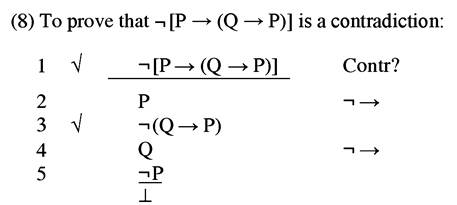
This forlorn tree has no branches, and the only path ends in a contradiction. So the original statement is a contradiction.
By the same token, a statement would be a tautology if and only if every possibility consistent with its negation led to a contradiction. Therefore we would need to construct a truth tree whose only premise is its negation, and show that all paths are closed. Let’s prove that the following is a tautologous statement form:
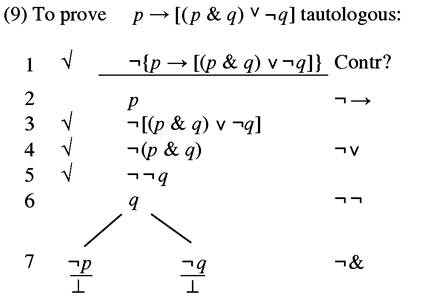
Here the negation of the original statement form is proved to be a contradiction, so that the original statement form is thereby proved tautologous.
Two statements P and Q, finally, are logically equivalent iff their truth tables are identical. As we have seen, this would mean that the biconditional formed from them, would have to be a logical truth. So, to prove them logically equivalent, we would need to construct a tree whose only premise is the negation of the biconditional formed from them,
 і, and show that all its paths are closed. An example:
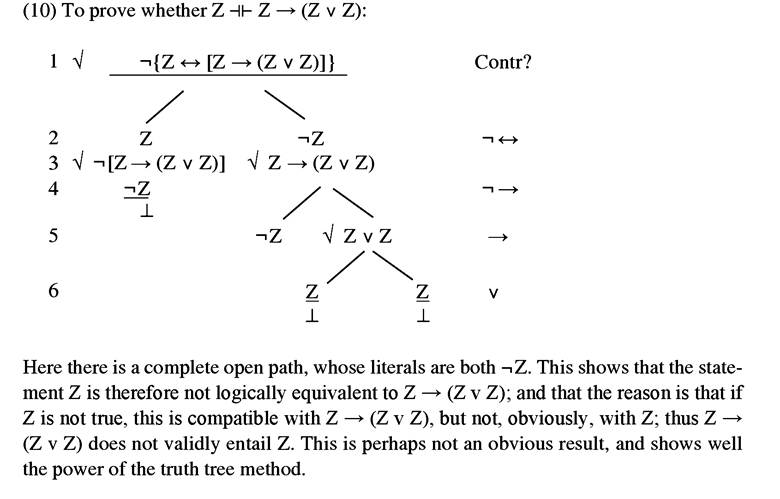
14.2.2