EVALUATING VALIDITY OF SYLLOGISMS
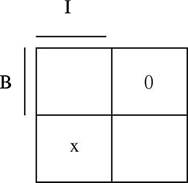
More than one categorical statement can be represented on the same diagram. For instance, the statements “All BA’ATHISTS are IRAQIS” and “Some IRAQIS are not BA’ATHISTS” can be represented on the same diagram thus:
What happens when there are more than two predicate terms or categories? How do we represent them on the same diagram? Categorical statements involving three distinct predicates, A, B, and C, each of which may apply or not apply to a given individual, require 23 or eight distinct regions.
Carroll has a neat way of representing this, but the following is a modification of his diagrams (see Appendix 3 on Logic Diagrams). Within the above square, we draw two horizontal lines bisecting the upper and lower rectangles of the square, creating a new region of 4 rectangles in the middle: individuals inside this region are those to which the third category C applies, those in the 2 rectangles above and 2 rectangles below it are those to which the third category does not apply, like this: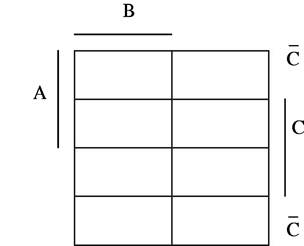
Thus the two statements “Some AFRICANS are BUDDHISTS” and “No CHEROKEES are Africans” can be represented as follows:
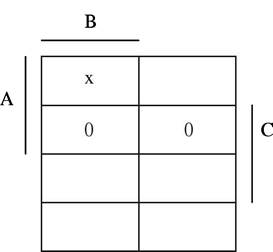
Note that if we’d filled in the first premise first we would not know which region of AB to put the X in: does it go in ABC or In such a case we would have to put an x straddling the two regions, only to find that there were none in ABC. But then when we enter the second premise, we see that the region ABC has a 0, so the x must be in
 This motivates the following rule of procedure:
It always pays to do those statements involving ‘0’s first and those involving
‘x’s last —that is, to do the universal or A- and E-statements first, and the particular or I- and О-statements last.
Now we can evaluate validity as follows. According to our definition, if an argument is valid, then the denial of the conclusion will be incompatible with the truth of the premises. So if we have entered the premises of an argument on our diagram, then the denial of the conclusion will be incompatible with what we have entered; or, equivalently, the conclusion should be entailed by the information we can read off the diagram. Thus the above diagram shows that the argument
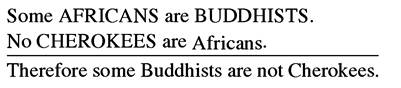
is VALID. But the argument 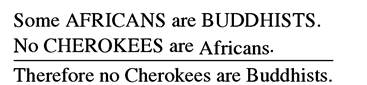
is INVALID. The information in the diagram does not preclude there being non-African Cherokee Buddhists: in order to do that, the ABC region would have to have a 0.
As another example, let’s look at the following argument:
Some elementary PARTICLES are ELECTRONS.
All electrons are CHARGED.
Therefore there are charged particles.
After drawing our diagram of eight regions, we should enter the second premise first, since this is universal, while the first is particular: That all electrons are charged is equivalent to there being no electrons that are not charged, so we put a 0 in the two rectangles that are
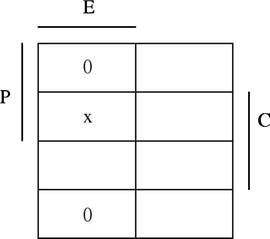
Now we see that it is impossible for the conclusion to be false: the x in the EPC region shows that there are charged particles. The argument is VALID.
Let’s look at some more examples. In his Monadology, Leibniz argues:
No SIMPLE substances are DIVISIBLE.
No indivisible substances can come to an END naturally.
Hence, no simple substances can come to an end naturally.
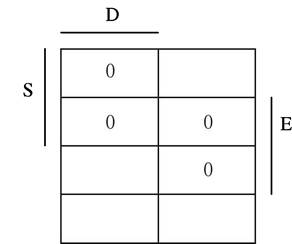
The second premise says that no D are E, so we put 0’s in regions.
Some POLITICIANS are CORRUPT.
All SENATORS are politicians.
Hence, some senators are corrupt.
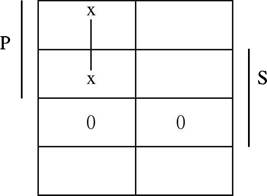
Here we do not know from the premises whether the individuals who are corrupt politicians are senators or not, so we have to put x’s joined by a line on either side of the SS divide. That is, the individuals could be on the or non-S, side. Thus the premises are compatible with there being no corrupt senators (a 0 in CSP as well as CSP ), which is the denial of the conclusion. Therefore, by the definition of validity, the argument is INVALID!
Finally, we should note that sometimes we can simplify our analysis by restricting the universe ofdiscourse. Thus returning to the argument concerning electrons,
Some elementary PARTICLES are ELECTRONS.
All electrons are CHARGED.
Therefore there are charged particles.
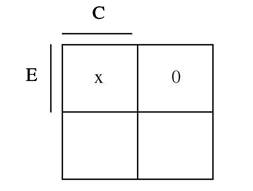
we note that the only things under discussion are elementary particles. So we could have restricted the UD to elementary particles. Then we would no longer have P as a predicate, but only E and C:
Some elementary particles are ELECTRONS.
All electrons are CHARGED.
Therefore there are charged particles.
This gives the simpler 2-predicate diagram:

SUMMARY
• The validity of categorical syllogisms can be evaluated by a modified Carroll diagram for representing statements involving 3 categories. The premises are entered, and then the diagram is inspected. If the denial of the conclusion is incompatible with what has been entered, the argument is valid; if it is compatible with the entered premises, the argument is invalid.
• It pays to enter universal premises first, and particular ones later.
• Sometimes the analysis of an argument can be simplified by restricting the UD. Whenever one of the predicates in an argument applies to all the individuals under discussion, that predicate may be dropped and the UD restricted to those individuals to which the predicate applies.
EXERCISES 15.3
6. Ann Scott, discussing the military draft in 1972, commented that “as long as Congress intends to draft CITIZENS, and WOMEN are citizens, women will be DRAFTED.”2 What categorical syllogism does this seem to involve? Determine whether it is valid using a Carroll diagram.
Foreach of the following (7-17), put the argument in standard form (e.g., iiAllA areB”). (In cases where the predicates need clarifying, we will indicate them using the following notation: Hx := x is intense heat, Sx := x is a kind of painful sensation, etc.) Then use the Carroll diagram method to determine whether it is VALID or INVALID:
7. Some NEUTRINOS go FASTER than light. But no neutrinos have rest MASS. It follows that some things with no rest mass go faster than light.
2
Ann Scott, “The Equal Rights Amendment: What’s in It for You?,” Ms. (July 1972): p. 85; quoted from Howard Pospesel, Introduction to Logic: Predicate Logic, 1st ed. (Prentice Hall), p. 80.
3. ARIANS do not BELIEVE in Christ’s divinity. Therefore Arians are DEISTS, since no Deists believe in Christ’s divinity.
4. All AARDVARKS are EDENTATES. Some animals that eat TERMITES are not edentates. Thus there are aardvarks which do not eat termites.
5. No WAFFLES sold here are HEALTH food. For they all contain TRANSFATS, and nothing that contains transfats is health food
ILA newspaper article reports consumer advocate Bess Myerson Grant as saying: FILET mignon is not a KOSHER cut of meat. Federal regulations define filet mignon as beef cut from the HIND quarter. But Jewish dietary laws forbid eating meat cut from the hind quarter of any animal [i.e., no such meat is kosher].[63]
12.
An alleged argument against atheism:Anyone is MORAL who UPHOLDS the teachings of a religious faith. Therefore, since no ATHEIST upholds the teachings of a religious faith, it follows that no atheist is moral.
13. From Monty Python’s Holy Grail:
Anything MADE of wood BURNS. WITCHES bum. Therefore witches are made of wood.
14. From G.H. Hardy’s A Mathematician's Apology:
... it is obvious that irrationals are uninteresting to engineers, since they are concerned only with approximations, and all approximations are rational.
(Ix := X is interesting to engineers, Rx := x is rational, Ax := x is an approximation)
15. (CHALLENGE) From Plato’s Ion:
And no man can be a RHAPSODIST who does not UNDERSTAND the meaning of the poet. For the rhapsodist ought to INTERPRET the mind of the poet to his hearers, but how can he interpret him well unless he knows what he means?
16. (CHALLENGE) From George Berkeley’s Three Dialogues between Hylas and Philonous:
... because intense HEAT is nothing else but a particular kind of painful SENSATION; and pain cannot exist but in a PERCEIVING being; it follows that no intense heat can really exist in an unperceiving corporeal substance.
(Hx := X is intense heat, Sx := x is a kind of painful sensation, Px := x exists in a perceiving being or substance)
17. (CHALLENGE) The Scots philosopher David Hume wrote:
All IDEAS are borrow’d from preceding PERCEPTIONS. Our ideas of OBJECTS, therefore, are deriv’d from that source [i.e., from preceding perceptions].
The following whimsical examples (18-23) are from Lewis Carroll’s Symbolic Logic. Determine by the method of Carroll diagrams whether they are valid or invalid; if the latter, what if anything could have been validly concluded (i.e., assuming each term appears exactly twice in the argument, is there a categorical statement (involving only two terms) that follows validly from the premises)?
18. Some EPICURES are UnGENEROUS. All my UNCLES are generous..,.
My uncles are not epicures. (G := are generous)19. Some CANDLES give very LITTLE light. Candles are MEANT to give light..,. Some things that are meant to give light give very little.
20. All LIONS are FIERCE. Some lions do not drink COFFEE..,. Some creatures that drink coffee are not fierce. (Restrict the UD to creatures.)
21. (CHALLENGE) HIS songs never LAST an hour. A song that lasts an hour is TEDIOUS..,. His songs are never tedious. (Restrict the UD to songs.)
22. A PRUDENT man SHUNS hyenas. No BANKER is imprudent..,. No banker fails to shun hyenas. (Restrict the UD to men.)
23. (CHALLENGE) BORES are DREADED. No bore is ever begged to PROLONG his visit..,. No one who is dreaded is ever begged to prolong his visit. (UD: people.)
24. The English materialist philosopher Thomas Hobbes claimed:
“The world (I mean the whole mass of all things that are), is corporeal, that is to say, body; and that which is not body is not part of the universe.”
That is, (i) “Everything in the UNIVERSE is BODY,” and (ii) “everything which is not body is not in the universe.” Do these two statements say the same thing? Find out by representing each by a Carroll diagram, and see whether the diagrams are the same.