UNIVERSAL QUANTIFICATION
The diagram methods we looked at in the last chapter were simple generalizations of Aristotle’s category logic. But it was not extended to cover a significantly wider class of arguments.
This situation changed radically in the late nineteenth century when Gottlob Frege introduced the notion of quantifiers. This gave him a way of symbolizing the categorical statements of traditional logic using statement connectives, thus enabling him to subsume all of Syllogistic Logic under an extended version of Statement Logic.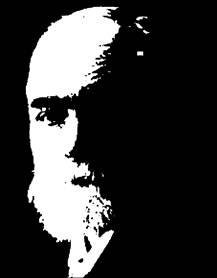
Friedrich Ludwig Gottlob Frege (1848- 1925) was a German logician of great originality, who made important contributions to the foundations of mathematics and the philosophy of language. He recast traditional logic in terms of quantifiers and proofs of validity, thus establishing modern predicate logic. His lifelong project of reducing mathematics to logic came unstuck with Russell’s discovery of an inconsistency at the heart of his axiomatic system.
This extended logic, called Quantifier Theory or just plain Predicate Logic, not only applies automatically to a much wider class of arguments than its predecessors, but is readily generalizable to predicates involving relations among several individuals, the Relational Logic we shall come to consider in chapter 20.
First we shall treat universal statements (A- and E-statements), postponing particular statements (I- and О-statements) till the next chapter. The basic idea is to treat universal statements as stating a conditional relationship between membership of the two categories or classes: the class of individuals to which the subject term applies, and the class of individuals to which the predicate term applies. Thus an A-statement “All M are N” is interpreted as saying: if an arbitrary individual is in class M, then it is in class N; whereas an E-statement “No M are N” says: if an arbitrary individual is in class M, then it is not in class N.
Borrowing from algebra, we denote the arbitrary individual by the variable x, and symbolize the А-statement “All M are N” as: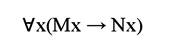
Here the symbol Vx stands for “for all x”; it is called a universal quantifier and the whole abstract statement that results is called a universal quantification. Mx stands for “x is an M” and Nx stands for “x is an N.” Thus the whole formula reads:
For all x, if X is an M then x is an N.
Similarly the E-statement “No M are N” is symbolized:

In both cases the ix, is understood to range over all the individuals of the kind under discussion. This is the “Universe of Discourse,” or UD for short, which we already met in the previous chapter. It is also called the domain of the quantifier.
The universe of discourse (UD) is the set of individuals over which the individual variable ix, (or iy ’ or iz,) occurring in a quantifier is assumed to range.
This is also known as the domain of the quantifier.
The UD is generally not specified, in which case it will be understood as including everything without qualification. But in certain cases where the kind of thing under discussion is some narrower class, say people, it will pay to restrict the UD accordingly, as we saw in the previous chapter.
One oddity of the Fregean way of symbolizing universal statements is that it is non-committal on whether there exist individuals in the classes mentioned. We already saw that in our treatment of universal statements in the previous chapter, where only I- and О-statements involved the assertion that there was an individual in the class denoted by the subject term (in the jargon, only I- and О-statements have existential import). For many statements this conflicts with our intuitions. If I said “All B ACTRIAN camels have
TWO humps,” you would certainly take this to imply that Bactrian camels exist—to the degree that you would accuse me of deliberately misleading you if there were no such things. On the other hand, though, a statement such as “All DODOS are EXTINCT” carries with it no such implication as to the existence of its subject—quite the contrary. This question is involved enough to deserve a thorough discussion, which I postpone to a section of chapter 18. For now, just take it as read that A- and Estatements are interpreted as having no existential import.
16.1.2