ONLY’ AND 6NOTHING BUT’
Finally, now that we know how to symbolize categorical statements, we are in a better position to understand the symbolization of two non-standard forms we have not yet looked at:
1.
“None but A are B,” “Nothing but A are B,” or “No one except A is a B”; and2. “Only A are B.”
Some examples:
Nobody but a MISER would SAVE egg shells.
Nothing but GOLD will SILENCE him.
Only RUBBISH can be had for a SONG.
If none but misers save egg shells, this means no one except misers, i.e., only misers, save egg shells. But does this mean that “All misers save egg shells”? No. It means “Anyone who saves egg shells is a miser,” i.e., All S are M. So
“Only M are S” is equivalent to “All S are M.”
This is immediately understandable when we symbolize. For
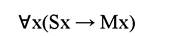
means
For all x, X is an S only ifx is an M.
or, “only if someone is a miser does he save egg shells.” So the kind of inversion we get with “only” with respect to “all” is the same as the inversion we got with “only if’ in relation to “if.” Similarly, the other two statements above come out as

16.1.3