SINGULAR STATEMENTS AND INDIVIDUAL NAMES
Suppose someone argues:
Of course Steve Sharkey is a MERCENARY. All BRITONS fighting in Angola are mercenaries, and he is a Briton fighting there.
We have two premises: one of them is an А-statement, “All Britons fighting in Angola are mercenaries”; but the other, “Steve Sharkey is a Briton fighting in Angola,” is a simple statement of a different kind.
It asserts that a given individual, Steve Sharkey, belongs in a given category. Expressions used to refer to individual things or people are called singular terms or individual names, and a statement containing one or more singular terms is called a singular statement. Individual names are symbolized by lower case letters. In general, we will symbolize a name by the first letter of the name or designating expression, which will be underlined; the letters x, y, and z, however, are reserved for the variables we have already encountered in universal and existential quantifications. (Variables are not names; they are placeholders for names; just as statement variables are not statements in statement logic.) In symbolizing a simple singular statement, we write the PREDICATE P first, and the name n second, thus: Pn.Thus in the above example, Steve Sharkey is symbolized as s, “is a mercenary” by M, and “is a Briton fighting in Angola” by B, “Sharkey is a mercenary” as Ms, etc., giving: 
Now a singular statement such as Bs is a statement—as indeed are the universal and particular statements we have already encountered. By our previous definitions, Bs is a simple statement: it has no components. Further examples of simple singular statements:
| SINGULAR STATEMENT | SINGULAR TERM | PREDICATE | SYMBOLIZED |
| Amos Judd LOVES cold mutton. | Amos Judd | LOVES cold mutton | Lj |
| ThisdishisaPUDDING. | This dish | is a PUDDING | Pd |
| Shakespeare WROTE Hamlet. | Shakespeare | WROTE Hamlet | Ws |
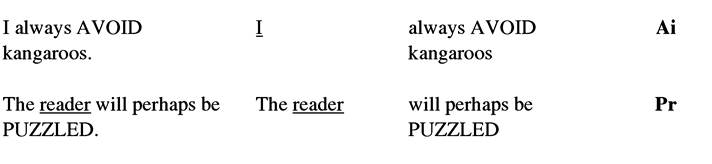
It should be noted here that not just names but also definite descriptions that are sufficient to pick out an individual, such as “The reader,” are treated as singular terms.
(We will give a more sophisticated treatment of definite descriptions in chapter 21.) Now we can make compounds from these simple statements using statement operators, just as with simple statements in statement logic. Thus Bs → Ms is a conditional statement, symbolizing “If Steve Sharkey is a Briton fighting in Angola, then he is a mercenary.” -∣Bs symbolizes “Steve Sharkey is not a Briton fighting in Angola,” and so forth.Note also that we may symbolize a statement differently in a different argument context. If some inference we were making depended on Steve Sharkey’s being a Briton, and another on his fighting in Angola, we would need to use the symbolization key: Bx := x is a Briton, Fx := x is fighting in Angola, and “Steve Sharkey is a Briton fighting in Angola” would be symbolized: Bs & Fs.
Traditionally, singular terms presented something of a difficulty for logicians. One way of dealing with them had been to treat them as classes with only one member. That way a singular statement could be represented as an А-statement. This is the approach adopted, for example, by Lewis Carroll in his Symbolic Logic, from which, incidentally, all the above examples are taken. Thus Carroll treated “Amos Judd loves cold mutton” as “All those who are Amos Judd love cold mutton,” assimilating it to an A-statement. This works if, like him, one holds A-statements to have existential import. For from the fact that Amos Judd loves cold mutton, it clearly follows that someone loves cold mutton. But if, like Frege (and us), one denies that А-statements have such import or entail their corresponding !-statements, this option is foreclosed.
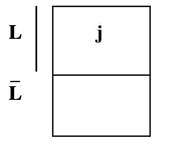
In fact, it is very easy to accommodate singular terms to the Fregean approach, and to Carroll’s diagrams. For to assert that “Amos Judd loves cold mutton” is simply to assert that the class of those who LOVE cold mutton has as member the individual Judd. That is, the individual named j is to be found in the class L. This is diagrammed:
Similarly, if we diagram the premises of the “mercenary” argument with which we began this subsection, we obtain
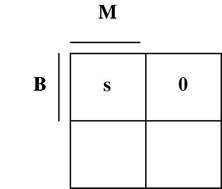
Entering the А-statement first, “All BRITONS fighting in Angola are MERCENARIES,” the fact that Steve Sharkey is a Briton means that the s is in the B-region; the only place to enter it is in BM.
Hence the conclusion follows: Sharkey is a mercenary.SUMMARY
• The symbol Vx stands for “for all x”; it is called a universal quantifier. It precedes a formula in the variable x, and the whole abstract statement that results is called a universal quantification.
• The А-statement “All M are N” is symbolized Vx(Mx → Nx), which reads “For all x, if X is an M then x is an N.”
• The E-statement “No M are N” is symbolized Vx(Mx → -∣Nx), which reads “For all x, if X is an M then x is not an N.”
• The universe of discourse (UD) or domain of a quantifier such as Vx is the set of individuals over which x is assumed to range.
• If there is an individual in the class denoted by the subject term, a categorical statement is said to have existential import. On the interpretation adopted here, only I- and О-statements have existential import, and universal quantifications such as A- and E-statements do not.
• Expressions used to refer to individual things or people are called singular terms or individual names. They are symbolized by lower case letters from a to w; the letters x, y, and z are reserved for variables.
• The abstract statements “Only M are S” and “None but M are S” are each equivalent to “All S are M.”
• A statement containing one or more singular terms and no variables is called a singular statement. A statement that the predicate P applies to an individual m is symbolized Pm. Such singular statements can be combined using the 5 truth functional operators to form compound statements.
EXERCISES 16.1
!.Symbolize the following A- and Estatements:
(a) GOURMETS don’t eat their steaks WELL-done.
(b) Each TABLET contains 15 mg of CAFFEINE.
(c) No WORLD Series is ever DULL.
(d) Anybody who RACES horses has got to BELIEVE in miracles.
(e) YEOMEN are all PETTY officers.
(f) He who laughs LAST laughs LOUDEST. (A, O)
2. Symbolize the following nonstandard categorical statements:
(a) Only MEN go BALD.—J.R.
Lucas(b) None but the BRAVE DESERVE the fair.—Lewis Carroll
(c) Only those living along the COAST will have RAIN today.—TV weatherman
(d) No one would DOUBT it but a SKEPTIC.
3. Symbolize the following singular statements:
(a) Socrates is MORTAL.
(b) That book is BORING.
(c) Quentin Crisp was GAY and PROUD of it.
(d) Pat TRAINED hard, but didn’t WIN.
(e) If Beeblebrox LAUGHED his head off, he would STILL have one head left.
(f) If Eugene Hasenfus was not a CIA agent, he would not have worked for SOUTHERN AIR.
(g) The experiment is WORTHWHILE only if it TESTS something.
The following syllogisms of Lewis Carroll (4-5) have one premise that is a singular statement. Represent the premises using Carroll diagrams, and determine whether the stated conclusions follow:
4. No DOCTORS are ENTHUSIASTIC. Alice is enthusiastic. Therefore Alice is not a doctor.
5. John is in the HOUSE. Everybody in the house is ILL. Therefore John is ill. [UD: people]
Assuming that every predicate or name is to appear exactly twice in the argument, use Carroll diagrams to work out the conclusions of the following arguments 6>∕CarrolΓs:[64]
6. All PUDDINGS are NICE. This dish is a pudding. No nice things are WHOLESOME. Therefore...
7. No EXPERIENCED person is incompetent. Jenkins is always BLUNDERING. No COMPETENT person is always blundering. Therefore... [UD: people]
8. (CHALLENGE) My gardener is well WORTH listening to on military subjects. No one can REMEMBER the Battle of Waterloo unless he is very OLD. Nobody is really worth listening to on military subjects unless he can remember the Battle of Waterloo. Therefore... [UD: people]
16.2