RULES OF INFERENCE: UI AND UG
We have proved the above argument about mercenaries valid using the Carroll diagram method. Now let us investigate how to deal with it in Predicate Logic. It seems obvious that if every X that is a B is an M, and s is a B, then s must be an M.
Yet, by our definitions the А-statement “All Britons fighting in Angola are mercenaries” is a simple statement, not a conditional: no part of the original statement is itself a statement. Nonetheless, it seems perfectly valid to infer the conditional Bs → Ms from it. This is in effect our first rule of inference for Predicate Logic, universal instantiation. But to state it properly, we need to define a few terms. First we need a term for the part of the universal statement that is not the universal quantifier. In the above example, ∀x(Bx → Mx), this would be (Bx → Mx). We call this a propositional function:A propositional function in x (symbolically represented Φx) is a formula containing at least one variable x such that when an individual name is substituted

This definition (adapted from Bertrand Russell) will suffice for our purposes here, although we shall have to modify it in chapter 19 below when we come to statements involving more than one quantifier, and other variables, у and z.[65] With it we can define universal quantification and an instance of one:
A universal quantification is a propositional function in x (or y, or z) preceded by a universal quantifier
The variable x in a propositional function formed as above is no longer “bound” by the quantifier, and is thus called a “free variable.” (A formal definition of “free variable” can wait until we have defined the scope of a quantifier in chapter 19.)
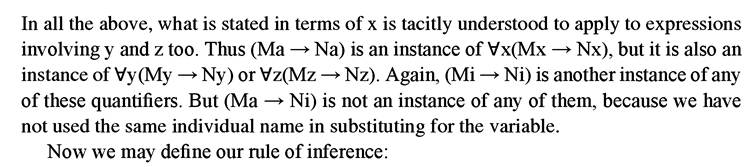
An instance of a quantification is what is obtained when the initial quantifier Vx is dropped and all instances of the free variable x in the resulting propositional function are replaced by the same individual name n.
Universal Instantiation (UI)
From a universal quantification infer any instance of it.
From VxΦx derive Φn, where n denotes any individual name.
Again, what is stated here in terms of x is tacitly understood to apply to expressions involving у and z too. Likewise, Φx can be any propositional function in x. So the rule allows
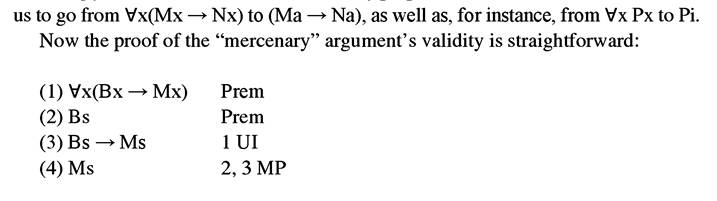
Other more complex arguments involving singular statements can be handled just as easily. Here’s an example:
No PERFECT being is immoral. No MORAL being would punish AGNOSTICISM. It follows that if God is perfect, he will not punish agnosticism. 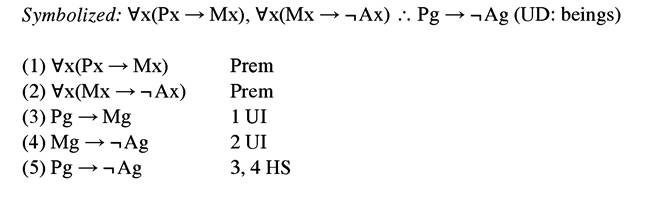
Now what about categorical syllogisms? When I was listening to PBS one night while working away on some exercises for this book, I heard the following argument:
Many people don’t realize that MUSHROOMS are FUNGI and fungi are mICRO-OR- GANISMS, so that mushrooms are in fact micro-organisms.
This is the most basic valid categorical syllogism, expressed abstractly as:
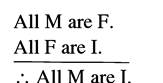
or, in terms of predicate logic:
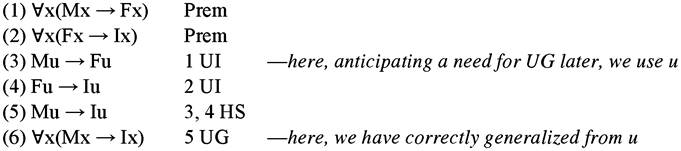
We could give a justification of the validity of this syllogism as follows. Suppose we take some arbitrary individual. Then the first premise tells us that if it is a mushroom, then it is a fungus, while the second premise tells us that if it is a fungus it’s a micro-organism. From this we may infer by HS that if it is a mushroom, then it’s a micro-organism. Now if the individual we chose was suitably arbitrary, then it seems we would be justified in generalizing from this to say that any mushroom is a micro-organism.
This is what is involved in our next rule, Universal Generalization.Notice that the argument we just gave is a suppositional argument, but one in which we suppose something for the sake of example, that is, for the sake of giving specific content to a general principle. That is, in effect, we are now showing how to formalize suppositional arguments of the second kind considered in chapter 7.3. What we need is the notion of an arbitrary individual. To this end let us reserve the letters u, v, and w for arbitrary individuals assumed in a proof by universal generalization. For our purposes here, an arbitrary individual is one that has not already been mentioned in the statement of the argument, and has been introduced in the proof solely in anticipation of generalizing from it later. (This means that it must be a distinct arbitrary name from the other arbitrary names we will be introducing in the next chapter for Existential Instantiations, for which we reserve the letters i, j, and k.) Then the above reasoning can be rendered as follows: suppose we have an arbitrary individual, say u. Then the first premise gives Mu → Fu, and the second gives Fu → Iu, from which we may infer Mu → Iu by HS. Now we need to have some way of legitimizing the step from the singular statement Mu → Iu, where u is an arbitrary individual, to the universal statement ∀x(Mx → lx). This motivates the following rule:
Universal Generalization (UG)
Infer a universal quantification from a suitably arbitrary instance of it.
From Φu derive ∀xΦx, provided
(i) Φu neither is nor depends upon an undischarged supposition involving u, and
(ii) Φu does not contain a name i (or j or k) introduced by an application of EI to a formula involving u.
The meaning of these two provisos will be spelled out in later chapters, and there will be no need to worry about them until then. The first comes into play in proofs involving suppositions for CP and RA, the second in multiple quantifications.
Remember, u is an arbitrary name, rather than the name of some individual occurring in the argument. Thus Φu is an instance of the quantifier, and not a propositional function, as it would be if u were a variable. Again, since Φu is an instance of VxΦx, in applying the rule, all occurrences of u must be replaced by x. The rule also applies if instead of u we had used either of the other two arbitrary names, v and w.
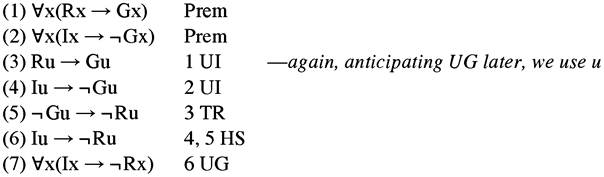
Here’s another example. According to the Utilitarian moral philosopher John Stuart Mill, only acts that promote the GENERAL interest are RIGHT. But since no act that INTERFERES with someone acting in his own interest while not affecting others promotes the general interest, no such act can be right. This gives the syllogism
 whose validity is proven as follows:
Finally, here are some examples of mistakes in applying the rules we have introduced. First, let’s consider the following erroneous proof of the (invalid) abstract argument

This is wrong because we can only apply UG when we have a suitably arbitrary instance of the quantification, i.e., one involving an arbitrary individual u (or v or w). Here a could have been anything in the universe of discourse, so the argument could have been, say, “Arthur is a cartoon ELEPHANT. Therefore everyone is a cartoon elephant,” which is clearly not valid.
The same kind of mistake occurs in the following proof. It is less serious here, but still a mistake:
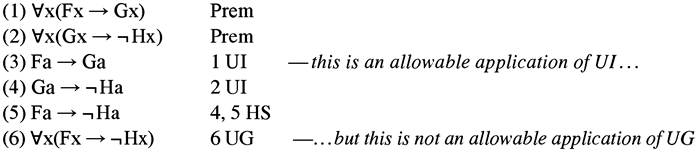
Because we can only apply UG to an instance involving u (or v or w), line 6 involves an error.
On lines 3 and 4 we should have taken our instances as Fu → Gu and Gu → -∣Hu, anticipating the need for u when we got to line 6. These were strategic errors on lines 3 and 4, but not errors in applying a rule of inference, as is line 6.SUMMARY
• A propositional function in x (symbolically represented Φx) is a formula containing at least one variable x such that when an individual name is substituted throughout for X the result is a singular statement; e.g.
or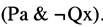
• A universal quantification is a propositional function in x (respectively, y, z) preceded by a universal quantifier in x, ∀x (respectively,
• An instance of a quantification is what is obtained when the initial quantifier ∀x (respectively, Vy, Vz) is dropped and all instances of the free variable x (respectively, y, z) in the resulting propositional function are replaced by the same individual name n.
• The rule of inference Universal Instantiation (UI) is: From a universal quantification infer any instance of it.
From VxΦx derive Φn, where n is the name of any indivual in the UD.
• The rule of inference Universal Generalization (UG) is:
Infer a universal quantification from a suitably arbitrary instance of it.
From Φu derive VxΦx, provided
(i) Φu neither is nor depends upon an undischarged supposition involving u, and
(ii) Φu was not obtained by an EI step in the proof.
EXERCISES 16.2
Prove the formal validity of the arguments in 9-12 by giving proofs in predicate logic:
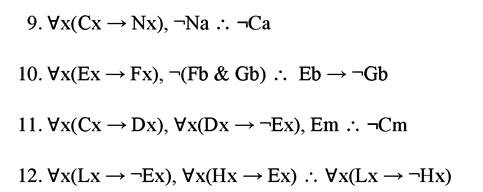
Instructionsfor exercises 13-16:
(i) Using the Carroll diagram method, determine whether each of the following arguments is valid or invalid, (ii) If it is valid, prove its validity by a formal proof in predicate logic.
13. “Also, what is SIMPLE cannot be SEPARATED from itself. The soul is simple; therefore, it cannot be separated from itself.”—Duns Scotus, Oxford Commentary on the Sentences of Peter Lombard [lx := x is simple, Ex := x can be separated from itself, s := the soul]
14. “Barcelona Traction was UNABLE to pay interest on its debts; BANKRUPT companies are unable to pay interest on their debts; therefore, Barcelona Traction must be bankrupt.”—John Brooks, The New Yorker (May 28, 1979)
15. “... no NAMES come in CONTRADICTORY pairs; but all PREDICABLES come in contradictory pairs; therefore no name is predicable.”—Peter Geach, Reference and Generality
16. “Since then fighting against NEIGHBOURS is an EVIL, and fighting against the THEBANS is fighting against neighbours, it is clear that fighting against the Thebans is an evil.”—Aristotle, Prior Analytics
Prove the formal validity of the arguments in 17-23 by giving proofs in predicate logic:
17. “These WAFFLES are not HEALTH food. They contain TRANSFATS, and nothing that contains transfats is health food.”
18. “Only AFRICANS are BANTUS, and no CARPATHIANS are Africans. So, it is obvious that no Carpathians can be Bantus.”
6. “A person can BE rehabilitated in prison only if he or she WANTS rehabilitation. MARIJUANA users do not want rehabilitation. So they cannot be rehabilitated in prison.” [UD: people]
7. “It seems that MERCY cannot be ATTRIBUTED to God. For mercy is a kind of SORROW, as Damascene says. But there is no sorrow in God; and therefore there is no mercy in him.”—Thomas Aquinas, Summa Theologia, I, question 21, art. 3 [Mx := X is mercy, Sx := x is sorrow, Ax := x can be attributed to (is in) God]
8. “And no man is a RHAPSODIST who does not UNDERSTAND the meaning of the poet. For the Rhapsodist ought to INTERPRET the mind of the poet to his hearers, but how can he interpret him well unless he knows what he means?”—Plato, Ion [UD: people; Ux := x understands the poet’s meaning]
9. “...it is obvious that irrationals are uninteresting to ENGINEERS, since they are concerned only with approximations, and all APPROXIMATIONS are RATIONAL.”—G.H. Hardy, A Mathematician ’$ Apology [Ex := x is interesting (or of concern) to engineers]
10. When the California Supreme Court ruled that the state’s system of financing education was illegal, it based its decision on the following argument:
California’s system depends on LOCAL property taxes, and a system that depends on local property taxes DISCRIMINATES against the poor. Hence, California’s system VIOLATES the Fourteenth Amendment, because any system that discriminates against the poor violates that amendment. [UD: systems of financing education]
11. (CHALLENGE) A news story written shortly before Pope Paul’s 75th birthday reported:
There have been recurrent rumors about a possible resignation since 1966, when he [Pope Paul] told Roman Catholic bishops around the world to hand in their resignations when they reach 75. By tradition the Pope is also Bishop of Rome.[66]
(a) Formalize the argument implicit in this story using the abbreviations: [Bx := x is a bishop, Rx := X should resign when he reaches 75, p := Pope Paul]
(b) Give a proof of its formal validity.