EXISTENTIAL QUANTIFICATION
Particular statements are interpreted as asserting the existence of at least one individual in the relevant category, or of which the relevant predicate is true. Thus the !-statement “Some P are Q” is symbolized:
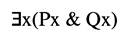
Here the symbol Ξx stands for “there is at least one x such that”; it is called an existential quantifier.
Thus the formula reads:There is at least one x such that x is a P and x is a Q.
Similarly, the О-statement “Some P are not Q” is symbolized

There is at least one x such that x is a P and x is not a Q.
Thus universal statements involve a universal quantifier and an arrow, →: particular statements involve an existential quantifier and an ampersand, &.
Some people are perplexed by this lack of symmetry. Granting the difference in quantifiers, why the difference in statement operators too? Why don’t universal statements have an ‘&,’ or existential ones an ς→,? The best way to answer this is to back-translate and see what Carroll diagrams (if any) correspond to statements of that kind. For instance, if Cx := X is a concept, and Mx := x is in the mind of God, and the UD (what’s contained in the Carroll box) is everything in the universe, then the formula  comes out as “Everything in the universe is a CONCEPT in the MIND of God.” Its Carroll diagram is:
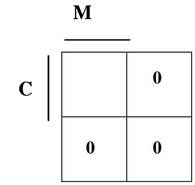
The difference between this and an А-statement diagram should be obvious at a glance. “All concepts are in the mind of God” rules out there being any concepts that are not divine ones ; but it does not rule out, as this does, other things in the mind of God (CM), and more importantly, other things in the universe (C)!
But what about a statement like the following?
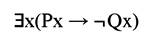
This asserts that there is an individual in the universe of discourse which, if it is P, is not Q.
We cannot represent this on a Carroll diagram. It’s a bit easier to understand with a concrete example in which the Universe OfDiscourse (UD) is delimited. Suppose the UD is airbags in motor vehicles, P is “has been activated” and Q is “crushes small children.” Then the statement would sayThere are airbags which, if they have been activated, do not crush small children.
This is not the same as saying “There are airbags that have been activated and do not crush small children” (although it may be understood this way, in ordinary imprecise conversation), precisely in that it does not claim, as the latter does, that there are airbags that have been activated. It does not assert the existence of the subject term (or the predicate term, for that matter); it asserts the existence of airbags, but remains agnostic on whether any have been activated or have failed to crush small children. In fact, it would be true if there’s at least one airbag that hasn’t been activated.
In general, the existential-quantifier-with-conditional is made true by the existence of one thing of which the antecedent is false, or by one thing of which the consequent is true. So they’re almost always true, but say what we hardly ever want to say. Similarly, the
universal-quantifier-with-conjunction is made false by one thing of which either the first conjunct or the second is false, so they’re almost always false, but say what we hardly ever want to say. Exercise: Try to think up (a) an interpretation of the predicates A and B, with any UD you wish, that would make a statement of the form 3x(Ax → Bx) false, or (b) an interpretation of the predicates C and D, with any UD you wish, that would make a statement of the form Vx(Cx & Dx) true.
SUMMARY ________________________________________________________________
• the !-statement “Some P are Q” is symbolized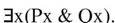
• the О-statement “Some P are not Q” is symbolized
• statements of the form Vx(Ax & Bx) and while meaningful, are
very rare.
• an existential quantification is a propositional function in x (respectively, y, z) preceded by an existential quantifier in x
EXERCISES 17.1
1. Symbolize the following as I- or O-statements:
(a) Some ATHEISTS are MORAL.
(b) Some DINOSAURS did not become EXTINCT.
(c) There are airline PILOTS who have an ALCOHOL problem.
(d) Many BIRDS fly at HIGH altitudes.
(e) Not everyone who TRAINS WINS.
(f) There are few ANIMALS that can not be TAMED.
2. Back-translate the following abstract statements into colloquial language using the following key: UD: people; Px := x is a politician, Ax := x is ambitious, h := Hillary: 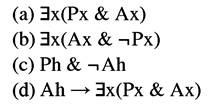
17.2