EXISTENTIAL INSTANTIATION
We now pass to rules of inference for particular statements, the first of which is Existential Instantiation, (El). As in Universal Instantiation, it allows us to pass from the quantified statement to a particular instance of it.
A little reflection will show that this, like UG, must have some restrictions. From the premises “There was a nineteenth century LOGICIAN who wrote CHILDREN’S books” and “George Boole was a nineteenth century LOGICIAN” we cannot infer the conclusion that George Boole wrote children’s books. But if there were no restriction on EI, this is exactly what we could infer: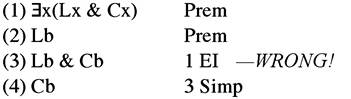
Note that the second premise hasn’t even been used to reach the conclusion. But that is not the problem. The point is that if EI had no restrictions we could infer (3) that “George Boole was a nineteenth century LOGICIAN who wrote CHILDREN’S books” directly from (1), the fact that someone did. The instance of the existential quantification needs to involve an arbitrary individual, not someone we are already interested in. Given the existential statement, that is, we know it is true of someone or something, and we suppose an individual to which it applies. Just as with the case of proofs involving UG considered in the previous chapter, we assume it true of such an individual for the sake of example. That is, we are again showing how to formalize suppositional arguments of the second kind considered in chapter 7.3, ones that involve not statements assumed for the sake of argument, but individual cases assumed for the sake of giving specific content to a generalization.
As was the case in UG, in order for the name we use in EI to be arbitrary it cannot have occurred either in the symbolization of the argument or on any previous line of the proof. But the arbitrary individual we assume in an EI argument needs to be one of the individuals the existential generalization is true of, so we need to introduce distinct names for these arbitrary individuals to distinguish them from the ones assumed in UG arguments, u, v, or w.
Let us reserve the letter і for the arbitrary individual in an EI; if і has already been used in a previous line or in the symbolization of the argument, we shall use j, and if this has been taken, k, as was the case for the arbitrary individuals u, v, or w. Of course, having assumed the existential generalization true for a specific instance, the individual name і we supposed cannot appear in the conclusion. But this is already taken care of by the rule that the name cannot have occurred in the symbolization of the argument: it could only appear in the conclusion if this rule had been violated. Now we may state the EI rule as follows:Existential Instantiation (EI)
From an existential quantification infer a suitably arbitrary instance of it.
From 3xΦx derive Φi, where і denotes an arbitrary individual name (one that has not occuιτed either in the symbolization of the argument or on any previous line of the proof).
Again, what is stated here in terms of x is tacitly understood to apply to expressions involving у and z too, and what is said of і applies also to j and k.
First, let’s look at some examples of derivations that fail to obey the restrictions on EL Consider the following erroneous proof of the obviously invalid argument
Some ROCK stars are ENGLISH. So Madonna is English

If some rock stars are English, we can take some arbitrary individual who is an English rock star and reason about him or her; but Madonna is clearly not such an arbitrary individual, since she is named beforehand.
Now here’s an example involving a violation of the restriction that the name cannot occur on a previous line of a proof:
id="Picutre 519" class="lazyload" data-src="/files/uch_group76/uch_pgroup316/uch_uch7361/image/image519.jpg">
On line (4) we should have used a different individual, j.
But then we would not have been able to infer anything very interesting from Si & Ri together with Pj & Rj, since Ri and Rj are two different statements.The EI rule enables us to prove certain arguments with negative conclusions, like this one:
It is false that there are MUONS composed of QUARKS. For all muons are LEPTONS, and no leptons are composed of QUARKS. [UD: elementary particles]
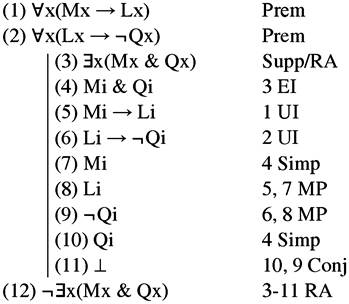
A few points to note about this proof:
• It is a standard reductio proof: we assume the contradictory of the conclusion and aim for a contradiction.
• The contradiction 1 reached on line 11 is , where Qi is the statement:
“Elementary particle і is composed of quarks.”
• It was vital that on line 4 we did EI before applying UL Otherwise і would not have been arbitrary, for it would have occurred on a previous line of the proof:
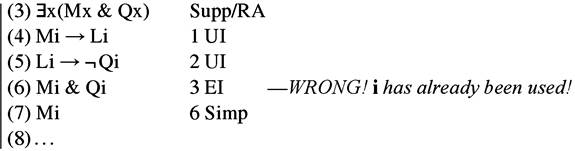
On line (6) we could validly have used j instead, but that won’t get us anywhere:

This motivates the following procedural rule:
Always use EI before UI wherever possible.
Finally, here are two examples to show why we keep distinct the two kinds of arbitrary individual—і (or j or k) for EI, and u (or v or w) for UG.
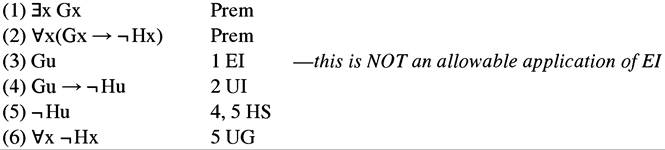
Line (3) is an error: you must EI onto і (or j or k). Otherwise, line 6 would have been fine, since we have the u for UG. On the other hand, if on line (3) we EI onto i, we do not have the u (or V or w) we need for UG, as here:
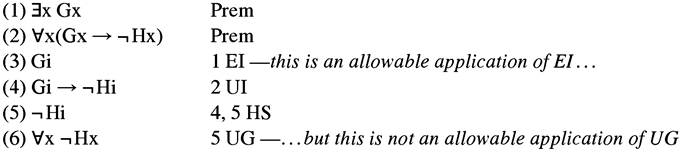
17.2.2