Fallacies
Oftentimes, unfortunately, we do not reason correctly.
We may think that because we had a bad meal at a restaurant, therefore all of the food at the restaurant is lousy, and we never frequent the place again.
How can we conclude that all of the food is lousy if we’ve never had all of it?Or you may think that the reason you caught a cold was that you weren’t dressed warmly enough last Friday night, when in fact the rhinovirus that was on the doorknob you touched at work made it into your system when you rubbed your eyes a few moments later, and that’s what caused your cold. What makes you continue to believe the myth that “you’ll catch a cold” if you don’t dress warmly enough, especially since there have been literally hundreds of studies featuring tens of thousands of participants where it has been consistently shown that there is no correlation between lowered body temperature and catching a cold?
Or we conclude that a product or service is the best one on the market because some celebrity who has been compensated uses it. Why do we take one person’s word for it? Especially when it’s a paid endorsement?!
Or we may “jump to the conclusion” that a politician from a party with which we disagree has nothing of value to say about public policy just because she’s from the opposing party. How can we think that when we haven’t even heard her out?
The examples of incorrect reasoning just mentioned are all types of fallacies.
A fallacy is an error in reasoning whereby someone attempts to put forward an argument whereby a conclusion supposedly has been appropriately inferred from a premise (or premises) when, in fact, the conclusion does not and should not be inferred from the premise(s).
In other words, a fallacy is a bad thing, logically, and from a critical thinking standpoint should be avoided at all costs. Further than this, whoever is putting forward the fallacy may innocently be unaware of the fact that the conclusion does not follow from the premise(s).
That is probably the case for a majority of the fallacies put forward in human history, and thinkers have had to point out the error in reasoning after the fact upon analysis of the argument. On the other hand, someone may want to dupe people into thinking that the conclusion follows from the premise(s) of an argument, which is how many feel about the kind of rhetoric utilized by politicians who “push their agendas” upon a populace. People who want to sell you on almost anything - a product, service, idea, policy - often will utilize a fallacy in their so-called pitch. So there is often vagueness and ambiguity in the language of a fallacy, coupled at times with an intention to deceive that the critical thinker must be cognizant of as a possibility.Formal Fallacies
Broadly speaking, there are two types of fallacies, formal fallacies and informal fallacies. Formal fallacies are found in the deductive realm of reasoning (we already talked about two logical systems, categorical logic and propositional logic) whereby it is determined that a conclusion does not follow from a premise or premises based upon an examination and understanding of the argument’s structure or form, rather than its content. Here, one need only examine whether the argument is set up correctly or not according to the principles of the particular logical system - if not, then the argument is fallacious. Here are examples of formal fallacies from everyday life.
In the realm of propositional logic, you may think that “If it’s raining, then the sidewalks are wet,” and you see that in fact “the sidewalks are wet” and then conclude “it’s raining.” This an example of a famous type of formal fallacy called affirming the consequent. In argument form, it looks like this:
(1) If it’s raining, then the sidewalks are wet.
(2) The sidewalks are wet.
(3) It’s raining.
When the claims have been symbolized in argument form, the argument looks like this:
(1) R ⊃ S.
(2) S.
(3) R.
And it reads like this:
(1) If it’s Raining, then the Sidewalks are wet.
(2) The Sidewalks are wet.
(3) Therefore, it’s Raining.
You cannot logically and rationally draw the conclusion that it’s raining from these two premises because it could be that a sprinkler made the sidewalks wet, or there was a break in the local water main, or it had rained earlier that day, or any number of other reasons for the sidewalks’ being wet. That said, if you reasoned like this, you would be correct in your thinking:
(1) If it’s raining, then the sidewalks are wet.
(2) It’s raining.
(3) The sidewalks are wet.
When the claims have been symbolized in argument form, it looks like this:
(1) R ⊃ S.
(2) R.
(3) S.
This is a basic and powerful piece of deductive reasoning known as modus ponens (Latin for “method of affirming”). If it’s true that “If it’s raining, then the sidewalks are wet” and it’s true that “It’s raining,” then we can conclude absolutely, positively, definitely, without a shadow of a doubt that “The sidewalks are wet.” (Notice that this argument is an example of the form of reasoning utilized by Chrysippus in (A) above.) Now compare these two:
| (1) R ⊃ S. | (1) R ⊃ S. |
| (2) R. | (2) S |
| (3) S. | (3) R. |
| Modus ponens | Affirming the consequent |
Once you observe the modus ponens argument symbolized, it becomes clear to the critical thinker that the argument’s structure or form is correct, showing that it is an appropriate piece of reasoning. And once you see that the correct structure or form has been altered - the R and the S are in the wrong places - this demonstrates the fact that it is a formal fallacy. When modus ponens’ form is altered exactly in the way shown above, then it is the formal fallacy of affirming the consequent.
Here is another example of affirming the consequent:(1) If it’s icy outside, then the mail is late.
(2) The mail is late.
(3) So, it’s icy outside.
No! You can’t logically draw that conclusion. It could be that the mail truck had a flat tire, or that the mail carrier got caught up at a previous site, or there could be any number of other reasons for the late mail.
Informal Fallacies
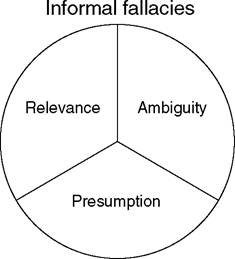
Informal fallacies, on the other hand, are found in the inductive realm of reasoning whereby it is determined that a conclusion does not follow from a premise or premises based upon an examination and understanding of the argument’s content, rather than its structure or form. And the argument’s content consists of claims, as we noted above, which are expressed using a language. So, it’s really through an investigation of the language used in an informal fallacy - and the things to which that language refers - that informal fallacies are identified. An informal fallacy involves such things as the abuse or misuse of words or grammar, misconceptions or faulty understanding due to biases or underlying presuppositions, misstatements of fact or opinion, or illogical sequences of thought.
One of the most common informal fallacies people commit is known as a false cause, which itself comes in a variety forms, as we’ll see in this book. In a false cause, a supposed cause of some event or other phenomenon is put forward as a premise of an argument, and the event or other phenomenon the cause is supposed to explain is put forward as the conclusion of the same argument; however, upon inspection the cause meant to explain the event or phenomenon is not the correct one. Superstitions are straightforward examples of the fallacy of false cause. Consider these, which are almost laughable:
(1) Every time I watch my favorite team play at Casey’s Bar, they win.
(2) Tomorrow night my team is playing.
(3) Thus, I have to be at Casey’s Bar to watch the game to ensure they win again.
(1) I hit the side of my TV when the picture was fuzzy, and it no longer was fuzzy.
(2) So, it’s obvious that my hitting the side of the TV is what fixed it.
(1) A black cat crosses your path.
(2) Hence, that’s why you trip a minute later and fall.
But there are other, less laughable, examples of false cause. Consider all of the people who think that one particular substance in pill form is the key to losing weight, or improving memory, or clearing up skin blemishes. The late-night, multi-billion-dollar-a-year infomercial culture depends upon people’s thinking fallaciously like this. Or, think about how many times we have heard someone say that the President is solely responsible for unemployment, or inflation, or any other calamity in a particular nation.
As will be shown in this book, false cause is normally classified as an informal fallacy of presumption. A fallacy of presumption occurs when an argument rests on some hidden assumption - it could be an unknown factor, a condition, set of circumstances, state of affairs, or idea - that, if not hidden, would make it clear that the assumption is not sufficient to be able to reason to (draw, infer) the conclusion.
So, in the first example in the list immediately above, we all know that there are myriad causes, events, and states of affairs that go into a team’s winning a game and that it is mere coincidence that it wins every time you watch the team play at Casey’s bar - your watching them at Casey’s has absolutely no effect on whether the team wins or not. You presume that there’s a causal connection between the two (thus, it’s a fallacy of presumption), but if you had knowledge of the myriad causes, events, and states of affairs associated with each game - a kind of god’s eye view - then you would know the correct causes and processes involved in (the reasons for) your team’s winning.
The second example is subtler, because your hitting the TV was not the direct cause of the picture’s becoming clear; rather, it probably jostled something related to the internal antenna, perhaps knocking the node at the end of the antenna (that had fallen off) back onto the TV’s receiver and reestablishing the connection between the antenna and the receiver, and that reestablished connection is the actual, correct cause of the clarity of the picture. It may be that, if you hit the TV once more, the antenna node would detach from the receiver, causing the picture to be fuzzy again.
The final example is as absurd as the first. You tripped and fell a minute later because of something other than the supposed superstitious power associated with a black cat’s crossing your path.
In addition to false cause, other typical fallacies of presumption that we will see in this book include false dilemma, suppressed evidence, complex question, hasty generalization, and begging the question. You beg the question when you assume in your premise(s) what you’re trying to prove in your conclusion, so that you really haven’t proven anything. You have just restated your premise as your conclusion (or your conclusion as your premise, if you look at it from that angle). Here is a famous example:
(1) It says so in the Bible that God exists.
(2) Therefore, God exists.
You may ask a believer, “Why do you think that God exists?” or “What evidence or proof do you have that God exists?” and the believer may respond, “Well, it says in the Bible that God exists. In fact, the Bible talks about God all throughout.” Now, many fallacies are squirrely and difficult to see (as we intimated above), and in fact that is part of the reason their conclusions seem to convince so many people. In the above argument, God’s existence is implicit in the premise because God is supposed to be a co-author - if not the author, according to some religious groups - of the Bible, so the argument more clearly and explicitly should look like this:
(1) It says so in the Bible (written by a God that exists) that God exists.
(2) Therefore, God exists.
So in this fallacy, what is supposed to ground the fact that God exists? Put another way, what is supposed to be the proof or justification for God’s existence? Well, the fact that God exists! The person putting forward this fallacious argument wants you to think that the fact that God exists demonstrates that God exists or from the fact that God exists, we can conclude that God exists. The fallacious reasoning should now be evident. Begging the question is a form of circular reasoning, and we can see the circularity present here: God’s existence is proved by God’s existence, which proves God’s existence, which is proved by God’s existence, which proves God’s existence, which is proved by God’s existence, which proves God’s existence, and so on. You can see how the argument really just restates the premise in the conclusion, thus demonstrating nothing. It’s kind of like saying this:
(1) When you move your legs quickly across a solid surface in a steady gait, it’s beneficial to your body.
(2) Therefore, running is good for you.
Above we mentioned hasty generalization as a type of fallacy of presumption, and people commit this fallacy almost daily when they conclude “they’re all like that” from an experience of just a few instances (or even just one instance) of the “they” in question. More specifically, someone may hold a prejudice that goes like this:
(1) My experience of a person from that ethnicity, creed, or sex has been negative.
(2) So, they’re all like that. (Every experience I have, or anyone will have, of a person from that ethnicity, creed, or sex will be negative.)
Can one rationally or logically draw that conclusion? Of course not. The main reason is that you will never be able to experience all people from that ethnic background, creed, or sex. Other examples: Sally will jump to the hastily generalized conclusion that “Cars from Brand X are all lemons” from the fact that she had one bad experience with a car from Brand X. Or think of how a restaurant in a small community can literally go out of business because it has gotten around by word of mouth that “Frank got a case of E. coli from that place” even though the restaurant has always been up to code and recently had a thorough, independent inspection performed. People hastily and incorrectly generalize that if one patron got a case of E. coli from the restaurant, then all patrons will get a case of E. coli from the restaurant, which may be an unfounded, illogical, fallacious move to make in one’s thinking.
Besides fallacies of presumption, informal fallacies can be classified as fallacies of relevance (or irrelevance) and fallacies of ambiguity. A fallacy of relevance occurs when the premise(s) of an argument is/are found to be logically irrelevant to the conclusion, even though they may appear to be relevant, because of an appeal to psychological or emotional relevance. Typical fallacies of relevance that we will see in this book include appeal to the person (ad hominem), appeal to force, appeal to inappropriate authority, and appeal to the people (ad populum).
Coast to Coast AM with George Noory is a radio program featuring topics in conspiracy theory and the paranormal that airs on XM satellite radio as well as on terrestrial radio stations in the middle of the night. On January 5, 2016, the topic was cryptozoology, a pseudoscience concerned with the supposed existence of cryptids, creatures like Bigfoot, the Loch Ness monster, and chupacabra. A caller noted something like the following:
That there is no hard evidence of these cryptids is baffling because they exist. There are too many accounts of these creatures for them not to exist. One of these days, someone will find a carcass. They have to.
There are a few things to note about this piece of poor reasoning. First, the caller seems to see the value of “hard evidence” and one can only assume that the carcass he mentions later would be an instance of that evidence. Yet, he has not appealed to that hard evidence in order to justify the existence of cryptids. What he has appealed to, however, is known as one of the most unreliable forms of evidence: witness testimony. “There are too many accounts of these creatures for them not to exist,” he claims. Crack open any law school textbook dealing with courtroom evidence, and you will see references to hundreds of studies that have been performed in the last 50 years showing how people will claim to have witnessed events that did not occur or see objects that do not exist. There’s even a phenomenon known as a mass or collective hallucination whereby several people claim to see something that really does not exist. What the caller has committed is a form of the informal fallacy known as appeal to the people, appeal to the masses, or in Latin, argumentum ad populum, which looks like this:
(1) Several people claim X is true or is the case.
(2) Therefore, X is true or is the case.
The caller fallaciously concludes that cryptids exist because “There are too many accounts of these creatures for them not to exist,” when what he really should do is suspend judgment until someone finds a carcass.
A fallacy of ambiguity relies on some ambiguity (vagueness, obscurity, non-clarity) in wording or phrasing, the meanings of which shift/change to various degrees of subtlety during the course of the argument. Consider this argument:
(1) The conflict in the Middle East is no news.
(2) And no news is good news.
(3) So, the conflict in the Middle East is good news.
Our intuition is that not only is the conflict in the Middle East not good news (in other words, the conclusion is false) but also that the conclusion does not follow from the premises. But why? What has occurred with this argument is known as equivocation, which refers to a term’s changing its meaning throughout the course of a sentence, discussion, or, in this case, an argument. Equivocation is a bad thing, logically, linguistically, and for many other reasons. Specifically, the meaning of no news has changed: in the first premise, it means something like “known by all or most people” while in the second, it means something like “nothing bad is happening, or otherwise, that grabs our attention.” When made explicit, we can see that the conclusion does not follow from the premises:
(1) The conflict in the Middle East is known by all or most people.
(2) And nothing bad is happening that grabs our attention is good news.
(3) So, the conflict in the Middle East is good news.
So, if for some crazy reason you wanted to justify the claim that “The conflict in the Middle East is good news,” you would need to do it some other way because your argument here is fallacious and should be rejected.
One more thing should be pointed out in relation to this argument that gets at the distinction between formal fallacies and informal fallacies. Read purely from a formal perspective, the argument might appear to be valid. If we symbolize the elements of the argument formally, without diagnosing its content, it looks like this:
(1) CME is NN.
(2) NN is GN.
(3) So, CME is GN.
The link from CME to GN is clearly, and validly, made through NN. However, it is vital to look at the content of the claims as we have done above, since even formally, then, the argument’s conclusion does not follow from the premises, as can be seen:
(1) CME is KBA.
(2) NBH is GN.
(3) So, CME is GN.
There is no longer a link from CME to GN and now, even formally, the argument is invalid.
In addition to equivocation, other typical fallacies of ambiguity that we will see in this book include amphiboly, accent, composition, and division. And there are countless other types of informal and formal fallacies - complete with examples from famous writings, speeches, interviews, debates, stories, lore, and colloquialisms - that exist in the world today.