Why Be Concerned about Fallacies?
Fallacies are so rampant in our thinking that they affect public policies, civil laws, and even what are taken to be moral laws all over the world. Unfortunately, fallacious thinking has led to much pain and suffering in human history.
Consider again the question-begging argument that fallaciously concludes to God’s existence. How many people have used that very argument in the history of Western civilization as a justification for all kinds of unjust, exploitative, and atrocious activities? Or the hasty generalization that concludes, “They’re all like that.” Think of all the countless slavery laws, or religious laws, or voting laws that have been a part of various cultures throughout human history that have this fallacious conclusion as a basis, in addition to the base fact that one group, race, creed, or culture is always dominating and exploiting another.The Logical Two Step
In addition to describing claims, evidence, support for the truth of claims, arguments, persuasion, and inference, above we mentioned reasoning correctly vs. reasoning incorrectly. Reasoning incorrectly is what leads to fallacious thinking and the creation of fallacies. Reasoning correctly is part and parcel of forming your own good arguments as well as evaluating an argument to see if it is a good one or not. In general, there is a two-step process to the evaluation (analysis, critique) of an argument:
Step 1: Make sure the conclusion follows from the premise(s).
Step 2: Make sure all of the premises in the argument are true.
Recall that a fallacy occurs when one thinks a conclusion follows from a premise (or premises) when in fact it does not. We must be constantly on the lookout for this possibility when evaluating an argument, and the suggestion here is that it is the very first thing a critical thinker needs to check. (Note that one of the reasons it is important to place an argument in argument form is so that one can more easily visually determine whether a conclusion follows from a premise (or premises) or not.) Consider this argument:
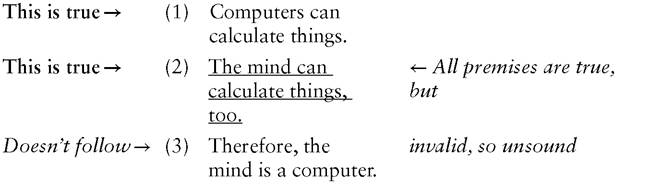
(1) Computers can calculate things.
(2) The human mind can calculate things, too.
(3) Therefore, the mind is a computer.
There is something intriguing about this argument, and our immediate reaction may be to say that it all makes sense, especially given the emergence of work in artificial intelligence in the past 60 years or so. However, the argument is fallacious, as can be demonstrated by this more intuitive argument, which is of the exact same form:
(1) Birds can fly.
(2) Airplanes can fly, too.
(3) Therefore, an airplane is a bird.
We can see that not only does the conclusion not follow from the premises, but also that, in this case, the conclusion is false. Airplanes are not the same things as birds just because they both can fly. Notice that it is absolutely true that computers can calculate things and that human minds can too but that we cannot conclude, therefore, that the mind is a computer - at least not from the two premises in that particular argument. The fallacy committed above is the formal fallacy known as the fallacy of the undistributed middle term, which you can see described in this book in more detail.
So, once again, it is absolutely imperative that you first check an argument to see if it commits a fallacy or not, namely, whether the conclusion follows from the premise(s) or not. And we will see numerous examples of formal and informal fallacies in this book.
However, that’s not enough when evaluating an argument. You have to make sure that all of the premises are, in fact, true. That’s the second step of the two-step process involved in the evaluation (analysis, critique) of an argument. Why? Because it’s possible that a conclusion follow from a premise (or premises) and that the conclusion be still false or unsupported because the premise(s) is/are false. Believe it or not, there is no fallacy committed in the following argument:
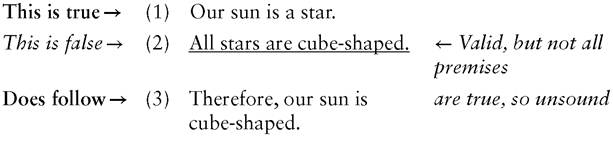
(1) Our sun is a star.
(2) All stars are cube-shaped.
(3) Therefore, our sun is cube-shaped.
The conclusion absolutely, positively follows from the premises in this argument and, in fact, you can’t conclude anything other than “Therefore, our sun is cube-shaped.” Yet, something is not right here.
We know that our sun is most definitely not cube-shaped. Yes, it’s true that our sun is a star as is noted in the first premise, but the second premise is false and, in this particular argument, this makes the conclusion false as well. Now consider this argument:(1) In over 1 million controlled studies, it was shown consistently that people lost 10% of their body weight in a month on a 5,000- calorie-a-day diet.
(2) You are starting that same diet at the beginning of next month.
(3) Therefore, all things being equal, you too will likely lose 10% of your body weight in a month on a 5,000-calorie-a-day diet.
No fallacy is committed here. However, the first premise is absolutely false (it was just concocted). Once again, in this particular argument, given the falsity of the first premise, the conclusion is false, too. If someone were trying to convince you of the truth of the conclusion utilizing this argument, hopefully you would not be convinced.
Good and Bad Arguments
Above we mentioned deductive reasoning and arguments vs. inductive reasoning and arguments. There are good arguments and there are bad arguments in both the deductive and the inductive realm. A good argument, in either realm, is one that meets the conditions of the two-step process mentioned above: (1) the conclusion does in fact follow from the premises and (2) all of the premises are in fact true. If either one of these conditions is absent, then the argument is bad and should be rejected.
In the deductive realm, that a conclusion follows from premises means that the argument is valid - it is invalid if the conclusion does not follow. Strictly speaking, in the deductive realm, an invalid argument is one where a formal fallacy has been committed. When an argument is valid and all the premises are true in the deductive realm, the argument is said to be a good, sound argument. If the argument is invalid or any of the premises are false, then the argument is unsound - thus, both conditions, validity and truth of all of the premises, must be met.
This will make it so that the conclusion absolutely, positively, without a doubt, is true, and this is a good thing!So, the “Our sun is cube-shaped” argument is valid but still unsound because the second premise is false. It is thus a bad argument and should be rejected.
On the other hand, the “The mind is a computer” argument has true premises but is still unsound because it’s invalid. It, too, is a bad argument and should be rejected.
In the inductive realm, that a conclusion likely will follow from premises means that the argument is strong - it is weak if the conclusion likely does not follow. A weak argument is one where an informal fallacy has been committed. When an argument is strong and all the premises are true in the inductive realm, the argument is said to be a good, cogent argument. If the argument is weak or any of the premises are false, then the argument is uncogent - thus, both conditions, strength and truth of all of the premises, must be met. This will make it so that the conclusion most likely or probably is true, and this is a good thing, too!
So, the 5,000-calorie-a-day weight loss argument is strong but still unco- gent because the first premise is false. It is thus a bad argument and should be rejected.
| False → | (1) | In over 1 million controlled studies, it was shown consistently that people lost 10% of their body weight in a month on a 5,000- calorie-a-day diet. | |
| True → | (2) | You are starting that same diet at the beginning of next month. | |
| Follows → | (3) | Therefore, all things being equal, you too will likely lose 10% of your bodyweight in a month on a 5,000-calorie-a-day diet. | Strong, but not all premises are true, so uncogent |
On the other hand, the following argument has true premises but is still uncogent because it’s weak - a fallacy has been committed.
It’s an example of the informal fallacy known as appeal to inappropriate (or false) authority or inappropriate appeal to authority. It, too, is a bad argument and should be rejected.| This is true → | (1) | He is an accountant by trade. | |
| This is true → | (2) | In his opinion, global | All premises are |
| warming occurs. | true, | ||
| Doesn’t | (3) | Therefore, global | but weak, so |
| follow → | warming occurs. | uncogent | |
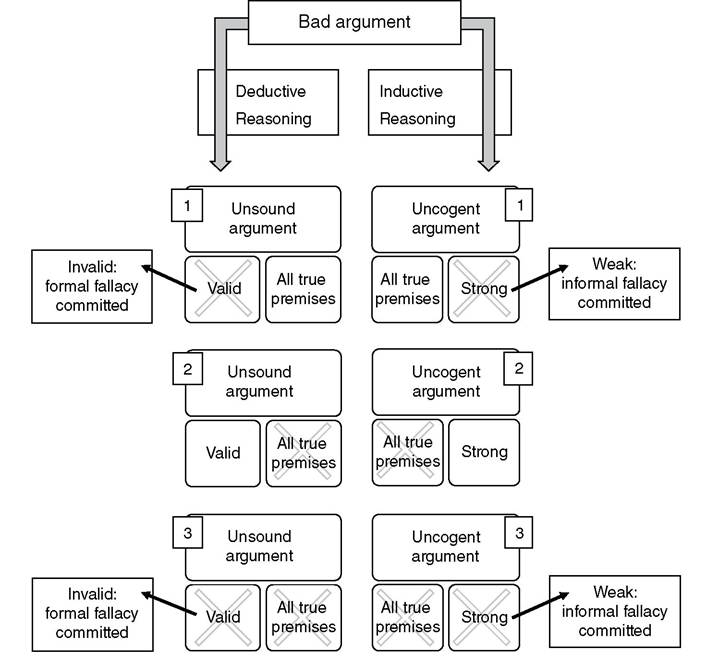
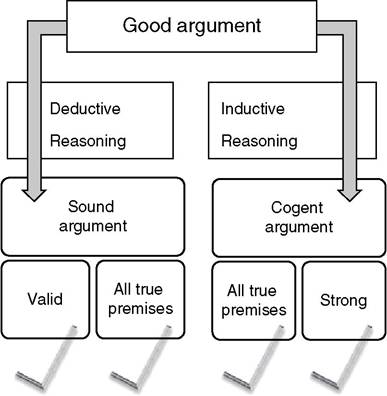
Below are two diagrams. The first shows that there are two types of good argument, a sound argument in the deductive realm of reasoning and a cogent argument in the inductive realm of reasoning. Again, for an argument to be sound, it must meet two conditions: it must be (1) valid - the conclusion absolutely/positively does, in fact, follow from the premise(s), and (2) all of the premises in the argument must be true. And for an argument to be cogent, it must meet two conditions: it must be (1) strong - the conclusion likely/probably does, in fact, follow from the premise(s), and (2) all of the premises in the argument must be true. If an argument is valid in the deductive realm, then no formal fallacy has been committed. And if an argument is strong in the inductive realm, then no informal fallacy has been committed.
The second diagram shows that there are two types of bad argument, an unsound argument in the deductive realm of reasoning, and an uncogent argument in the inductive realm of reasoning. However, there are three ways that an argument can go bad in each realm. In the deductive realm, if an argument (1) is invalid, (2) has a false premise, or (3) both, then it’s unsound. In the inductive realm, if an argument (1) is weak, (2) has a false premise, or (3) both, then it’s uncogent. If an argument is invalid in the deductive realm, then a formal fallacy has been committed, and if an argument is weak in the inductive realm, then an informal fallacy has been committed.