FENCING
One reason why you may sometimes feel overwhelmed by a problem is that it may appear to be bigger, more complex, and more confusing than it really is. The technique of fencing the problem down to a smaller size can help you regain a feeling of confidence and mastery.
It is sometimes said that “inside a big problem, there is usually a small problem struggling to get out. ’ By looking at the problem carefully, and not getting distracted by the way someone first presents it to you, you may be able to put your finger on the one key factor that lies at the heart. Deal with that key factor, and you often can solve the problem effectively, without ever having to get tangled up in all the other side issues. Fencing is a reductive strategy; it seeks to condense the problem to its very essence so you can resolve it most efficiently.Let’s look at some examples of the technique of fencing. Here is a good problem.
EXAMPLE PROBLEM 7-1 (FENCING)
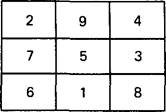
Picture a З ? З-grid square, i.e. three squares by three squares. How can you arrange the nine digits from 1 to 9, assigning one number to each of the nine squares in such a way that each row, each column, and both diagonals total up to exactly 15? Before reading further, take your pen and paper and experiment with the problem. Try to discover a way to fence the problem-to reduce it down to manageable proportions. Test various possibilities to see if you can reduce a rule that governs the arrangement.
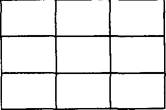
(Put the numbers 1, 2, 3, 4, 5, 6, 7, 8, and 9 in the proper boxes.)
Ready to look at the logical thinker’s solution? Refer to the diagram at the end of the chapter.
Let me see... how can I (!)restate this? I have to put the nine numbers in groups of three, and each group has to add up to 15 (rephrasing).
There are three rows, three columns, and two diagonals. Each number gets included in more than one group of three, so I have to make sure the groups are all compatible with one another.... Hmm, how can I (!)narrow it down, so I don’t have to try all those combinations to find the right one? Well, for one thing, let me look at that center position—the middle box in the matrix. There must be something special about that number because it gets added to every other number in the grid. Let’s try some possibilities—suppose I put a 1 in the center. Would that work? Well, (!)if I add it to 2 in some other box I only get 3, and there isn’t any other number large enough to bring the total to 15. (!)So 1 is out and (!)2 is out for the same reason (stepping). Let’s see, what about high numbers. If I put a 9 in the center spot and I put 8 in any other box, I’ve already overshot the total of 15 before I even add in the third number. So I know that 1 won’t work, 9 won’t work, 2 won’t work, 8 won’t work.... I wonder if there is only one acceptable number for the center? Yes, the only possible choice for the center square is 5. The number 4 and any smaller number are too low, and 6 and any higher numbers are too high. So I’ve narrowed down the possible choices to one number, 5 (fencing). Now let me start filling in the other squares on a trial basis and see what happens...”The rest of the problem yields fairly easily to a straightforward process of checking the positions of various numbers and making sure the totals are correct in all directions. Once you have done that, you can come up with an arrangement of numbers that satisfies the basic condition of providing totals of 15.
From this simple process, you can see how powerful a technique fencing can be. Just think of the number of trial-and- error attempts you would have to make to check out most of the combinations of numbers involved, hoping to find a combination that works. Using the process of fencing, you can reduce the number of combinations you have to try to a very small number.
This gives you a feeling of mastery over the problem, and it increases your confidence in your ability to think clearly and logically.How about another example? Here’s one that seems highly mathematical at first, and yet it can be fenced quite easily by thinking carefully about the relationships involved. Take a pen and paper, and give it a try before reading further.
EXAMPLE PROBLEM 7-2 (FENCING)
r^*
A flock of seagulls came in to land on a row of wooden pilings. We don’t know how many seagulls there were, and we don’t know how many pilings there were, but we can find out from the following information. When the birds tried to land so that
it is done by a skilled thinker, you are learning something. If you’ve had difficulty with logical processes in the past, it’s reasonable to expect fairly slow progress at first. Little by little, you will develop a feel for the process of organizing and controlling information in your mind, and the more examples you read, the more you will be able to apply the techniques used in the examples.
Now, try your hand. The following puzzle is one you can solve with the aid of the technique of fencing. Before you attack it, here is a helpful hint: At first glance, it looks like a mathematical puzzle, but it really isn’t. You don t have to do any involved calculations—just look for a strategy that will quickly eliminate the uncertainty involved. If you don’t get it soon, come back and reread this hint.
PracticeProbIem 7-1 (Fencing)
You have 10 bags of gold coins. The bags are numbered from 1 to 10. Each bag contains 10 coins, and each coin is supposed to weigh 1 ounce. However, you suspect that one of the bags is light, i.e. each of the coins it contains weighs only nine-tenths of an ounce instead of 1 ounce. You have an accurate weighing scale available, but you will only be allowed to make one weighing with it.
How can you figure out which bag has the light coins by making only one weighing with the scale?Practice Problem 7-2 (Fencing)
Four playing cards are stacked up on the table, face down. They are an Ace, a King, a Queen, and a Jack. They represent all four suits. By progressively eliminating possibilities, can you fence the problem down so you can determine which face and suit are in each position? Here are the key facts:
1. The King is not the top card, but it is closer to the top than either the Ace or the Jack.
2. The Heart is above the Club.
3. The King is not a Heart, and it is not a Club.
4. The Ace is neither a Spade nor a Diamond.
5. TheDiamondisbelowtheClub.
How did you make out? I hope that by proceeding in careful steps and progressively fencing in the problem, you have developed a greater sense of confidence in your logical processes. As you face various other problems from day to day, make a point to look for opportunities to fence them down to manageable proportions. Don’t give up on my problem unless you have made an effort to reduce it. Fencing doesn’t always guarantee you a simple solution because many problems are not simple. But it often will help you get the problem under control and give you a greater sense of confidence and mastery.
Solutions to Problems
Example Problem 7-1 (Fencing)
Practice Problem 7-1 (Fencing)
Take 1 coin from bag 1, 2 coins from bag 2, 3 coins from bag 3, and so on up to 10 coins from bag 10. Keeping them in separate stacks, put them on the scale and weigh them. If they weigh exactly 1 ounce each, the total will be 1+2+3+4+5+6+7+8+9+10 ounces, or 55 ounces. If one bag is light, the total will be less than 55 ounces, by an amount—measured in tenths of an ounce—equal to the number of the bag that is light. That is, if the sampled coins weigh four-tenths of an ounce less than 55 ounces, you know that bag 4 is light because you took 4 coins from that bag.
Practice Problem 7-2 (Fencing)
From the top of the stack down, the cards are as follows.
Queen of Hearts
King of Spades
Ace of Clubs
Jack of Diamonds