ITEMIZING
One of the easiest and most effective ways to get control of a confused situation is simply to itemize the variables involved. You may be surprised to see how many times the simple process of taking a pen and making a list of the key factors involved can bring the problem clearly into focus.
Despite the cynical comments many people make about making lists, it remains one of the most useful of all logical thought processes. For example, working from a list of things to do every day gives you the power to decide how you can best spend your time, and which of the many demands on your time represent the best possible payoffs.Similarly, when you are discussing some projects with another person, it helps enormously to itemize the various things to be done. You can also itemize the various problem areas you might encounter, the various issues to be resolved in carrying out the project, and the various people whose support you must enlist. If you don’t already use this process of itemizing the factors involved in situations, begin now to make it a reliable and permanent habit. In this chapter, we will solve a few puzzle problems with the aid of the tactic of itemizing so you can see how well it works and how straightforward a skill it can become.
EXAMPLE PROBLEM 8-1 (ITEMIZING)
If you flip two coins at the same time, what are the chances that they will both come up heads? Or, in other words, if you flip them many times, what percentage of the times will you get two heads?
Try to discover how you can use the technique of itemizing to understand the problem thoroughly. Think about this with the aid of your pen and paper before reading the expert thinker’s approach.
Ready to tune in on our friend the logical thinker? Refer to the figure at the end of the chapter.
“Let me see, flipping a coin. Two at a time... each coin can come up one of two ways, and there are only so many combinations of heads and tails.
First, I have to (!)figure out how many possible combinations of heads and tails I can get with the two coins (stepping, itemizing). Then I just have to (!)count the number of those combinations that consist of two heads (itemizing). When I have those two numbers, Ijust divide the number of “head-head” pairs by the total number of pairs that can turn up and I’ll have the percentage of times two heads can be expected to come up. That’s the same as the “probability” of two heads.“Well, let me (!)itemize the possible combinations... with two coins, I can get ‘heads-heads,’ ‘heads-tails,’ ‘tails- heads,’ and ‘tails-tails’ (itemizing). By this I see that two heads can come up once out of the four possibilities, so if all the combinations are equally likely to come up, two heads will come up 25 percent of the time. In other words, the probability of flipping two heads is.25, or 25 percent. Wonder if that’s right? Maybe I’ll test it by flipping two coins a hundred times or so... no—think I’ll go to lunch instead.”
How did you make out with this problem? This is a very interesting one, and if you didn’t solve it at first you needn’t be discouraged. This kind of thought process, especially dealing with probabilities, is unfamiliar to many people. Nevertheless, it is a useful process. You may have hit a blank wall at first, not knowing exactly how to get into the problem. Itemizing the possibilities may seem to be a rather novel way to attack it; it isn’t the kind of problem that comes along and says “Please itemize me.” You have to think carefully about each of the seven logical tactics to see which ones might help you with a given problem.
Let’s try another problem. Again, take your pen and paper and apply the itemizing process to help you solve it. Work on it carefully before reading further.
EXAMPLE PROBLEM 8-2 (ITEMIZING)
A lady went into the post office, gave the clerk a dollar, and said “I want exactly a dollar’s worth of stamps. Make it some two-cent stamps, 10 times as many one-cent stamps as two-cent stamps, and the rest in five-cent stamps.
How many of each kind of stamp did she buy?Now, let’s see how the logical thinker tackled this problem. Refer to the diagram at the end of the chapter.
“Hmm... exactly a dollar? No change left? Well... that means there must be some exact relationship between the numbers of stamps and their denominations that multiplies out to exactly IOO cents (rephrasing). We just have to check out various combinations to see which ones work (stepping, itemizing). Let me see... she buys two-cent stamps, one-cent stamps, and five-cent stamps, so we have three categories to work with. Let me (!)write those down in a column (itemizing). Then, I’ll make two other columns—one for the number of stamps of each kind, and one for the cost of those particular stamps. Let me see, how many 2-cent stamps can she buy— seems like quite a few... no! For every 2-cent stamp, she buys ten 1-cent stamps. So she’s committed to buying two’s and one’s in ‘lots’ that cost 12 cents. Hmm, it’s shaping up now. She buys a certain number of lots of two’s and one’s at 12 cents per lot. That quantity, multiplied by 12 cents, takes up part of the dollar, and the rest has to be taken up exactly by a certain multiple of 5 cents.
“So, I think it boils down to (.,)finding a multiple of 12 and a multiple of 5 that give us a total of 100 cents (fencing). Now, the 5-cent stamp imposes certain limits on things—there can only be 5 cents worth, 10 cents worth, and so on. Aha! We have to find a multiple of 12 cents that ends in a five or a zero, in order for the 5-cent stamps to give us a total of 100 cents. The only multiple of 12 that will work is 5—that is, 5 lots of stamps at 12 cents per lot gives 60 cents. Then we can use the other 40 cents to buy eight 5-cent stamps. Let me (!Roublecheck —five 2-cent stamps, plus fifty 1-cent stamps, and eight 5cent stamps, for a total of one dollar. Got it!”
Okay, now it’s your turn. Here are some easy problems you can use to practice your skill at itemizing.
You’ll find the solutions at the end of the chapter.PracticeProbIem 8-1 (Itemizing)
Look at the following figure. It contains 16 squares, doesn’t it? But does it? Look closely and you’ll see that it has 17 squares, including the big square that forms the boundary. But wait! There are other squares contained in the figure besides those that measure one-by-one. There are also two-by-two squares,... well, how many squares are there in the figure? 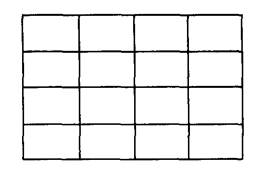
Practice Problem 8-2 (Itemizing)
What is the minimum number of coins I must have in my pocket to be able to go into a shop and make a purchase, paying the exact amount for any price ranging from one cent to a dollar, and which coins do I need?
I hope you’re finding the technique of itemizing convenient, natural, and useful. Train yourself to spot those situations in which putting things down in orderly fashion can help you or others to think more effectively. Of course, be sure to combine the tactic of itemizing with all the others you’ve learned to get maximum benefits from all of them.
Solutions to Problems
Example Problem 8-1 (Itemizing)
Draw a diagram something like this.
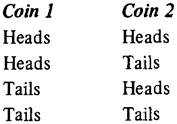
Number of possible combinations: 4
Number of times two heads comes up: 1
Probability of two heads: 1 in 4, or 25%
Example Problem 8-2 (Itemizing)
Draw a diagram something like this.

Then, try different guesses for x until you find a combination that works exactly.
Practice Problem 8-1 (Itemizing):
1. Ixl squares: 16
2. 2x2 squares: 9
3. 3x3 squares: 4
4. 4x4 squares: 1
Total: 30
Practice Problem 8-2 (Itemizing)
Make a diagram something like this.
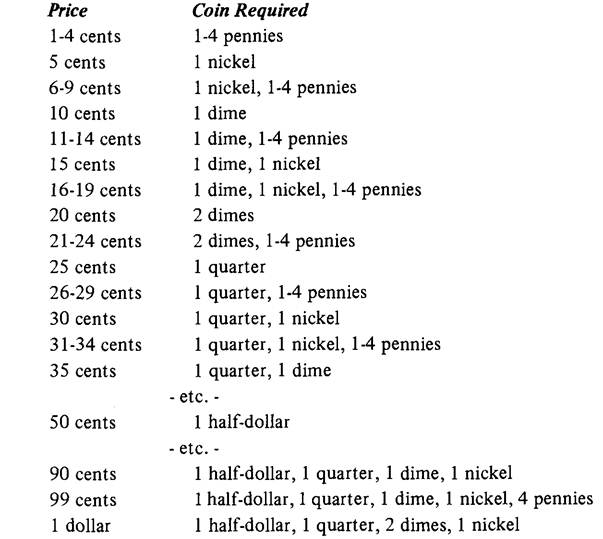
Total number of coins: 9—4 pennies, 1 nickel, 2 dimes, 1 quarter, 1 half-dollar.
Note that if you used 1 dime and 2 nickels instead of 2 dimes to make 20 cents, you would need an extra penny to reach 1 dollar. With 2 dimes and 1 nickel, you can actually exceed 1 dollar—$1.04.